In the realm of intellectual discourse, the epitome of a critical thinker often embodies a mosaic of attributes and skills that transcend simple analysis and extend into profound inquiry. A critical thinker is more than a proficient analyzer of information; they are a navigator of ideas, adept at weaving through complexities to arrive at well-informed conclusions. This article will delve into the multifaceted nature of critical thinking by examining various examples and identifying the core characteristics that define an exceptional critical thinker.
1. Curiosity: The Bedrock of Inquiry
Curiosity is the primordial trait that fuels the critical thinker’s quest for knowledge. It compels individuals to ask questions that penetrate the surface, leading to deeper insights. Take, for instance, the story of a scientist who challenges conventional theories by seeking alternative explanations for observable phenomena. This relentless pursuit of understanding prompts further inquiry, demonstrates flexibility in thought, and encourages a comprehensive examination of evidence. The critical thinker, driven by an insatiable curiosity, seeks to unearth the “why” behind answers, fostering a culture of intellectual exploration.
2. Skepticism: The Shield Against Fallacy
While curiosity ignites the flame of inquiry, skepticism guards against misleading assertions. A critical thinker approaches claims with a discerning mindset, wary of cognitive biases that may skew perception. For instance, a historian investigating historical narratives might critically evaluate sources, questioning their credibility and motivations. This does not translate to being cynical; rather, it embodies a cautious approach that demands substantiation. By engaging skeptically, the critical thinker ensures that conclusions are rooted in sound reasoning rather than unfounded beliefs.
3. Open-Mindedness: The Embrace of Diverse Perspectives
Open-mindedness is a crucial quality that engenders a willingness to entertain diverse viewpoints. A prime example is that of a social scientist who considers various cultural contexts when analyzing human behavior. This openness not only fosters empathy but also enables the critical thinker to synthesize differing opinions to form a more holistic understanding of issues. This aspect of critical thinking highlights the importance of collaboration and dialogue in refining ideas, as listening to opposing views can illuminate blind spots in one’s reasoning.
4. Analytical Skills: Dissecting Information with Precision
Essential to critical thinking is the ability to dissect information with analytical acuity. This skill is vividly illustrated by the work of a financial analyst who meticulously evaluates data to uncover market trends. By employing logical reasoning and employing quantitative methods, they unravel complex datasets, allowing for informed decision-making. Analytical skills facilitate the examination of arguments, recognizing fallacies and identifying underlying assumptions that shape conclusions. Such dexterity in analyzing information equips critical thinkers to navigate the intricate landscape of knowledge.
5. Effective Communication: Articulating Thoughts Clearly
Moreover, effective communication is indispensable for a critical thinker. The capacity to articulate thoughts clearly and persuasively is paramount. Consider a policy advocate who mobilizes communities through compelling narratives and well-reasoned arguments. Their ability to communicate complex ideas in an accessible manner helps bridge the gap between intricate concepts and public understanding. By refining their rhetoric and utilizing argumentative structures, critical thinkers can influence discourse and inspire action.
6. Problem-Solving: Navigating Complex Challenges
Problem-solving is another defining characteristic of a critical thinker. The adeptness in grappling with ambiguity and uncertainty enables these thinkers to devise innovative solutions. For instance, an engineer confronted with a design flaw might leverage brainstorming techniques and collaborative strategies to overcome obstacles. This iterative process of trial and error exemplifies a critical thinker’s ability to harness creativity while remaining rooted in logical analysis. Their knack for viewing problems from multiple angles results in comprehensive solutions that address fundamental issues.
7. Reflective Thinking: The Path to Continuous Improvement
Critical thinkers also engage in reflective thinking, a metacognitive process that promotes self-awareness regarding one’s thought processes. After completing a project or making a decision, a reflective thinker might ask themselves what worked well and what could be improved for future endeavors. This practice of introspection is transformative; it enhances future critical thinking endeavors by drawing on past experiences. In education, for instance, students who reflect on their learning processes can cultivate adaptability and resilience, essential traits in an ever-evolving world.
8. Ethical Considerations: Judging the Morality of Actions
Finally, an ethical dimension permeates the fabric of critical thinking. Engaging with ethical considerations reinforces the critical thinker’s commitment to social responsibility. For example, an environmental activist may employ critical thinking to advocate for sustainable practices, rigorously examining the implications of legislation and its impact on ecosystems. This ethical lens is vital; it compels critical thinkers not only to seek truth but also to evaluate the ramifications of their conclusions on society and the environment.
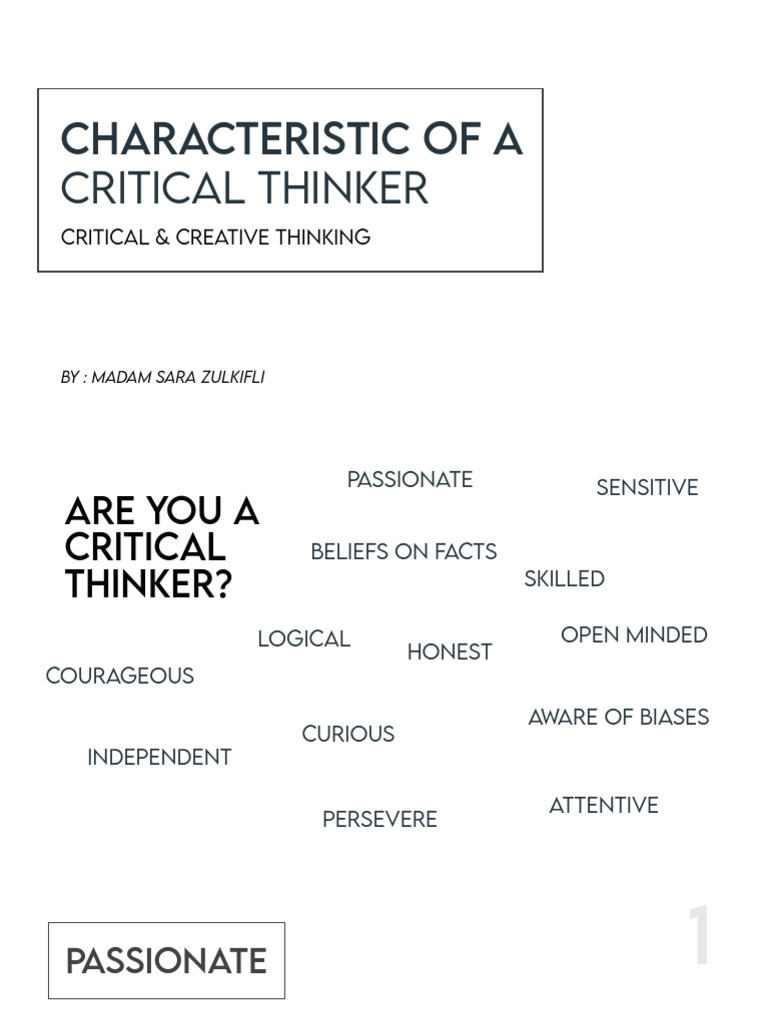
In conclusion, the profile of a critical thinker is both vast and intricate, integrating a blend of curiosity, skepticism, open-mindedness, analytical skills, effective communication, problem-solving, reflective thinking, and ethical considerations. By cultivating these traits, individuals can elevate their cognitive processes, leading not only to personal enrichment but also to meaningful societal contributions. Embracing the mantle of a critical thinker opens up a world of possibilities—one where inquiry, dialogue, and reasoned judgment reign supreme, shaping a more informed and compassionate society.