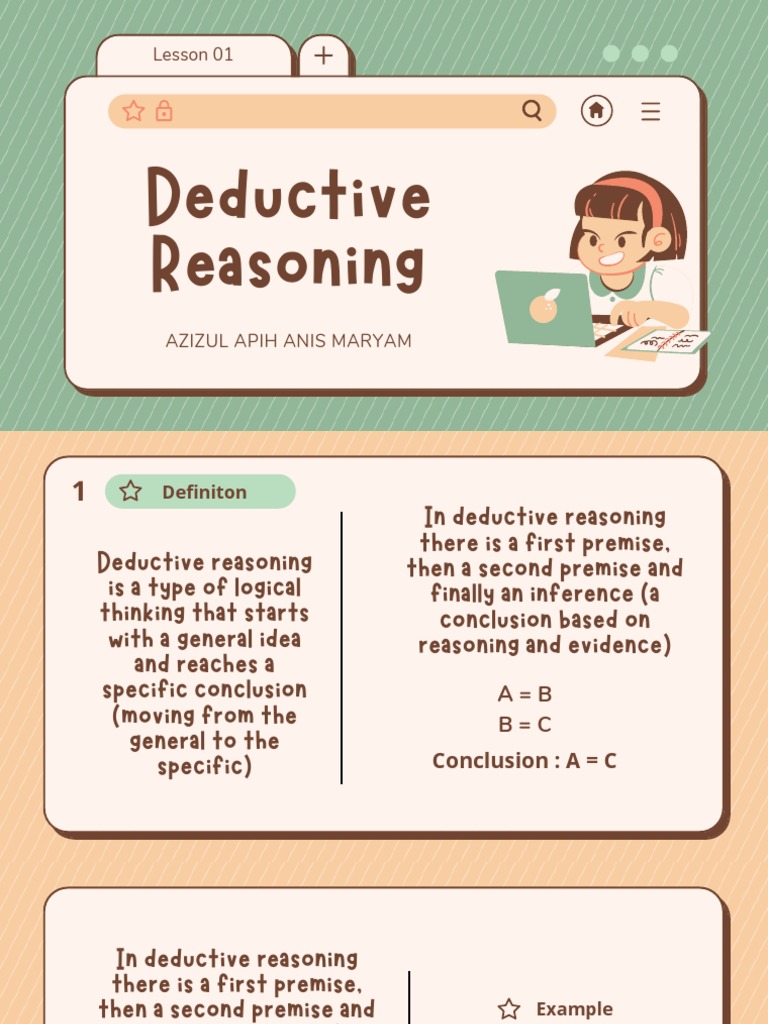
Deductive reasoning is a sophisticated cognitive tool, akin to a finely tuned compass. It guides us through the dense forests of logic, allowing us to navigate complex pathways with precision. This type of reasoning operates on a straightforward principle: if the premises are true, then the conclusion must also be true. In this article, we will explore the intricate landscape of deductive reasoning through compelling examples that illustrate its elegance and utility.
To grasp the essence of deductive reasoning, consider the classic syllogism: “All humans are mortal. Socrates is a human. Therefore, Socrates is mortal.” This succinct structure encapsulates the power of deduction, where the premises form an unassailable foundation for the inevitable conclusion. Such logical frameworks help illuminate the broader themes of life and existence, guiding our understanding of the universe.
Let us delve deeper with a more elaborate allegory. Imagine standing at the edge of a cliff, looking down at a swirling sea of possibilities. Deductive reasoning is your lifebuoy, enabling you to distinguish between the turbulent waters of assumptions and the crystalline clarity of truth. Each premise represents a sturdy rock in the turbulent sea, and the conclusion is the safe harbor you arrive at when making sound decisions based on firm ground.
Consider a practical application in the realm of law: “If someone unlawfully takes another’s property, it constitutes theft. Jane took David’s bicycle without his permission. Therefore, Jane committed theft.” Here, the logically sound premises set out the foundation of legal principles. The process of deduction distills abstract laws into concrete realities, illustrating how the theoretical framework of law operates in tangible scenarios.
Beyond the courtroom, deductive reasoning also permeates scientific inquiry. Scientists employ this reasoning to formulate hypotheses and test theories. For instance, examine the hypothesis: “If all metals expand when heated, and iron is a metal, then iron expands when heated.” This reasoning elevates the confidence level in scientific assertions, transforming hypotheses into established truths through rigorous experimentation.
Transitioning from the realm of law and science to everyday encounters highlights the ubiquity of deductive reasoning. Consider, for instance, the statement: “All birds have feathers. A robin is a bird. Therefore, a robin has feathers.” This example, steeped in simplicity, illustrates the seamless integration of deductive reasoning into daily thought. Observations about the natural world coalesce into conclusions that foster understanding of biological classifications.
In addition to its clarity, deductive reasoning possesses an innate elegance that compels curiosity. The meticulous construction of premises and the palpable inevitability of the conclusion yield a sense that each thought is a stepping stone toward greater enlightenment. This logic crafts a tapestry that invites us to engage in deeper philosophical inquiries, nudging us to explore the very essence of knowledge itself.
However, the compelling nature of deductive reasoning is not without its caveats. It operates under the assumption that the premises are irrevocably true; a single false premise can unravel the entire argument. Reflect on the statement: “If it is raining, then the ground is wet. It is not raining. Therefore, the ground is not wet.” This example illustrates the fallacy of denying the antecedent, emphasizing the importance of verifying premises before constructing conclusions. The artistry of deduction relies on the quality of its input; if the premises are flawed, the conclusions falter.
Moreover, the cultural implications of deductive reasoning are profound. Many philosophical schools advocate for its usage as a pathway to navigate ethical dilemmas. For instance: “If an action maximizes happiness for the greatest number, then that action is morally right. Helping others enhances their well-being. Therefore, helping others is morally right.” This philosophical application illustrates how deduction can refine our moral compass, guiding societal principles and influencing legislative frameworks.
As we continue our exploration, we must appreciate the unique allure of deductive reasoning. It is both a tool and a way of thinking, inviting those who engage with it into a realm where clarity reigns supreme. The intricate dance between premises and conclusions sparks an intellectual curiosity that elevates the mind; it liberates us from the constraints of ambiguity, allowing us to navigate life’s complexities with assuredness.
In conclusion, deductive reasoning stands as a formidable ally in the quest for knowledge and understanding. It acts as a beacon, illuminating our path through the murky waters of thought and guiding us to the shores of certainty. By appreciating its elegance, we not only enhance our cognitive capabilities but also deepen our engagement with the world around us. The journey through deductive reasoning is not merely an academic exercise; it is an exploration of the very fabric of logic and the human experience—a journey worth embarking upon for anyone seeking enlightenment.