When faced with a decision or a problem to solve, have you ever wondered how to arrive at a conclusion? Inductive reasoning might be the answer you’re looking for. It involves making generalizations based on specific observations or instances. In essence, it’s a method of deriving a broader principle from specific examples. But let’s pose a playful question: what if every time you encountered a situation, you made an assumption based on a single experience? Would that serve you well, or could it lead to misguided judgments? This challenge is at the heart of understanding inductive reasoning.
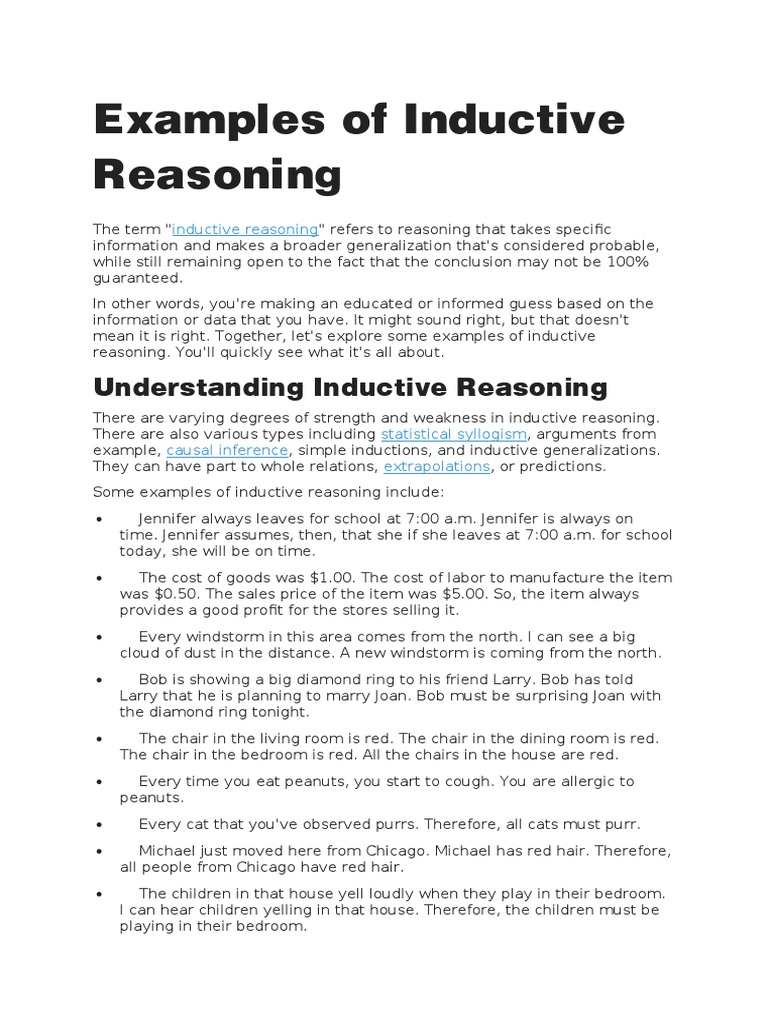
To dive deeper, let us first delineate what inductive reasoning entails. Unlike deductive reasoning, which starts with a general statement and narrows down to a specific conclusion, inductive reasoning works in the opposite manner. It begins with specific instances and culminates in a general conclusion. For instance, consider the classic example of observing that all the swans you have seen are white. From this, you might conclude that all swans are white. However, this leap showcases the beautiful yet delicate dance of forming conclusions without absolute certainty.
Inductive reasoning permeates our everyday lives, influencing decisions both trivial and significant. Think about your morning routine: if you notice that your alarm clock rings at 7 AM every day, you might assume it will ring at the same time tomorrow. This assumption rests not on an unfaltering law but rather on the pattern you’ve observed. However, this poses a potential challenge: what if the alarm malfunctions, leading to a very different morning? Such scenarios highlight the risk of relying solely on inductive reasoning.
The beauty of inductive reasoning lies in its ability to forge connections and construct generalizations that seem intuitive. Take, for instance, the world of science. A scientist may observe a series of phenomena—like an apple falling from a tree. This observation, combined with others, might lead them to formulate the theory of gravity. This process exemplifies how inductive reasoning can pave the way for major scientific advancements but also requires continuous scrutiny. What if the scientist examined a different kind of fruit? Would their conclusions still hold firm?
To further explore inductive reasoning, we can consider various domains where it thrives. In literature, authors often use inductive reasoning to develop characters. A writer might show a character consistently displaying kindness; hence, the reader may conclude that this character is inherently altruistic. However, what happens when the character is placed in a challenging situation? Would their behavior uphold the readers’ inductive conclusion? This brings forth another layer to the discussion: the impact of context in shaping our interpretations.
Education is another arena vividly illuminated by inductive reasoning. In classrooms, educators frequently employ this method to guide discussions. For example, a teacher might present a series of historical events to help students deduce a broader theme, like the struggle for civil rights. Through this inductive process, students learn to make connections and see patterns in history. Yet, the critical challenge here is ensuring that students do not overlook counterexamples which could refine or alter their generalized conclusions.
Moreover, technology has ushered in a new era for inductive reasoning with data-driven insights. Businesses analyze consumer behavior, collecting extensive data over time. By discerning patterns, they can predict future trends. Yet, reliance on this method comes with its own peril; unexpected events, such as a global pandemic, can disrupt patterns and lead to erroneous assumptions. Consequently, businesses must remain adaptable, questioning whether their inductive conclusions still apply in changing circumstances.
Inductive reasoning can be especially potent in everyday problem-solving situations. Imagine a person moving to a new city. They might notice that on weekends, the parks are crowded, leading them to conclude that weekends are popular for outdoor activities. When planning future outings, this individual may lean toward Saturday picnics, blissfully unaware of a potential rainstorm lurking on the horizon. This example serves to illuminate the inherent unpredictability of life that can upend even the most logical inductive reasoning.
It’s crucial to distinguish between strong and weak inductive arguments. A strong inductive inference is grounded in a substantial body of evidence, while a weak one may draw a conclusion based on insufficient instances. For instance, if a biologist observes marine life in a specific region and concludes that all marine life thrives in that area without considering other habitats, the inductive reasoning is decidedly weak. This serves as a reminder that while inductive reasoning can lead to valuable insights, it demands rigorous reflection and validation.
In conclusion, inductive reasoning is a fascinating yet intricate method of forming conclusions based on specific observations. Its applications range across everyday choices, scientific exploration, literature, education, and data-driven decision-making. While it provides a robust framework for understanding the world, it also poses challenges that demand careful consideration. The next time you find yourself making an inference, pause for a moment and thoughtfully question the validity of your conclusion. By doing so, you can enhance your critical thinking skills, navigate ambiguity, and ultimately make more informed decisions in an ever-evolving landscape.