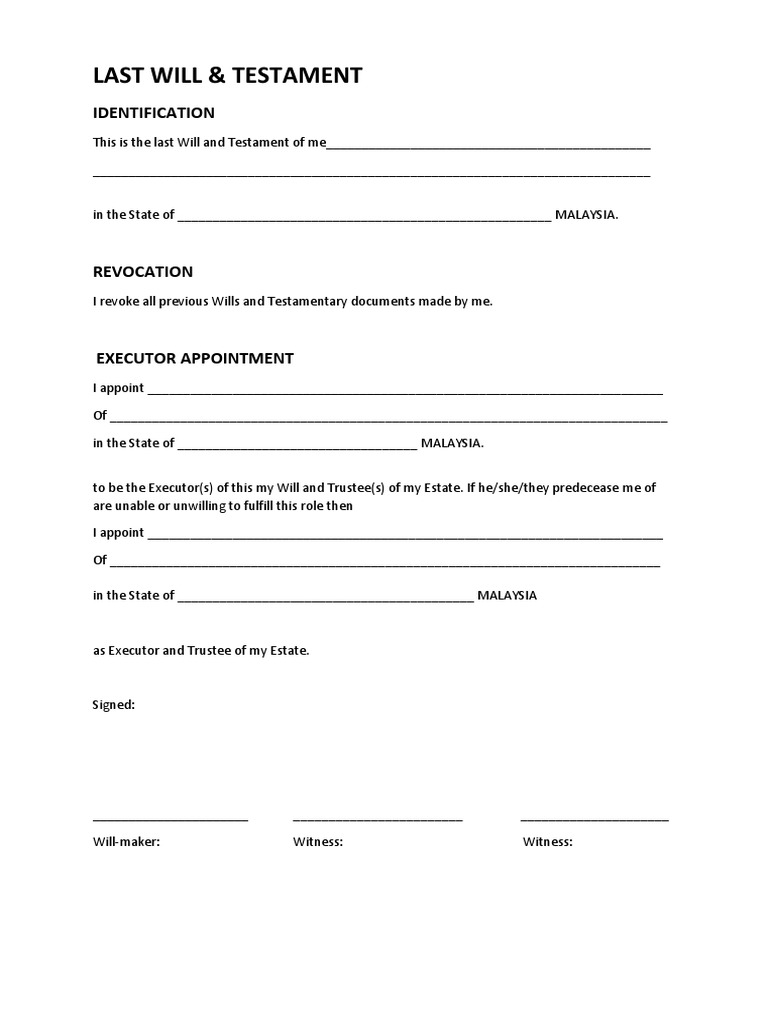
When we contemplate the passage of life, the notion of a last will often surfaces, laden with both solemnity and practical necessity. It serves as a crucial document that articulates one’s final desires, encapsulating personal legacy and emotional bonds. Yet, despite its rigid formality, the last will retains a captivating allure, fueling our curiosity about mortality, inheritance, and the unyielding nature of time. Here, we delve into a poignant example of a last will, examining its fundamental components while unveiling the deeper psychological implications tethered to this quintessential legal instrument.
A last will, or a will and testament, is essentially a legal declaration outlining how an individual wishes their assets and affairs to be organized following their death. While it may appear to be a straightforward compilation of directives, it is, in fact, layered with intricate nuances. The inner workings of this document often reflect the values and priorities of the testator, the individual who creates the will. Through the examples of phrasing and choices made within a will, one can glean insight into the complicated web of relationships and responsibilities that defined the testator’s life.
To present a structured illustration, consider the following elements typically encapsulated within a last will:
1. Introduction and Declaration:
The commencement of a last will usually begins with a formal declaration. In this section, the testator identifies themselves clearly, often including pertinent details such as their full name, domicile, and affirmation that they are of sound mind and body. This legal affirmation serves to preemptively mitigate disputes regarding the will’s validity. For instance:
“I, John Doe, residing at 123 Maple Street, Springfield, do hereby declare this to be my last will and testament, executed while I am of sound mind and memory.”
2. Revocation of Prior Wills:
Successive iterations of a will may happen throughout a person’s life. Therefore, an essential component involves explicitly revoking any prior wills or codicils to avoid conflict and ambiguity. This declaration is often succinct, yet critical in affirming the testator’s most current wishes. It might read:
“I hereby revoke all former wills and codicils made by me.”
3. Appointment of Executor:
One cannot underestimate the importance of designating an executor — an individual entrusted with the responsibility of ensuring that the terms of the will are executed meticulously. This figure acts as the steward of the testator’s last wishes and might be accompanied by a brief description of their qualifications or relationship.
“I appoint my sister, Jane Doe, as the executor of this will, entrusting her with the responsibility to ensure my wishes are fulfilled.”
4. Bequests and Gifts:
At the heart of the will lies a detailed enumeration of bequests; this is where the testator articulates specific gifts to individuals or organizations, which could range from tangible assets, such as personal property or monetary gifts, to more profound legacies, like family heirlooms. Each item is usually accompanied by a name and possibly a relationship context. Such decisions often inspire fervent debate among family members.
“I bequeath my grandfather’s pocket watch to my son, Alex Doe, along with my entire collection of vintage vinyl records to my daughter, Sarah Doe.”
The language here not only dictates the transfer of possessions but also imbues the will with emotional significance that echoes beyond mere legalities.
5. Residual Clause:
This clause is a pivotal aspect of any last will, as it captures any remaining assets not explicitly designated elsewhere within the document. By including such a clause, the testator can ensure that nothing is left to chance, which can be particularly vital in mitigating the repercussions of missed bequests:
“All remaining assets, not previously bequeathed, shall be divided equally between my children, Alex and Sarah Doe.”
6. Guardianship Provisions:
For those with dependents, particularly minors, addressing guardianship emerges as an integral facet of the will. Here, a testator designates a trusted individual to care for their children, reflecting profound concern and foresight in light of tragic circumstances:
“In the event of my untimely passing, I hereby appoint my close friend, Tom Smith, as legal guardian of my children.”
This selfless act underscores the ethical obligation of ensuring the welfare of the next generation.
7. Signatures and Witnesses:
A last will’s legitimacy hinges upon the verification of the testator’s intent and capacity, typically accomplished through notarization or the supervision of witnesses during its execution. These formalities provide a legal safeguard against future challenges.
“Signed on this day, the 1st of January, 2023, in the presence of witnesses.”
Merely drafting a will may appear simplistic; however, the implications it carries resonate through familial relationships, economic considerations, and emotional legacies. As such, it becomes a narrative that encapsulates a life lived, revealing the complex web of vulnerabilities and values individuals possess.
Ultimately, the example of a last will showcases not only the pragmatism requisite in life’s final arrangements but propels contemplation on the value of legacy, the fragility of existence, and the eternal connections we forge with those we leave behind. As we confront our mortality, we find ourselves not just pondering what we leave, but rather, the tales we weave through our final wishes. In the trajectory of life and death, a last will transcends the mere transfer of assets; it forms a poignant reflection of love, responsibility, and the enduring bonds that bind us across time and space.