
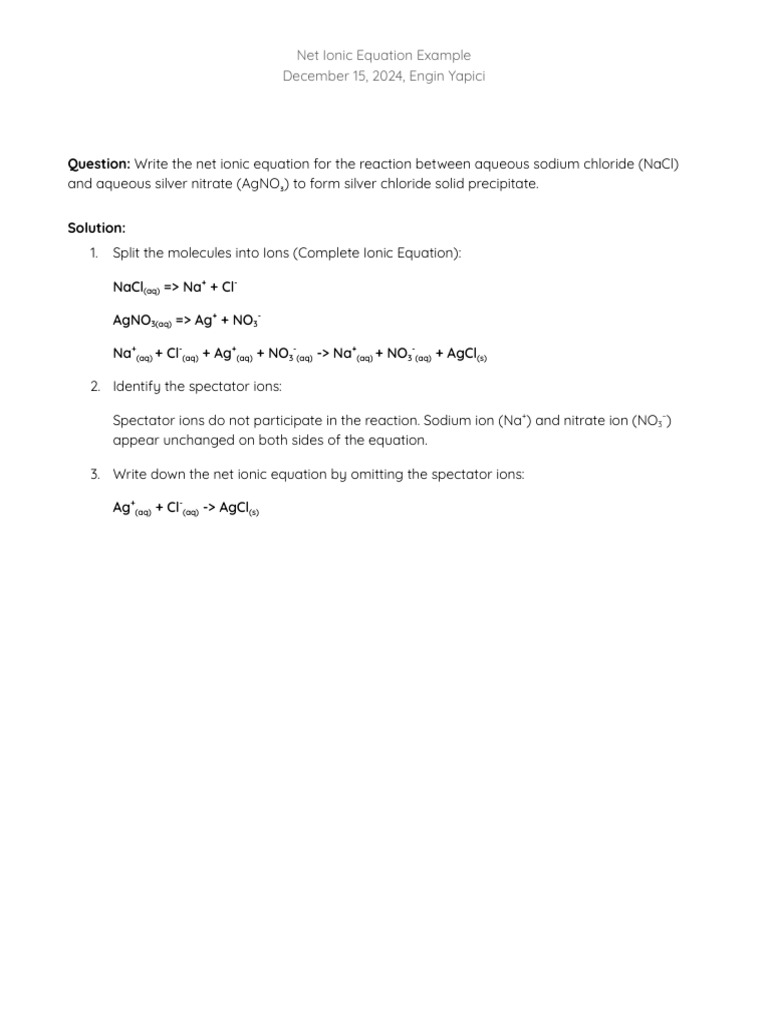
Have you ever found yourself wondering about the secret life of ions? What if I told you that within every chemical reaction, there exists a simplified narrative hidden amongst a multitude of complex interactions? Dive into the world of net ionic equations, where the essence of a reaction unfolds in a more elegant form. But before we delve deeper, let’s pose a playful question: Can you identify the spectator ions amidst the chaos of reactants?
In the realm of chemistry, a net ionic equation serves as an abstraction of reactions occurring in aqueous solutions. It highlights only the ions and molecules that participate actively in a chemical change while dismissing those that remain inert throughout the process. To clarify this intriguing concept, we shall explore an example demonstrating how to derive a net ionic equation from a full ionic equation.
Consider the reaction that occurs when sodium sulfate ((Na_2SO_4)) and barium chloride ((BaCl_2)) are combined in an aqueous environment. When these two compounds are mixed, they undergo a double displacement reaction yielding barium sulfate ((BaSO_4)), a precipitate, and sodium chloride ((NaCl)), which remains soluble in water.
To illustrate the complete ionic equation, we begin with the relevant species in their ionic forms:
- Sodium ions ((Na^+))
- Sulphate ions ((SO_4^{2-}))
- Barium ions ((Ba^{2+}))
- Chloride ions ((Cl^-))
The balanced complete ionic equation for this reaction can be represented as:
(2Na^+ (aq) + SO_4^{2-} (aq) + Ba^{2+} (aq) + 2Cl^- (aq) rightarrow BaSO_4 (s) + 2Na^+ (aq) + 2Cl^- (aq))
Here, the sodium ions and chloride ions appear on both sides of the equation. These species do not undergo any transformation and act as spectators in this reaction. Recognizing that they simply observe without participating is crucial for simplifying our equation further. So, what do we do next? We eliminate these spectator ions from our equation, allowing the vital interaction to stand alone.
Now, let’s condense the equation down to its core:
(Ba^{2+} (aq) + SO_4^{2-} (aq) rightarrow BaSO_4 (s))
Voila! The result is our net ionic equation, succinctly encapsulating the chemical change that transpires: the barium and sulfate ions coalesce to form an insoluble compound, barium sulfate, that precipitates out of solution. This net ionic equation now articulates the heart of the reaction, a narrative stripped of the superfluous content. Isn’t it fascinating how chemical reactions can reveal such intricate tales with just a few crucial characters?
But what relevance do net ionic equations possess? Their utility transcends mere simplification. They provide potent insights into the underlying chemistry, making them invaluable in fields such as environmental science, pharmacology, and materials science. For instance, in the treatment of wastewater, understanding net ionic equations assists in predicting how contaminants will interact with treatment agents, leading to effective remediation strategies.
In the classroom setting, educators harness net ionic equations to deepen students’ comprehension of reactions. They challenge students to recognize patterns in ionic charges and predict the formation of products based on solubility rules. The elimination process reinforces critical thinking as students identify which ions are pivotal and which merely spectate.
It is also worth noting the role played by solubility rules in determining whether a compound will dissolve in solution or precipitate. Learning these rules—ranging from the behavior of alkali metal ions to the exceptions concerning sulfates—can act as a powerful tool for predicting outcomes in both educational and practical applications.
Now, let’s entertain another potential challenge: can you conceptualize a scenario where predicting the formation of products without resorting to net ionic equations becomes troublesome? Consider a reaction where multiple reactants interplay, yielding various potential products. Without the clarity provided by net ionic equations, deciphering the preferred pathway could become tangled in confusion. That is the beauty of focusing on the active participants—clarity amidst the complexity.
Ultimately, understanding net ionic equations not only enhances one’s grasp of chemistry but also fosters an appreciation for the art of simplification. In a world where information often becomes overwhelming, the ability to distill essential truths is a formidable skill. So, the next time you encounter a chemical reaction, challenge yourself: can you uncover the pivotal ions at play and articulate the net ionic equation?
In closing, net ionic equations offer a meritorious glimpse into a reaction’s fundamental transformation. They distill complexity into clarity, guiding students and professionals alike through the intricate world of chemistry with ease and elegance. Whether you are a dedicated chemist or an inquisitive learner, the allure of identifying the essential players in each chemical drama is a challenge worth embracing.













