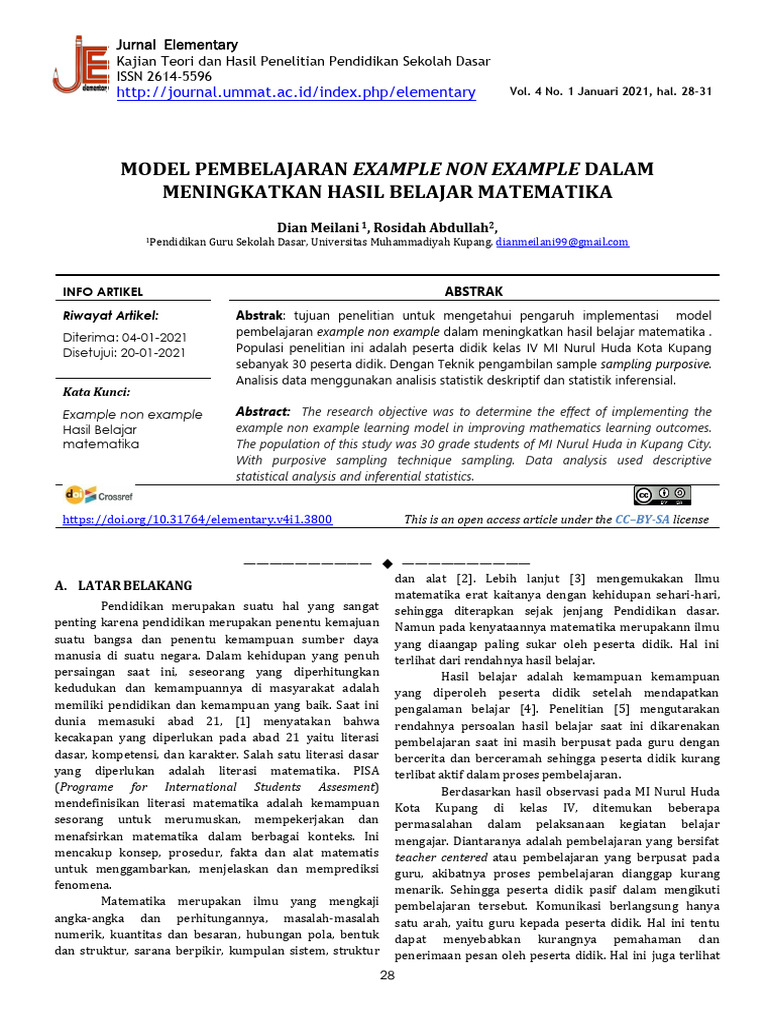
In the realms of cognition and conceptual understanding, the distinction between examples and non-examples serves as a cornerstone in the scaffolding of knowledge. The phrase “example of a non-example” itself invites a level of intrigue; it juxtaposes the familiar enveloped within an unfamiliar context. Such interplay not only fosters inquiry but also elucidates deeper cognitive processes. This article aims to explore the concept of examples and non-examples, unveiling layers of fascination and insight that lie beneath the surface.
Understanding Examples and Non-Examples
At its core, an example is a manifestation of a broader term, illuminating its attributes through practical illustration. Conversely, a non-example serves to delineate boundaries, offering insight into what the term does not encompass. When approaching the building of knowledge, this binary framework allows individuals to refine their understanding, sharpening their cognitive skills in the process.
For instance, consider the category of domestic animals. A dog may serve as an example, while a car embodies a non-example. The juxtaposition is not just a matter of classification but reveals an intricate tapestry of attributes, roles, and behaviors that fortify our grasp of the original concept.
The Cognitive Utility of Non-Examples
Non-examples play an essential role in cognition, functioning as a clarifying agent against which examples can be contrasted. When we encounter a non-example, it compels us to reconsider our initial perceptions and assumptions. Why isn’t a car a domestic animal? This seemingly simple question unveils layers of understanding pertaining to biological classifications, utility, and societal roles. Through such inquiry, our comprehension deepens, leading us to appreciate the subtleties that define various concepts.
This cognitive agility also echoes the philosophy of dialectics, which posits that understanding arises from the tension between contrasting ideas. Non-examples offer that necessary tension, fostering critical thinking and enhancing our evaluative skills. In educational contexts, teachers often employ non-examples to help students navigate complex topics, highlighting misconceptions and misconceptions as a mechanism for deeper learning.
Real-World Applications: From Education to Innovation
In practical terms, the interplay between examples and non-examples finds extensive application across various domains, from education to product design. In a classroom setting, when learners grapple with theoretical concepts—like the principles of democracy—the teacher might use historical instances of authoritarian regimes as non-examples. This method not only elucidates the core principles of democracy but also instills a more profound understanding of governance by displaying contrasting models.
Similarly, in the realm of innovation, designers often engage with non-examples to pivot their creative energies. In brainstorming sessions, when a team seeks to develop a new product, exploring what constitutes a failure—a non-example—can be just as enlightening as discussing successful iterations. Understanding what does not work illuminates pathways that might otherwise remain obscured by conventional thinking.
Psychology Behind the Fascination
The human fascination with the dichotomy of examples and non-examples can also be traced to psychological principles. Cognitive dissonance, which arises when confronted with conflicting information, invites individuals to re-evaluate their frameworks of understanding. Non-examples challenge our preconceived notions, thereby catalyzing a deeper exploration of beliefs and attitudes. This process of confrontation and resolution drives personal and intellectual growth.
Moreover, the element of surprise accompanying non-examples instills a sense of curiosity. When something does not fit into our established categories, it beckons a response. This response can manifest as questions leading us to further inquiry, research, and ultimately, learning. The nuances of human cognition thrive within this dynamic interaction.
The Artistic Dimension: A Metaphorical Lens
In an artistic context, the concept of examples and non-examples transcends mere categorization and becomes an odyssey of exploration. Artists often grapple with the conventions of their medium, oscillating between what is expected (examples) and what is unconventional (non-examples). In the realm of abstract art, the artist’s decision to eschew traditional representation can yield a non-example that compels viewers to reflect on the very nature of perception and expression. Non-examples in art challenge audiences to reconsider their experiences, evoking broader dialogues about aesthetics.
Conclusion: The Philosophical Undertones
The exploration of examples and non-examples is not merely a pedagogical exercise; it embodies deeper philosophical inquiries about knowledge, classification, and perception. The interplay between these domains fosters a rich narrative that captivates our intellect and imagination. Each non-example is a portal to an expansive landscape of interpretation, prompting us to engage in reflective dialogue regarding our understanding of the world.
Ultimately, the fascination with examples and non-examples reveals layers of connection—between ideas, products, and even ourselves. As we navigate this intricate web, we are reminded of the infinite possibilities that arise from challenging our perspectives, fostering innovation, and fueling intellectual curiosity. The next time you encounter an example of a non-example, embrace the opportunity to explore the depths of meaning it may contain.