
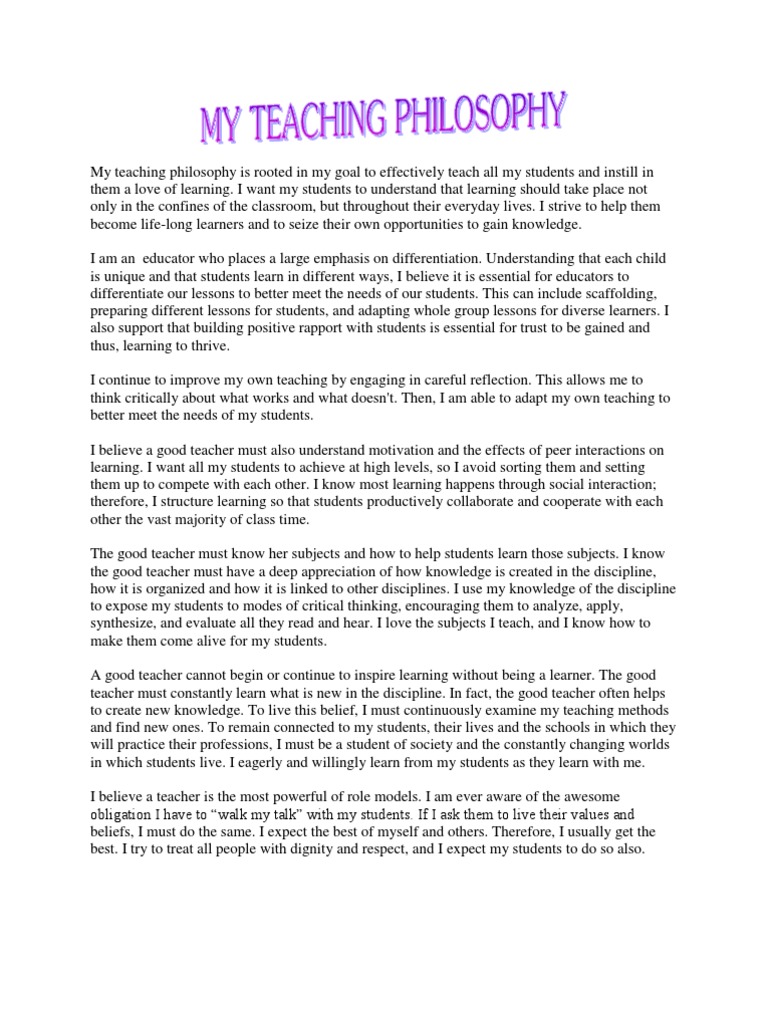
Teaching is often likened to a tapestry—an intricate weave of knowledge, skills, and experiences that comes together to create a vivid picture of growth and enlightenment. Just as a tapestry requires various threads to achieve its richness, the philosophy of teaching draws on numerous influences, theories, and practices to cultivate an environment where learners flourish. The fabric of a teaching philosophy encapsulates beliefs about education, the teacher’s role, and the dynamics of the student-teacher relationship. A strong philosophy of teaching serves as a beacon, guiding educators as they navigate the labyrinth of education. Here, we unveil an example of a teaching philosophy, unraveling its core elements and illuminating its unique appeal.
At the heart of any teaching philosophy lies a commitment to fostering a nurturing and inclusive environment. Imagine a garden, flourishing with diverse flora, each plant requiring different nutrients and sunlight to thrive. In education, this diversity manifests in the array of backgrounds, abilities, and interests present in the classroom. A well-crafted teaching philosophy underscores the importance of recognizing and celebrating differences, tailoring instruction to meet varied needs. By cultivating a space where all students feel safe and valued, educators foster a sense of belonging, allowing each learner to blossom.
Central to this philosophy is the belief in the transformative power of education. Education is not merely the transmission of knowledge but a catalyst for personal and societal change. Engaging students through relevant and meaningful content is akin to sparking a flame; it ignites curiosity and motivation. Educators must stand as facilitators, guiding learners on their journeys of discovery. This role involves harnessing innovative teaching strategies and embracing technology, comparable to wielding a painter’s brush to create a masterpiece. Engaging methodologies, such as project-based learning and collaborative initiatives, empower students to take ownership of their educational experiences. Through such approaches, educators cultivate critical thinkers, problem solvers, and responsible citizens.
Moreover, understanding that learning is an iterative process is fundamental to a robust teaching philosophy. In this context, mistakes are not failures but rather stepping stones toward mastery. The analogy of a sculptor chipping away at a block of marble illustrates this concept well. A sculptor sees potential within the stone, patiently revealing the artistry hidden within. Similarly, educators must nurture resilience in their students, encouraging them to embrace challenges and learn from setbacks. This fosters a growth mindset, where learners perceive difficulties not as obstructions but as opportunities for development and insight.
Another pivotal aspect of a teaching philosophy is the emphasis on collaboration and community. Weaving together the narrative of a classroom involves engaging not just the students but also the broader community. When educators form partnerships with families and local organizations, the educational experience becomes richer and more contextualized. This synergy fosters a sense of communal responsibility, creating a support network that extends beyond the four walls of the classroom. Just as a symphony orchestra harmonizes individual instruments, a collaborative approach amplifies student learning, ensuring that each voice contributes to the harmony of the educational experience.
Assessment also occupies a central role in a comprehensive teaching philosophy. Rather than viewing assessment merely as a tool for grading, it should be seen as a dynamic process that informs teaching and enhances learning. Assessments, when used thoughtfully, can illuminate the pathways through which students engage with content. This notion is reminiscent of a compass, guiding students in their academic exploration. Formative assessments facilitate ongoing feedback, allowing educators to adjust their instructional strategies in real-time, thereby ensuring that no learner is left adrift in the sea of knowledge.
The integration of ethical considerations cannot be overlooked in a philosophy of teaching. As educators shape the minds and futures of their students, they bear a profound responsibility. This obligation extends beyond imparting academic knowledge; it includes fostering ethical reasoning and social responsibility. Equipping students with the tools to navigate moral dilemmas ensures they emerge as conscientious individuals capable of making informed decisions in an increasingly complex world. In this light, teaching is a form of stewardship—one that requires vigilance, integrity, and an unwavering commitment to the greater good.
Ultimately, a compelling philosophy of teaching is not static; it evolves with experiences, reflections, and advancements in educational research. It is a living document, similar to a river in constant motion, adapting to the contours of changing currents. Educators must remain lifelong learners, committed to professional development and continuous improvement. This adaptability enhances the resonance of their teaching philosophy, ensuring it remains relevant and impactful in an ever-changing educational landscape.
In conclusion, a well-articulated philosophy of teaching serves as an essential compass for educators, guiding their pedagogical practices and fostering an environment conducive to learning. It champions diversity, embraces innovation, and emphasizes collaboration—transforming the classroom into a vibrant ecosystem of growth. Through the lens of a nuanced teaching philosophy, educators are not just instructors but architects of change, shaping the future one learner at a time. Just as a prism refracts light into a spectrum of colors, a well-rounded teaching philosophy refracts education into a kaleidoscope of opportunities for students, illuminating their paths toward enlightenment and empowerment.













