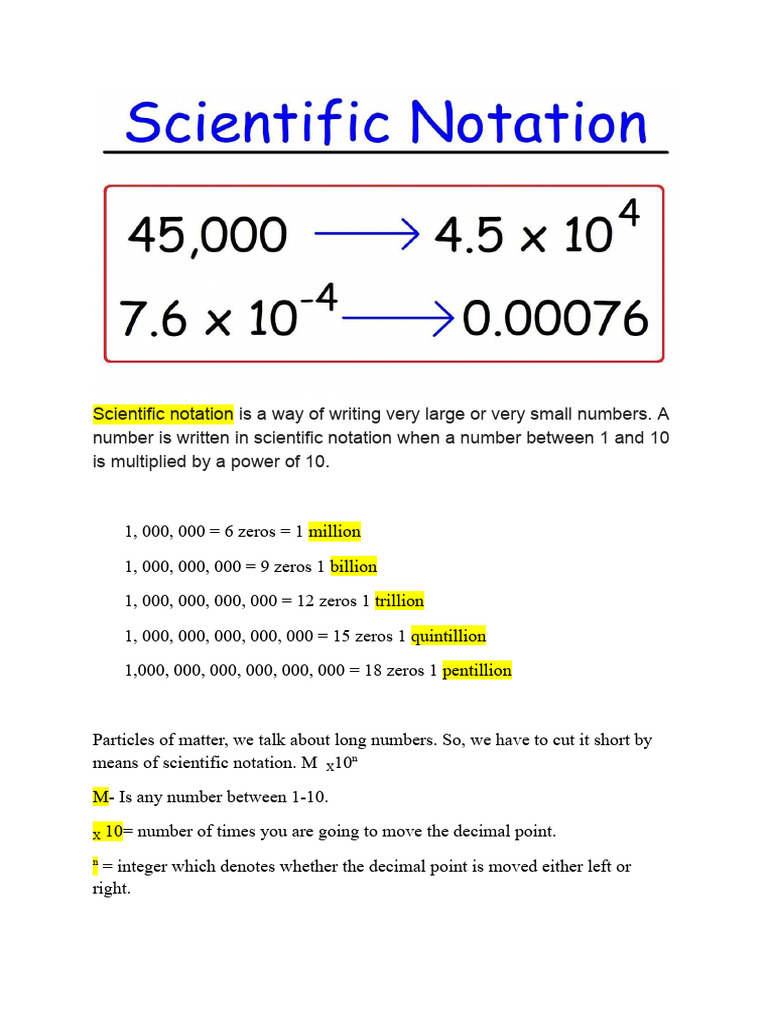
Scientific notation acts like a telescope, bringing distant cosmic phenomena into sharp focus. This method of expressing numbers, particularly those that are exceedingly large or strikingly small, offers a lens through which we can analyze and appreciate the intricacies of our universe. Rather than being mere abstract concepts, these numbers can be wielded like a scientific tool to illuminate the vast realms of knowledge.
At its core, scientific notation can be thought of as a linguistic shortcut, distilling voluminous information into digestible morsels. A number like 1,000,000, for instance, transforms elegantly into 1 x 10⁶. Here, the coefficient (1) and the exponent (6) work in concert, the former signifying the digit(s) before the decimal point, while the latter indicates how many places to shift that decimal point to the right. This concise representation not only streamlines calculations but also enhances clarity, especially in scientific communications where precision is paramount.
Imagine you are standing before an ancient library, each book representing a vast number. Piles of data, sprawling theory, and fundamental constants of nature beckon for your attention. Scientific notation organizes this vast library, rendering it navigable and approachably succinct. Take, for example, the speed of light—299,792,458 meters per second. In scientific notation, we condense this to approximately 3 x 10⁸ meters per second. Such transformations enable even the most complex figures to resonate with simplicity.
Another fascinating application arises in the context of astronomical measurements. The distance from Earth to the nearest star, Proxima Centauri, is roughly 4.24 light-years away—or about 25 trillion miles. Expressed in scientific notation, this marauding figure becomes 2.5 x 10¹³ miles. In this manner, the astronomical labyrinth where such distances bloat becomes a more navigable landscape for astronauts and astrophysicists alike. It is as if we are equipped with a universal map, guiding us through the cosmos.
To further encapsulate the importance of this concise notation, consider that the mass of an electron is around 0.000000000000000000000000000911 kilograms or 9.11 x 10⁻³¹ kilograms. Here, in the realm of subatomic particles, scientific notation shines as a beacon of clarity. The minuscule figure conveys grandeur in its infinitesimal existence, illustrating how even the tiniest components of matter possess their own vital narratives.
For those venturing into the realms of chemistry, scientific notation is indispensable. The quantity of molecules in a mole—a fundamental concept defined by Avogadro’s number—is approximately 6.022 x 10²³. This monumental figure quantifies the virtually incomprehensible multitude of particles, encapsulating the essence of substance in a nutshell. A mole of substance serves as a bridge, linking the macroscopic world to the unseen molecular universe, translating molecular metrics into tangible realities.
In modern technology and digital communications, scientific notation has transcended the scientific sphere and embedded itself into everyday vernacular. Internet connections are often quantified in terms of megabits per second (Mbps), where data transfer rates may soar to billions of bits. Expressing these figures in scientific notation allows consumers to comprehend the dizzying scale of data flow. A connection that offers 1,000 Mbps would be elegantly summarized as 1 x 103 Mbps, thus adding a layer of sophistication to technological jargon.
Furthermore, the financial sector employs scientific notation to articulate vast sums of money. For instance, a company value of $1,000,000,000 translates to 1 x 10⁹ dollars. In a world where financial scalability rules, mastering numerical representation becomes an invaluable asset, providing clarity to investors and analysts alike. It elevates the mundane numeral into a powerful statement on economic might.
In the realms of education, scientific notation serves as an invaluable pedagogical apparatus. It empowers students to engage with mathematical concepts through tangible examples, fostering a deeper understanding of the world. Engaging with the order of magnitude and developing an intuitive grasp of numbers allows learners to imbibe the essence of quantitative reasoning—a skill set requisite for navigating the swirling currents of the contemporary world.
In closing, scientific notation may appear to be a mere mathematical expediency, but it is akin to the refined art of storytelling. It encapsulates vast narratives of the universe within a compact framework—transcending mere digits to convey stories about magnitude, distance, and realms yet to be explored. Just as a fine sculptor chisels a block of marble into a nuanced masterpiece, scientific notation molds complex numbers into forms that are intuitive and elegant. Embrace this vital tool, for it leads us to a deeper comprehension of our universe, linking the monumental with the minute, and simplifying the complex tapestry of existence into comprehensible strokes of brilliance.