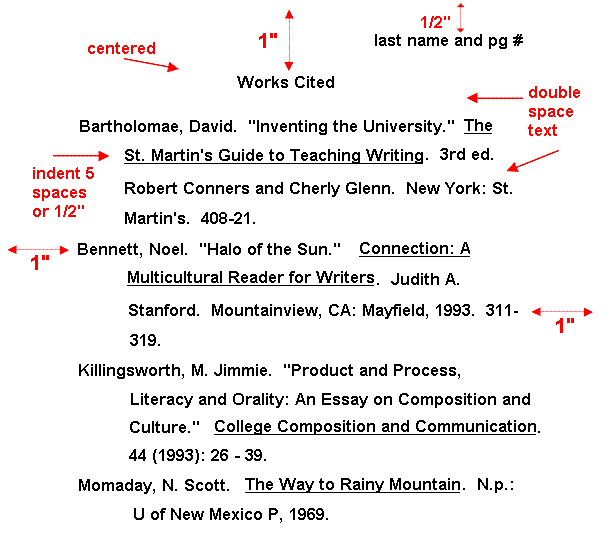
In the realm of academia, understanding how to properly cite sources is paramount to maintaining intellectual integrity. Among the various citation styles that scholars and students utilize, crafting a Works Cited page is a fundamental task. It serves not merely as a formality; rather, it is a vital component in weaving a narrative that acknowledges the scholarly contributions of others and situates one’s own arguments within a broader context. This article dissects the intricacies of constructing a Works Cited entry, elucidating not only its structure but also the significance it embodies.
When one observes a Works Cited list, the first impression is often one of uniformity. Every entry appears systematic, as if part of a meticulous blueprint. This typical format is not arbitrary; rather, it arises from the need for clarity and consistency across academic writing. Each citation includes essential details such as the author’s name, the title of the work, the publication details, and the medium of publication. These elements create a collective tapestry of scholarly dialogue, linking diverse ideas back to their origins.
To comprehend the profound relevance of a Works Cited page, it is instructive to first examine its structural components. A standard entry in the Modern Language Association (MLA) style, for example, could resemble:
Author’s Last Name, First Name. “Title of the Article.” Title of the Journal, vol. number, no. number, Year, pages. Database, DOI or URL.
This structure underscores the importance of precision and attention to detail. Each segment feeds into a larger narrative, ensuring that readers can trace the lineage of ideas, theories, and arguments presented. For instance, how many times have we encountered a riveting claim in a paper, only to find ourselves wondering, “Where did this come from?” Without a satisfactorily compiled Works Cited, clarity dissolves, leaving behind questions that erode the foundation of scholarly discourse.
Yet, while the technicalities of citation are vital, a deeper fascination resides in what these works represent—the connections between thinkers and the building blocks of knowledge. In essence, citing a source acknowledges the collaborative nature of scholarship. It’s a nod to those who paved the way, simplifying the labyrinthine journey of academic inquiry. The act of citing not only pays homage to predecessors but also intertwines current research with past endeavors, an intricate dance of intellectual legacy.
This interconnectedness invites reflection on the nature of knowledge itself. Often seen as a solitary pursuit, the act of scholarship is overwhelmingly collective. Each citation carries the weight of its own historical moment, encapsulating the struggles, evolutions, and revolutions of thought that have preceded it. Understanding this transforms the seemingly mundane task of compiling a Works Cited into a more profound engagement with the academic landscape—one that propels personal insights into a continuum of scholarly dialogue.
Moreover, the manner in which sources are chosen and presented on a Works Cited page can reveal much about the academic ethos of a writer. Are citations dominated by contemporary research, or do they include seminal works that laid the foundation for current examination? The selections made can reflect not just individual preferences but prevailing trends within a discipline. This nuance adds layers to academic writing; it allows readers to gauge not just the content, but the intellectual underpinnings of the arguments presented.
Consider a student who, in preparing a dissertation, curates an extensive collection of sources. Each title etched into the Works Cited page narrates a narrative of exploration, each work a stepping stone on their scholarly journey. This compilation becomes a prism through which the evolution of their arguments can be viewed, highlighting not only the sources that bolstered their thesis but also those that challenged it. It is in this cyclical interplay of support and opposition that the rich tapestry of academic discourse truly flourishes.
Furthermore, the impact of technology cannot be overstated when examining the contemporary formulation of Works Cited pages. With the advent of digital resources, a kaleidoscope of information is now at the fingertips of scholars. However, this convenience also necessitates vigilance; the prevalence of online materials brings challenges related to credibility and source evaluation. Assembling a Works Cited page in this context becomes an exercise in discernment, urging writers to critically assess both the authority and the relevance of their sources.
As we contemplate the ultimate function of a Works Cited page, it is important to recognize its role in fostering a culture of accountability. In a time when misinformation can easily propagate, providing a solid basis for claims made within academic works serves as a bulwark against intellectual dishonesty. It encourages a rigorous examination of facts, urging writers to substantiate their assertions with reliable evidence. The mere existence of a Works Cited page demands respect for the scholarly process, positioning each author as both a contributor to and a steward of knowledge.
In conclusion, a Works Cited page is far more than an obligatory addition to academic work; it stands as a testament to integrity, collaboration, and the intricate fabric of scholarly inquiry. The diligence invested in crafting this compilation not only enriches the work itself but also affirms a commitment to the very principles that underpin the academic pursuit: respect for intellectual lineage, an appreciation for complexity, and an unwavering dedication to truth. As one pens their citations, they engage in an act of homage, a recognition that the quest for knowledge is inherently communal, echoing through time and across disciplines.