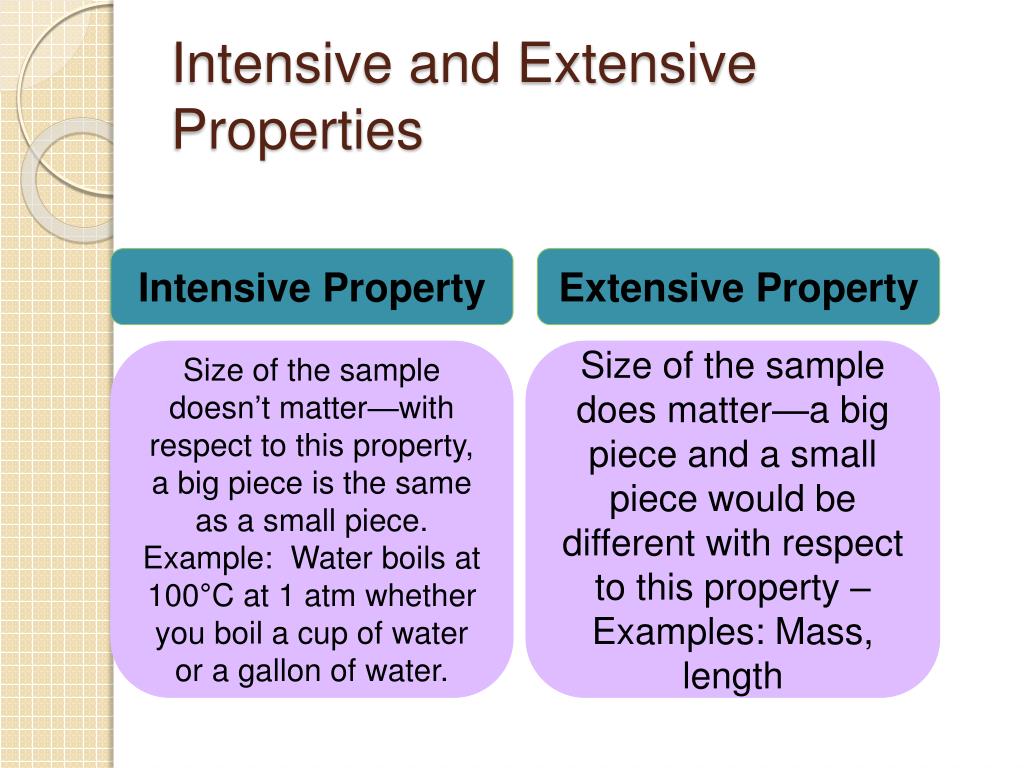
In the realm of scientific inquiry, properties of matter are classified into two definitive categories: extensive and intensive properties. The elucidation of these concepts beckons a deeper understanding of how matter behaves under varying conditions. Dive into the world of extensive properties, where quantity reigns supreme, and discover an example that is both quintessential and fascinating—mass.
Mass, a fundamental extensive property, possesses the remarkable ability to elucidate the fundamental essence of matter. It is, quite simply, the measure of the amount of substance within an object. Unlike intensive properties, which do not change regardless of the quantity of material (like temperature and density), extensive properties such as mass are directly proportional to the size or extent of a system. This transforms mass into a pivotal metric, serving as a cornerstone for both practical applications and theoretical explorations.
To cultivate an appreciation for mass as an extensive property, one must first encounter its ubiquitous presence in our daily lives. When you weigh a loaf of bread, the number you observe directly correlates with the amount of dough used. As soon as you slice that loaf in half, you experience an intrinsic altering of the mass—manifesting the essence of this extensive property. The two halves possess less mass individually than the whole loaf; however, their combined mass reinstates the original measurement. This relationship serves as a tangible metaphor for the concept of mass itself, revealing its fundamental nature as woven into the fabric of our reality.
But why does mass matter in the grand tapestry of science? Consider its ramifications in the fields of physics and chemistry. In physics, mass is a determinant in calculating the gravitational forces exerted upon an object. It forms the basis for Einstein’s theory of relativity, where the interplay between mass and energy is profoundly illustrated by the iconic equation E=mc². Here, mass transcends mere measurements; it is intrinsically linked to the very energy that underpins the universe.
In the domain of chemistry, mass reigns supreme in stoichiometry. The balance of a chemical equation hinges on the conservation of mass, ensuring that the atoms on the reactant side equal those on the product side. This principle mandates that in a closed system, despite the transformations that occur, mass remains conserved. A chemist, armed with this knowledge, can navigate through the complexities of reactions, providing precise measurements of reactants and products. The stoichiometric calculations elucidate the extensive property, bridging reality with theoretical constructs.
Moreover, the implications of mass extend toward the field of engineering, where architects and engineers must meticulously account for mass in their designs. The stability of structures hinges upon weight distribution, material selection, and load-bearing capacities. When designing a bridge, engineers must calculate the mass of materials to ensure that safety standards are met, demonstrating the quintessential role of mass in practical applications. It wields the power to transform mere ideas into majestic realities, enabling humans to conquer vast spans and create awe-inspiring edifices.
Curiosity beckons the question—what lies beneath the measured numbers? The perception of mass as merely quantitative dismisses its cultural and philosophical significance. In several ancient traditions, mass and weight were often intertwined with notions of value and worth. Gold, for instance, was not only sought after for its physical properties but also for the mass of its representation in wealth. Such cultural musings on mass deepen our appreciation, revealing that even scientific concepts harbor rich narratives.
Exploring the application of mass in real-world scenarios further piques interest. In the culinary arts, for instance, precision in measuring ingredients is paramount. A chef’s ability to calibrate the mass of flour versus sugar can lead to an entirely different outcome in a cake’s texture. Here, the manipulations of mass in a seemingly simple act of baking unveil complexities, thereby invoking a reverence for the balance of extensive properties within culinary creations.
In everyday life, this extensive property surfaces in more mundane tasks, from grocery shopping to health assessments. We quantify groceries by weight—apples, potatoes, and meats are sold by their mass. Even in medical settings, determining a patient’s mass plays a crucial role in diagnosing and administering treatments. As patients step onto the scale, their mass translates into vital data that can influence healthcare decisions. Thus, mass transcends its definition, intertwining with life’s narratives surrounding health, well-being, and sustenance.
Moreover, the future of understanding mass and its implications is ripe with scientific exploration. With advances in technology, measuring mass has become increasingly sophisticated. High-precision balances now allow scientists to observe minute changes in mass, unlocking doors to groundbreaking research in various fields, including material science and nanotechnology. The quest to comprehend and manipulate mass at microscopic levels promises to reshape our understanding of matter itself.
In conclusion, mass as an extensive property is not a mere numerical value; it is a dynamic interplay of science, culture, and daily necessity. From the weight of a simple loaf of bread to the grandeur of cosmic theories, mass dances through our lives, continuously shaping our understanding of the universe. As you navigate your surroundings, remember the essential role that mass plays. It urges us to look beyond the superficial and fosters a greater appreciation for the intricate web of properties that governs our reality. In mass, you find a reflection of quantity intertwined with significance, a delightful source of curiosity in the quest for knowledge.