
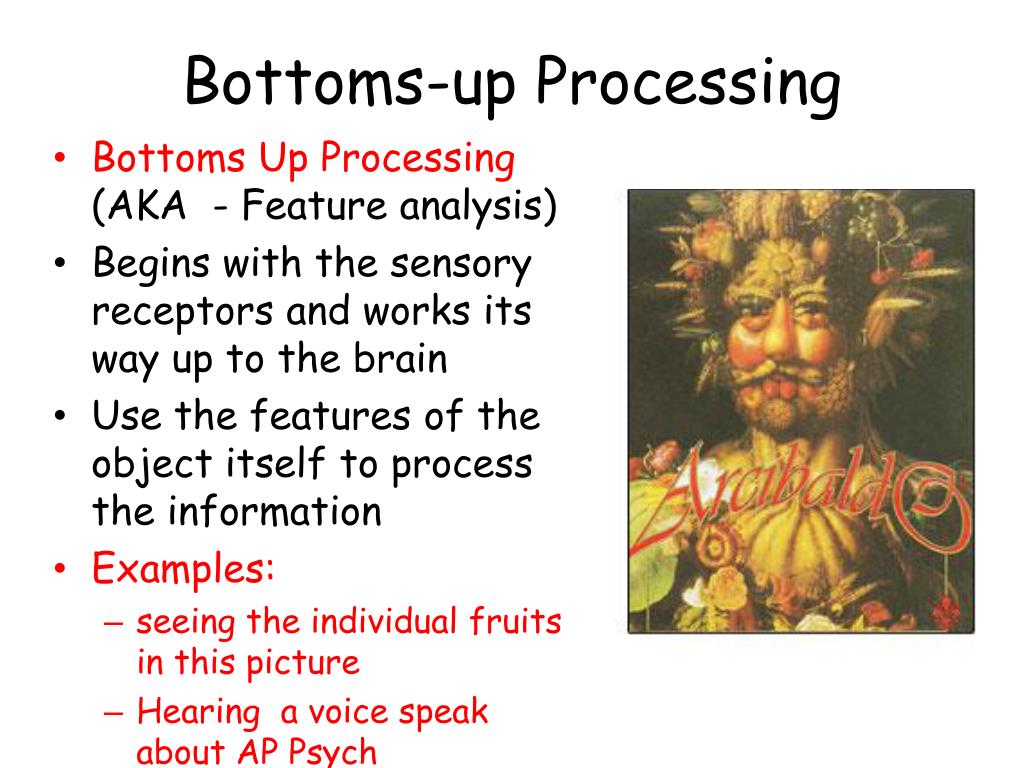
Bottom-up processing is a cognitive approach that begins with the most basic elements of perception, progressively integrating them to form a holistic understanding of our surroundings. This fascinating method is often contrasted with top-down processing, where preconceived notions and experiences shape our interpretations. In this exploration of bottom-up processing, we will thoroughly discuss its manifestations through real-world examples, unearthing the psychological mechanisms that govern our perception.
To illustrate the essence of bottom-up processing, let us consider an everyday phenomenon: the act of recognizing a letter on a page. Upon glancing at the text, our eyes detect the individual lines and shapes that comprise each letter. The curves of a ‘b’ are perceived first, followed by the vertical line of its stem. Only after perceiving these basic visual stimuli do we synthesize this information to recognize the letter itself. In essence, we accumulate sensory input to construct meaning, navigating through layers of perception like an artist blending colors on a palette.
This innate ability to discern patterns stems from our neurological architecture. Cones and rods in our retina serve as the initial receptors, translating photons into neural signals. These signals travel through the optic nerve to the brain, where higher-order processing occurs. The visual cortex, in particular, plays a pivotal role in synthesizing this information, revealing the intricate interplay between biological structures and perceptual phenomena.
Beyond the simple act of reading, consider how bottom-up processing interfaces with complex visual stimuli. Imagine walking through a botanical garden. As you enter, the myriad colors, shapes, and scents bombard your senses. You may begin by noticing a brilliant splash of red from a flowering plant. Your attention is drawn to this vibrant color, and as you approach, the sensory details deepen. You perceive the texture of the petals and the delicate fragrance wafting toward you. Each individual observation feeds into the broader experience of the garden, allowing you to develop a comprehensive understanding of your environment.
Interestingly, bottom-up processing not only reigns in the domain of visual perception but also extends into auditory recognition. Consider the experience of listening to a symphony. As the conductor raises their baton, individual instrument sounds converge into a harmonious collective. Initially, you may only distinguish the piercing notes of the violins or the rich timbres of the cellos. It is through careful attention to these discrete elements that you come to appreciate the complexity of the composition as a whole. The sensory details you perceive are the building blocks of your musical understanding, culminating in a comprehensive auditory experience.
The implications of bottom-up processing extend into various realms, profoundly affecting aesthetics, art, and design. Artists often exploit these cognitive pathways, utilizing color, shape, and texture to guide viewers’ perceptual journeys. For instance, in the realm of abstract painting, vibrant strokes may evoke immediate sensory reactions. The viewer is invited to engage with each brushstroke, gradually piecing together an emotional landscape that transcends mere representation. This relational approach fosters a deeper appreciation for how our sensory experiences impact not just our interpretation of art, but also our psychological responses.
In educational contexts, understanding the principles of bottom-up processing can enhance teaching methodologies. For example, educators may employ hands-on activities that require students to engage with materials directly. By facilitating direct interaction with the subject matter, learners can assemble knowledge from the ground up, enhancing retention and comprehension. As they manipulate physical objects or conduct experiments, students rely on their senses to glean insights, solidifying connections that might otherwise remain abstract.
Furthermore, bottom-up processing exhibits a meaningful presence within developmental psychology. Infants, blank slates in many regards, rely primarily on bottom-up mechanisms to navigate their environment. Through exploration and direct sensory experiences, they articulate their understanding of the world. When a child encounters a fluffy cat, they may first perceive the soft texture and warm body, gradually associating these sensations with the concept of ‘cat.’ This bottom-up trajectory underscores the significance of experiential learning in shaping cognitive development.
As we delve further, bottom-up processing also plays a critical role in the realm of artificial intelligence (AI) and machine learning. Designers of neural networks often take inspiration from human cognitive processes, aiming to replicate bottom-up mechanisms in their algorithms. These systems begin with raw data and utilize layers of processing to discern patterns and make predictions. Such models, seen in facial recognition technologies or natural language processing tools, mirror the bottom-up approach, with each layer extracting deeper insights from initial inputs.
In conclusion, the intricacies of bottom-up processing offer a profound understanding of how we perceive, interact with, and comprehend the rich tapestry of our environment. From the basic act of recognizing letters to the complex experiences evoked by visual art and symphonic music, this cognitive framework illustrates the brilliance of human perception. As we continue to explore the depths of our sensory experiences, we elicit fascination with the ways in which we build our understanding, layer by meticulous layer, transforming the world around us into a cohesive narrative. Emphasizing the value of direct interactions and sensory engagement, bottom-up processing invites us to cherish the artistry and complexity inherent in our perceptual experiences.













