
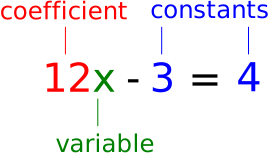
Have you ever wondered how many different types of numbers exist in mathematics? What if I told you that some numbers are like steadfast companions, never changing regardless of the circumstances? These are known as constants. Today, we will explore the fascinating realm of constants in mathematics. So, brace yourself for an enlightening journey that blends foundational concepts with playful inquiries!
At its core, the term “constant” refers to a value that remains fixed and unaltered no matter the context in which it appears. Unlike variables that fluctuate based on the situation or equation, constants stand as pillars of stability. For example, the number 5 is a constant. Whether you see it in algebra, calculus, or even in a geometry problem, its value remains unwavering at five. Can you think of the last time you encountered a number that seemed to have a permanent residence in your calculations? Perhaps you, like most, often find that constants play a crucial role in various mathematical disciplines.
To delve deeper into this topic, let’s categorize constants into different types, starting with numerical constants. These are the most straightforward, as they are simply fixed numbers such as 0, 1, or 3.14159 (which represents π, the ratio of a circle’s circumference to its diameter). Isn’t it intriguing how π transcends its numeric form to connect the realms of geometry and trigonometry? This is a prime example of a mathematical constant that has fascinated mathematicians for centuries, appearing not just in equations but also in practical applications like architecture and engineering.
Next, we encounter algebraic constants. These constants can be found in algebraic expressions, where they often coexist with variables. Consider the equation:
y = 3x + 2
In this equation, the number 2 is an algebraic constant. Its presence means that no matter what value x takes on, you can always count on the equation producing a result that is consistently influenced by that fixed value of 2. This raises an amusing question: If you were a number, would you prefer the stability of being a constant or the exhilarating unpredictability of a variable?
Now, let’s broaden our horizon to examine mathematical constants that arise in various formulas and theories. Take, for instance, Euler’s number (e), approximately equal to 2.71828. This transcendent constant appears in calculus, particularly in situations dealing with exponential growth or decay. From population dynamics to financial modeling, e illustrates a captivating convergence of arithmetic and real-world applications. Thinking of it this way, one might wonder, how does such an abstract number find its application in tangible scenarios?
Furthermore, we have the gravitational constant (G), pivotal in physics to understand the force that attracts two bodies toward each other. Its value, approximately 6.674 × 10^-11 N(m/kg)^2, serves as a reminder of how constants bridge mathematics and the physical universe. The challenge here lies in grasping the significance of such constants in profound theories like Newton’s Law of Universal Gravitation. Consider for a moment the elegance of mathematics shaping our understanding of celestial bodies and the cosmos—doesn’t that elevate the significance of constants?
A particularly playful aspect of constants is how they provoke intriguing mathematical curiosities. For example, one lesser-known constant is the golden ratio (φ), approximately equal to 1.61803. Found in various areas including art, architecture, and nature, the golden ratio has perplexed minds throughout history. Have you ever looked at a sunflower or a nautilus shell and pondered how mathematics manifests in the beauty of nature? Perhaps the next time you admire a piece of art, you could uncover hidden mathematical constants entwined within its design.
The exploration of constants doesn’t stop here. Mathematical constants often serve as benchmarks for comparison as well. Take, for example, Avogadro’s number (6.022 × 10^23), which is fundamental in chemistry. This constant acts as a bridge between the microscopic world of atoms and the macroscopic realm of observable matter. In this light, we can ask a thought-provoking question: How many constants do you encounter daily without even realizing their paramount importance?
Moreover, constants extend beyond mere figures; they enshrine relationships and patterns within mathematics. The concept of a mathematical constant is deeply rooted in the fabric of numerical relationships. For instance, the Pythagorean theorem (a² + b² = c²) utilizes numerical constants when specific values are substituted in, illustrating the relationship between the sides of a right triangle. This notion can later lead to a delightful riddle—what if you were tasked with discovering all the Pythagorean triples? Would the presence of constants empower or constrain your journey of exploration?
In conclusion, constants are unwavering companions in the vast landscape of mathematics. They not only provide stability and clarity amidst the chaos of variables but also enhance our understanding of the universe. From π swirling around in circles to the golden ratio revealing aesthetics in nature, constants weave a rich tapestry throughout various areas of study. As we navigate through equations, theories, and real-life applications, let us embrace the challenge of recognizing and appreciating these steadfast numbers. Next time you dive into a mathematical problem, think about your encounter with constants and let that spark a new sense of wonder in your mathematical explorations.













