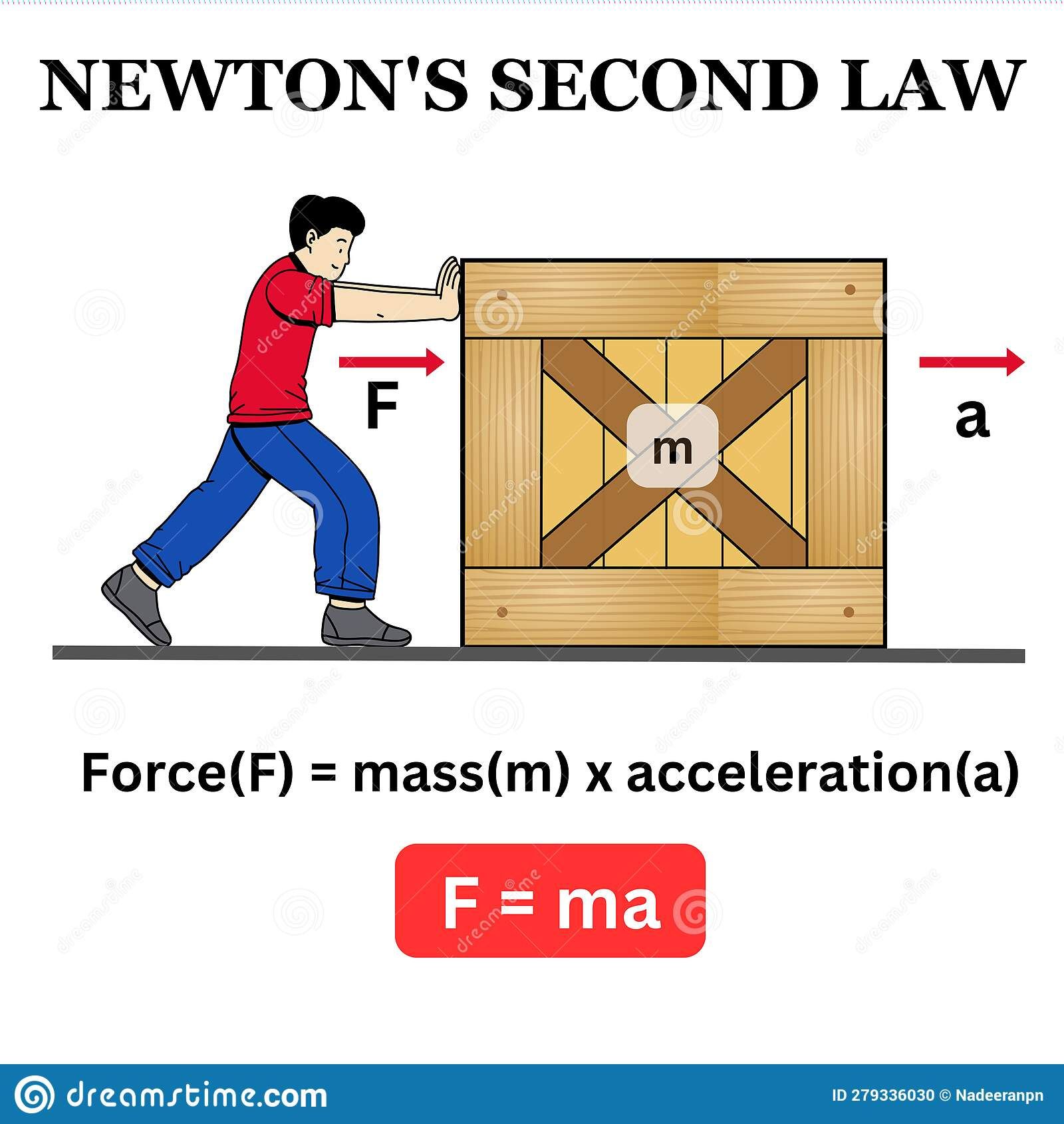
Newton’s Second Law of Motion, encapsulated in the succinct equation F = ma, serves as a cornerstone in the realm of classical mechanics. This fundamental principle postulates that the acceleration of an object is directly proportional to the net force acting upon it and inversely proportional to its mass. In terms that can be easily understood, if you push an object, how fast it moves (acceleration) depends on how hard you push it (force) and how heavy the object is (mass). With this foundational concept, one can explore various real-world applications and examples that vividly illustrate the effects and relevance of this principle.
One striking example of Newton’s Second Law can be observed in the context of sports, particularly in basketball. Consider a player making a shot from beyond the three-point line. When the player exerts force on the basketball, the resulting acceleration of the ball is contingent not only upon the amount of force applied but also its mass. A heavier ball will not travel as quickly as a lighter one when subjected to the same force, demonstrating the equation in action. Thus, players often rely on a suitable ball and tailored techniques to enhance their shooting effectiveness, showcasing the delicate interplay between force, mass, and acceleration.
In the realm of automotive engineering, this principle is further exemplified. When a car accelerates, the engine generates a force that causes the vehicle to speed up. However, the weight of the vehicle plays a pivotal role in determining how quickly it can reach its desired speed. For instance, a compact car, being lighter, will accelerate faster than a large SUV when equal amounts of force are applied. This phenomenon underscores the relevance of Newton’s Second Law in automotive design, where engineers meticulously balance weight and power to optimize performance.
A more dramatic illustration of the second law emerges during a rocket launch. Rockets utilize vast thrust to overcome gravitational pulls. Here, the equation gains profound significance, as engineers must calculate the precise amount of fuel needed to propel the craft into the atmosphere. The force generated by the rocket’s engines must be sufficient not only to lift the vehicle against the gravitational force but also to accelerate it forward into space. The immense mass of the rocket compounds the complexity since the force must multiply dramatically to achieve the desired acceleration. Consequently, these calculations are critical for successful missions, marking an impressive application of Newton’s Second Law.
The dynamics of cycling provides yet another compelling example. As cyclists accelerate their bikes, several factors come into play. The physical exertion applied through the legs generates a force that propels the bicycle forward. However, the mass of both the cyclist and the bicycle impacts how quickly the rider can attain a desired speed. Cyclists often seek to reduce their weight through lightweight gear while simultaneously increasing their strength, demonstrating a practical understanding of Newton’s law. The results are palpable during races, where every ounce and every pedal stroke counts.
In the context of everyday life, even simple tasks reflect the principles embedded in Newton’s Second Law. For example, when pushing a shopping cart, the acceleration is evident. A fully loaded cart, heavier than an empty one, requires significantly more force to achieve the same speed. Shoppers discover this principle firsthand; the more items they load, the more effort is required to navigate the aisles. This mundane task serves as a relatable illustration of how physics governs our daily interactions with the world around us.
Newton’s Second Law also finds its applications in thrilling scenarios, such as in the realm of amusement parks. Roller coasters are meticulously engineered to ensure that thrilling drops and sharp turns are not only exciting but also safe. The acceleration of the coaster cars is influenced heavily by their mass and the forces produced by gravitational pulls. Engineers must consider these factors to create safe yet exhilarating experiences, highlighting the equation’s relevance in entertainment as well.
In contrast, consider the catastrophic failures resulting from a lack of adherence to Newton’s principles. The collapse of structures due to insufficient understanding of forces and weights exemplifies how critical these laws are to engineering narratives. Careless oversight can lead to disastrous consequences, reminding us, with stark clarity, that every action bears consequences dictated by fundamental laws of motion.
Beyond physical manifestations in everyday life, the law also pervades the field of technology and robotics. As robots execute tasks, their movements hinge on calculated forces and expected accelerations. The design of robotic arms, for example, takes into account not just the intended actions but also the forces needed to operate effectively. The intersection of robotics and Newton’s Second Law has led to advancements that widen the scope of automation and functionality.
In conclusion, Newton’s Second Law of Motion is not merely a theoretical concept confined to textbooks; it vividly influences our daily lives, from the simplicity of a shopping cart to the complexities of rocket launches. The omnipresence of this principle in various contexts—from sports to engineering and everyday tasks—highlights its significance within the natural world and humanity’s continual pursuit of knowledge and utilization of physical laws. Understanding and applying these principles allows for innovation and safety across multiple disciplines, showcasing the enduring legacy of Newton’s insights into motion and force.