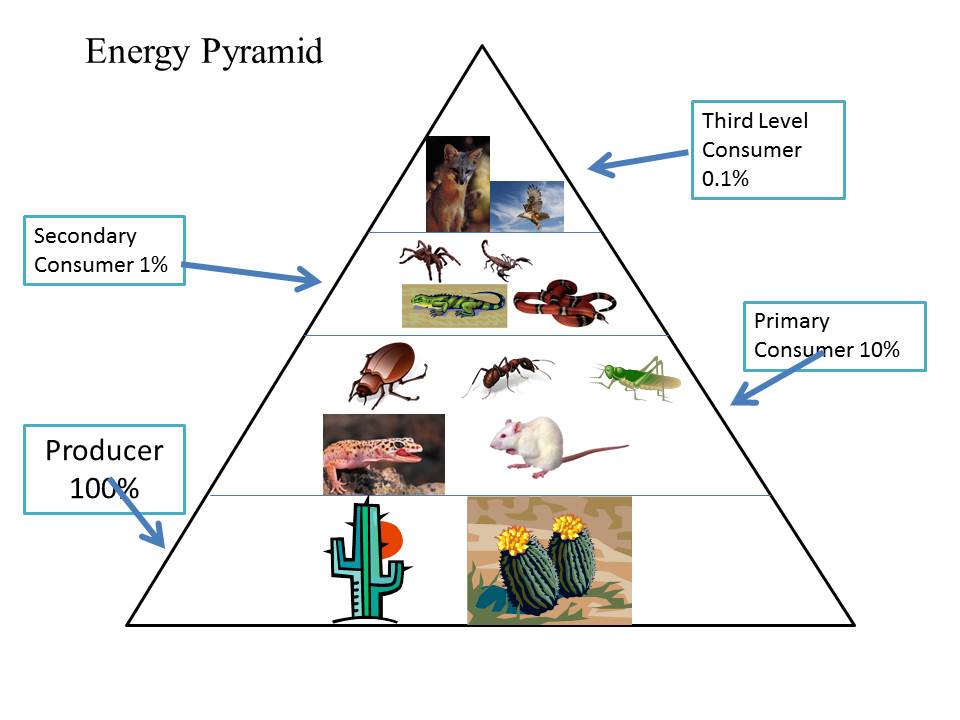
The intricacies of energy transfer within ecosystems reveal a fascinating world of interactions. One remarkable representation of this process is the energy pyramid—a vivid diagram that encapsulates the flow of energy from the sun, through producers, and ultimately to various levels of consumers. Have you ever wondered how much energy actually reaches you from a simple salad or a piece of fruit? This article explores the concept of the energy pyramid and delves into an example that elucidates its significance in the desert biome.
At the foundation of the energy pyramid are producers, primarily plants that harness solar energy through photosynthesis. In desert ecosystems, these producers are often resilient cacti, tough shrubs, and hardy grasses that flourish in extreme conditions. They are not just survivors; they are the vital first step in an incredibly intricate food web. In a world dominated by scarcity, how do these plants effectively capture sunlight? It’s worth pondering that their very existence hinges on the art of adaptation—strategies such as waxy coatings on leaves to minimize water loss, and expanded root systems to absorb moisture efficiently.
As energy flows from the sun to the producers, it is then transferred to herbivores, the primary consumers. In the desert, this might include creatures like the kangaroo rat or various insects that consume plant material. These organisms represent the second tier of the energy pyramid, and their role cannot be underestimated. Imagine a pyramid: at each level, energy diminishes. Thus, while the producers might convert sunlight into a staggering 1000 units of energy, the herbivores may only obtain about 100 units from their plant diet. How does this depletion of energy occur? It involves metabolic processes—growing, moving, and simply staying alive all require energy, and a significant proportion of it is lost as heat.
Continuing up the pyramid, we find the secondary consumers, the carnivores that feast on the herbivores. In our desert context, this could be represented by the talented hunters, such as the desert fox or the rattlesnake. These animals must expend energy to chase down their prey, often leading to further energy loss. Thus, if we follow the energy trail, from producers to herbivores and then to these secondary consumers, we observe an intriguing pattern: only about 10% of the energy from one trophic level is passed on to the next. Isn’t it astounding how this law of energy transfer is consistently observed, regardless of the ecosystem? The energy pyramid vividly illustrates that energy diminishes proportionally at each stage, compelling us to reflect on the efficiency of energy usage in nature.
At the apex of the pyramid are tertiary consumers, the top predators. In arid landscapes, these could be formidable animals like the golden eagle or the mountain lion. These organisms are often fewer in number due to the limited energy available. Their position atop the pyramid represents both power and vulnerability; they rely on the intricate balance of the entire ecosystem below them for their survival. This delicate balance prompts an interesting inquiry: how would the loss of a top predator affect the entire energy pyramid in this dessert ecosystem? The consequences could be dire, leading to overpopulation of herbivores, which in turn would decimate the plant life, disrupting the very foundation of energy flow.
This intricate food web is not just a theoretical construct but a reflection of the energy dynamics that play out each day in nature. When visualized through the lens of an energy pyramid, the complexity of these relationships becomes palpable. Each layer is dependent on the other, and the health of one influences the entire system. The desert biome, with its extreme conditions and remarkable adaptations, provides a striking example of resilience and interdependence.
Moreover, understanding the energy pyramid has broader implications. It serves as a foundational concept in environmental science and ecology, informing conservation efforts and sustainable practices. How can this knowledge help us mitigate the impact of human activities on natural ecosystems? By recognizing that each organism has a specific role, we can better appreciate the balance that sustains life on Earth.
As we consider the significance of the energy pyramid within the desert biome, we are compelled to ask ourselves: what role do we play within this vast network of life? Are we merely consumers, or can we strive to be responsible stewards of our environment? This exploration of energy transfer ultimately challenges us to rethink our relationship with nature, encouraging us to engage in practices that protect and understand the delicate balance upon which our survival depends.
In conclusion, the energy pyramid serves as a striking visualization of energy flow and interdependence among organisms in an ecosystem. From sun to plants, to herbivores and onto the apex predators, the journey of energy encapsulates a narrative of adaptation, loss, and survival. As you ponder over the energy underpinning the food you consume, consider also the implicit challenges and responsibilities that arise from such interconnectedness. The world around us is not merely a collection of independent entities but a complex tapestry of existence that calls for our respect and thoughtful stewardship.