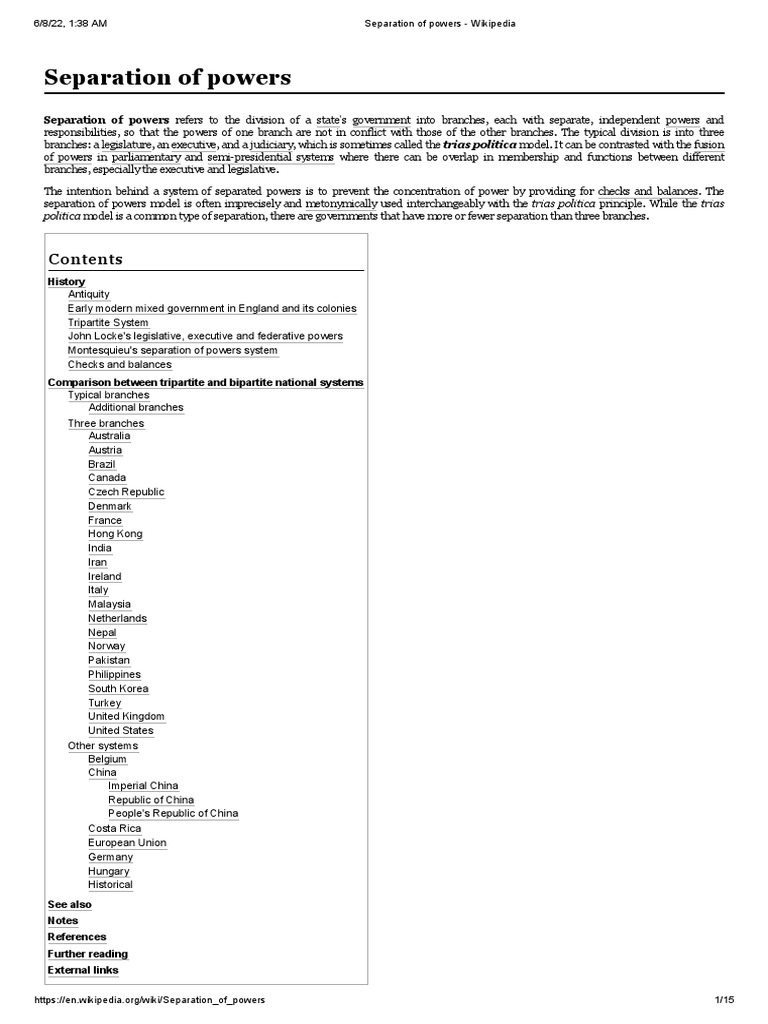
Separation of powers is a significant doctrine in the governance framework of many democracies, predicated on the principle that various branches of government must remain distinct and independent to prevent the concentration of power. This article delves into examples of separation of powers, elucidating how various systems around the globe implement this foundational concept, highlighting the intricacies and benefits associated with this structure.
In essence, separation of powers divides the government into three distinct branches: the executive, the legislative, and the judiciary. Each branch functions independently, thus ensuring a system of checks and balances that helps safeguard against tyranny and maintains the rule of law. Let us explore the examples from specific countries that have adopted this doctrine.
1. The United States: A Foundation of Democracy
The United States provides one of the most quintessential illustrations of separation of powers. The Constitution distinctly demarcates the roles and responsibilities of each branch. The legislative branch, embodied by Congress, is responsible for enacting laws; the executive branch, headed by the President, is tasked with enforcing laws; and the judiciary, comprising the federal court system, interprets laws.
This triadic structure not only engenders efficiency but also curtails the potential for one branch to encroach upon the authority of another. For example, while Congress may draft legislation, the President wields the power to veto it, necessitating a supermajority in both chambers to override such a decision—thereby fostering a collaborative legislative process.
2. France: A Unique Hybrid Model
Contrasting the U.S. model, France exhibits an interesting hybrid of separation of powers within its Fifth Republic. The executive branch is notably powerful, with the President possessing significant authority over the legislative agenda. Nonetheless, the legislative assembly retains potent oversight capabilities.
In France, the separation of powers is also reflected in the judiciary’s independence. The Constitutional Council, which ensures laws comply with the Constitution, operates autonomously from the legislative and executive branches, exemplifying how separation of powers can stabilize governance while allowing for expansive executive prerogative.
3. Australia: Constitutional Mechanisms at Work
Australia’s approach to separation of powers intertwines elements from both British parliamentary traditions and the American constitutional framework. The Australian Constitution establishes a delineation between the three branches, similar to the U.S., but with parliamentary sovereignty at the heart of its governance.
The High Court of Australia plays a pivotal role in upholding the rule of law, often adjudicating matters where the legislative and executive branches might overstep their bounds. This act of judicial review reinforces the concept that no branch is above the law, fundamentally emphasizing the necessity of accountability and transparency.
4. India: A Robust but Pragmatic Structure
India’s separation of powers is established within its constitutional framework, underscoring a robust yet pragmatic approach. The Parliament serves as the legislative branch, the Prime Minister and the Council of Ministers comprise the executive, and the judiciary is spearheaded by the Supreme Court.
The Indian judiciary holds expansive powers of judicial review and can invalidate legislation that contravenes the Constitution. Moreover, the intricacies of the Indian political landscape necessitate coalitions, often requiring collaboration across parties, thereby embodying a functioning democratic ethos where no single entity monopolizes governance.
5. Canada: A Parliamentary Democracy
Canada’s model offers a fascinating case of separation of powers within a parliamentary democracy. The Constitution Act, 1867, delineates the framework whereby the Parliament serves as the legislative arm, while the Governor General functions as the representative of the monarch, thereby underscoring the ceremonial aspects of the executive.
However, the judiciary remains firmly independent, with the Supreme Court of Canada acting as the arbiter of constitutional issues. The court’s influence manifests in landmark rulings that shape the interpretation of laws, highlighting the active role of the judiciary in maintaining the delicate equilibrium among branches of government.
6. Japan: A Post-War Reconstruction
Post-World War II Japan adopted a constitution that exemplifies the principles of separation of powers, instituting a parliamentary system wherein the Prime Minister serves as the head of government, while the Emperor remains a ceremonial figure. The National Diet, comprising both houses, acts as the legislative power, establishing laws and overseeing government activities.
The judiciary, independent and separate, interprets laws from a constitutional perspective, enhancing the role of judicial review to annul legislation that infringes upon individual rights. This delineation promotes a governance model characterized by transparency and accountability.
Conclusion: The Essence of Separation of Powers
The concept of separation of powers is pivotal in upholding democratic principles and ensuring that no single entity can dominate the political landscape unchecked. From the foundational frameworks in the United States to the unique hybrid approaches seen in nations like France and India, the application of this doctrine varies across contexts yet universally serves the purpose of fostering governance that is fair, accountable, and responsive to the citizenry.
In an era where governance faces myriad challenges, the reinforcement of separation of powers stands as a bulwark, ensuring that democratic values are preserved and that the voices of the populace remain paramount within the corridors of power.