
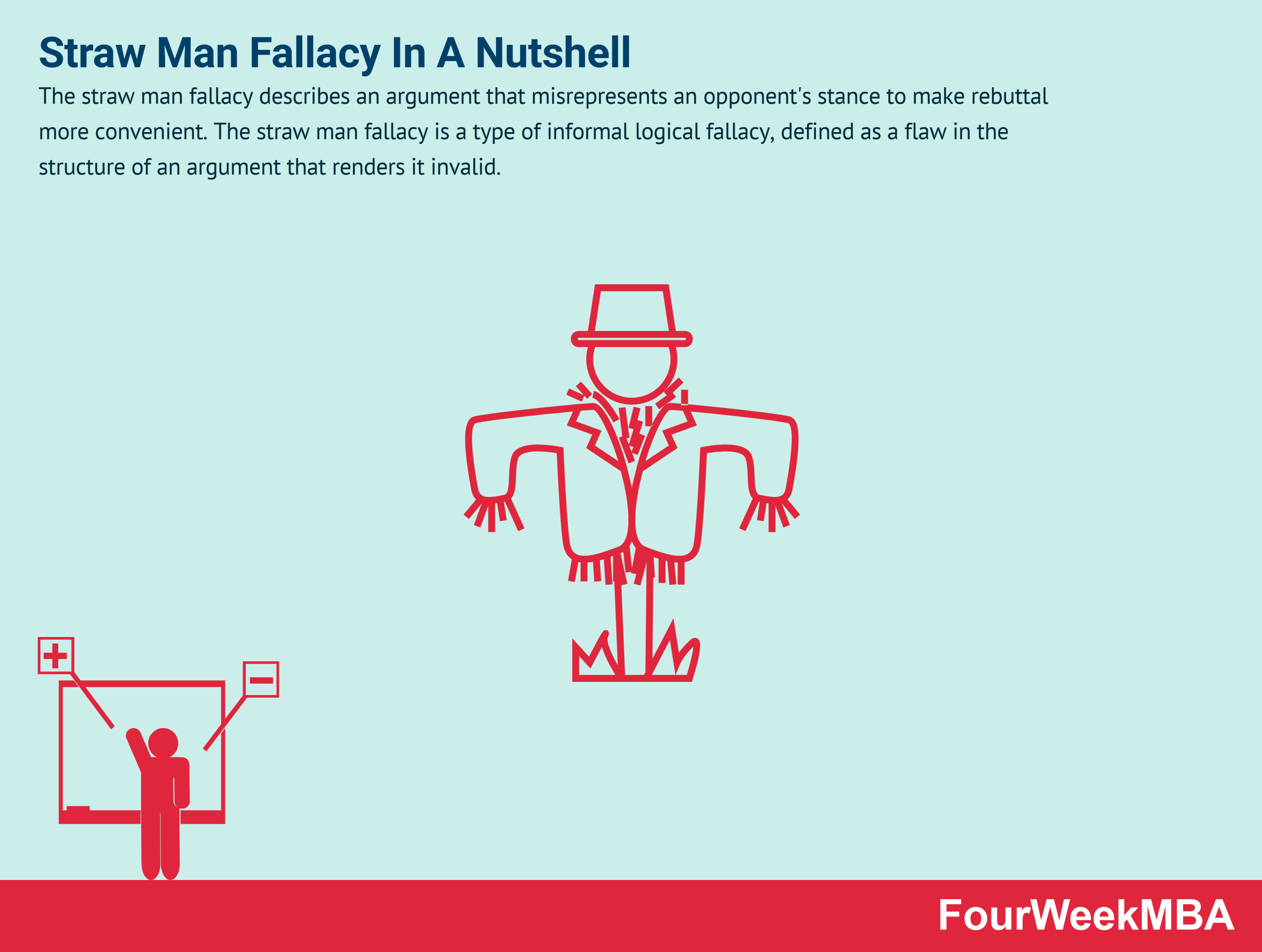
In the vast landscape of logical discourse, the straw person fallacy emerges like a mirage in the desert—a deceptive illusion that distracts from the core of an argument. This fallacy occurs when an individual misrepresents or caricatures an opponent’s viewpoint, thereby constructing a fragile figure made of straw, easily toppled and dismantled. It is an artful misdirection, leading the audience away from the substantive issues at hand. To explore this fascinating fallacy, we will delve into its intricacies, provide vivid examples, and articulate an intriguing metaphor that captures the essence of its operations.
The straw person fallacy primarily succeeds by distorting realities into digestible, simplistic versions of complex ideas. Imagine a skilled magician performing a trick—the audience’s eyes fixed intently on the shimmering cloth, oblivious to the sleight of hand. In a similar vein, the person employing this fallacy artfully diverts attention. Instead of grappling with the actual argument presented, they conjure an easier, often absurd version that can be easily criticized and dismantled.
Consider a political debate where one speaker advocates for comprehensive healthcare reform. Instead of addressing the nuanced arguments related to funding, accessibility, or outcomes associated with such reforms, the opponent might retort, “My opponent wants to turn our healthcare system into a socialist nightmare!” Here, the opponent simplifies and exaggerates the proposal, projecting a hyperbolic version that is easier to attack. This misrepresentation is akin to erecting a scarecrow in the field of debate—a figure designed to scare away substantive engagement.
The psychological appeal of the straw person fallacy lies in its ability to evoke emotional responses, generate polarization, and create a perception of superiority. Individuals rally around the perceived threat posed by the “straw man,” solidifying their own beliefs while dismissing the original argument. This reaction is like a wildfire fanned by a gust of wind; as fear spreads, reason diminishes, leaving behind scorched earth where dialogue once thrived.
Examples of the straw person fallacy are prevalent across various realms—politics, social issues, and personal debates. In an academic discussion surrounding climate change, one might advocate for carbon emissions reduction. Instead of engaging with the rationale behind the approach or presenting counterarguments regarding economic implications, an opponent may assert, “So you’re saying we should ban all cars and live in caves?” This hyperbole misinterprets the original stance, diverting attention from the pressing issue of environmental sustainability to an implausible extreme.
In everyday conversations, the straw person fallacy is a common pitfall. Perhaps during a discussion about healthy eating, one individual mentions the importance of balanced diets. Consequently, the other might retaliate with, “So, you think everyone should only eat lettuce and exclude other delicious foods?” This dismissal diminishes the complexity of the prior statement, reducing a nuanced conversation to absurdity, thus sidestepping a meaningful exchange.
The metaphor of the straw person recalls the image of a paper tiger—fierce in appearance yet devoid of substance. Just as a paper tiger may look intimidating but collapses at the slightest touch, the straw man stands tall until challenged with the genuine argument. Each participant in a conversation must recognize the fragility of the straw figure; to engage effectively, one must avoid the temptation to instantiate watered-down versions of adversarial positions.
To effectively navigate discussions riddled with the straw person fallacy, one must adopt a proactive approach that promotes clarity and mutual understanding. First and foremost, it is crucial to articulate one’s argument with precision. When discussing complex issues, such as immigration policy, one might specify that they support comprehensive reforms grounded in empathy and humanitarianism. By clearly stating beliefs and intentions, one minimizes the likelihood of being misrepresented.
Additionally, it is prudent to actively listen to the counterarguments. Engaging in reflective listening and summarizing the opponent’s position before presenting one’s rebuttal can help mitigate the emergence of straw person fallacies. A well-crafted dialogue essentially weaves a tapestry of understanding rather than a flimsy scarecrow. By genuinely attempting to comprehend the nuances of each other’s viewpoints, participants elevate the conversation above simplistic caricatures.
Furthermore, recognizing the red flags of the straw person fallacy empowers individuals to navigate discussions astutely. Be wary of emotional language that distances rather than connects. If an interlocutor resorts to exaggerated or unrealistic representations of your argument, acknowledge it and prompt them to clarify their understanding. This step invites them into a more constructive dialogue, fostering an environment rich in thoughtful analysis.
Ultimately, the straw person fallacy reveals the vulnerabilities embedded in human communication. While it may be tempting to construct a simplistic version of an argument to exert dominance in a discussion, such tactics rarely yield fruitful results. Instead, they perpetuate division and hinder genuine understanding. The artful dance of dialogue demands vigilance and respect; engaging in authenticity nurtures the fertile ground of discourse, enabling productive exchanges to flourish.
In a world rife with competing narratives, transcending the straw person fallacy becomes essential for fostering meaningful interactions. Embrace the challenge of encountering nuanced perspectives and recognize the multifaceted tapestry of human thought. Only then can we move beyond fearsome façades, embracing the profound complexity of ideas that characterize our collective experience.













