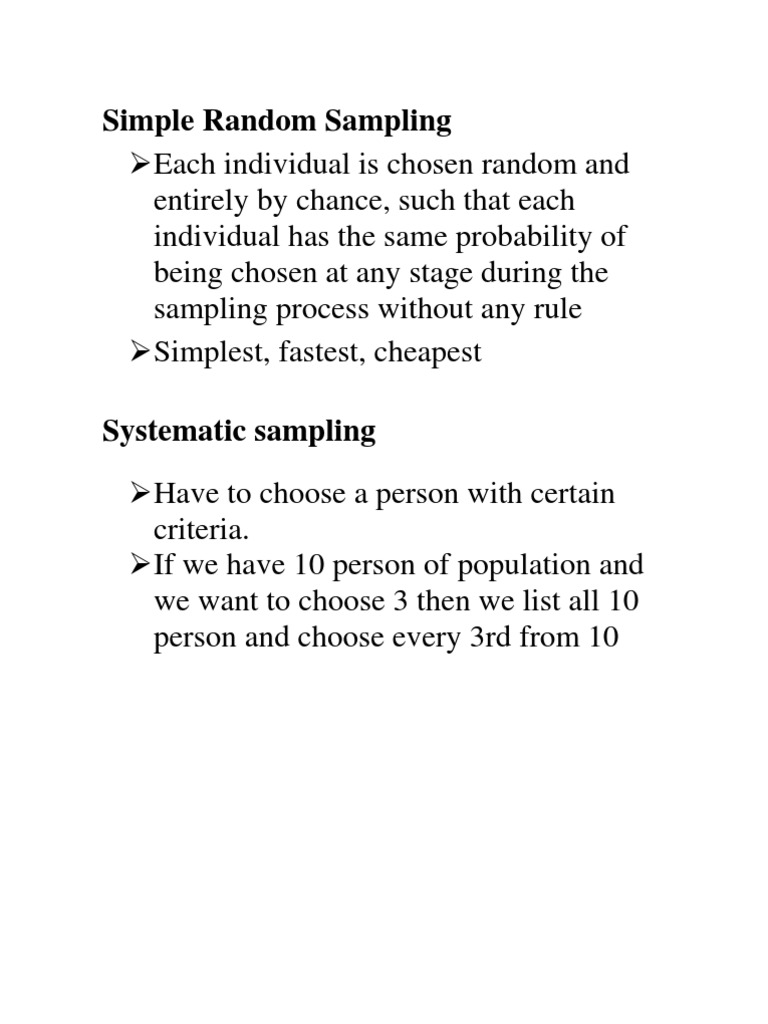
When venturing into the realm of statistical sampling, the concept of systematic random sampling captures the imagination with its blend of simplicity and precision. This technique, a cornerstone of quantitative research, offers an intriguing method that diverges from the conventional random sampling practices. By understanding its operations and implications, one can glean insights into how it influences research outcomes and the delicate tapestry of data collection.
At its essence, systematic random sampling involves selecting subjects from a larger population at fixed intervals. Unlike purely random methods, where each member has an equal chance at selection irrespective of others, systematic sampling utilizes a predetermined list or pattern. This technique introduces an element of order, which can be both advantageous and potentially misleading, depending on the nature of the data being collected.
The Prologue: Scope and Significance
Consider a researcher tasked with evaluating the satisfaction levels of patrons at a sprawling community college. The student body, rich and diverse, makes for a captivating subject of study. Rather than painstakingly sifting through student records to pick names haphazardly, the researcher may employ systematic random sampling to streamline the process.
Imagine this: the researcher has a total enrollment of 5,000 students and is interested in gathering opinions from 500 individuals. To maintain a level of randomness while ensuring coverage across the campus population, a sampling interval is devised. By selecting every tenth student from an initial randomized starting point, the researcher guarantees that opinions span the demographic spectrum, reflective of the entire student body.
Crafting the Method: Step by Step
To elucidate the process, let’s delve deeper into the systematic random sampling framework:
- Defining the Population: As a foundational step, it is crucial to delineate the population from which samples will be drawn. This involves identifying the scope—be it a university, a business, or a geographical area.
- Choosing the Sample Size: The researcher must ascertain how many subjects are required for a robust analysis. Adequate sample sizes enhance statistical reliability, allowing for more accurate inferencing.
- Determining the Sampling Interval: This step entails dividing the total population by the desired sample size. For instance, in a cohort of 5,000 students with a target sample of 500, the sampling interval would be 10.
- Selecting a Random Start Point: Randomness is preserved by selecting a starting point between 1 and the sampling interval (in this case, a random number between 1 and 10). This ensures unbiased initiation of selection.
- Executing the Sampling: From the random start point, every tenth student is chosen until the sample requirement is met.
This systematic approach fosters a decision-making process grounded in mathematical elegance, greatly reducing the potential for bias that can often accompany other sampling methods.
The Paradigm Shift: Advantages and Applications
One might wonder, why is systematic random sampling a favored technique among statisticians and researchers? The allure lies in its myriad advantages:
- Simplicity and Efficiency: The method is straightforward, allowing researchers to execute the sampling without elaborate tools or complex software.
- Structured yet Random: It strikes a balance between systematic order and randomness, assuring comprehensive representation of the population while minimizing the impracticalities of complete randomization.
- Predictable Outcomes: The fixed patterns of selection can yield predictable and consistent results, which are invaluable for longitudinal studies or repeated measures.
- Reduced Costs: Time and resources are conserved, as the orderly process curtails the bouts of randomness that can make statistical surveys cumbersome and laborious.
However, no method is without its pitfalls. Critics highlight a susceptibility to periodicity bias—a scenario where the sampling interval aligns with an underlying pattern in the population, leading to unintentional disproportionate representation. Thus, the success of systematic sampling is intricately tied to the variability of the dataset being examined. When used judiciously, though, its benefits can outweigh the drawbacks.
Extended Applications: From Research to Real-World Implications
The implications of systematic random sampling extend beyond academic research into various domains including marketing, quality control, and public health. For instance, in market research, a company may utilize this approach to gauge consumer satisfaction across different product lines, ensuring diverse demographics are represented in survey respondents.
Similarly, healthcare professionals might deploy systematic sampling in studies aimed at disease prevalence. By systematically selecting patients from hospital records or clinics at fixed intervals, practitioners can reveal patterns that influence public health decisions.
Concluding Thoughts: The Allure of Systematic Sampling
To contrive a rich understanding of systematic random sampling is to appreciate its capacity to reshape research narratives. This method not only promises a shift in perspective regarding how data is collected but also proffers a tantalizing glimpse into the intricate dance between randomness and order. By merging structure with unpredictability, systematic sampling stands at the intersection of scientific inquiry and practical application, inviting researchers to venture forth into a universe of data yet to be fully explored.
In today’s ocean of information, as we seek clarity amidst complexity, systematic random sampling emerges as an essential tool—a beacon illuminating the path toward more informed insights and evidence-based conclusions.