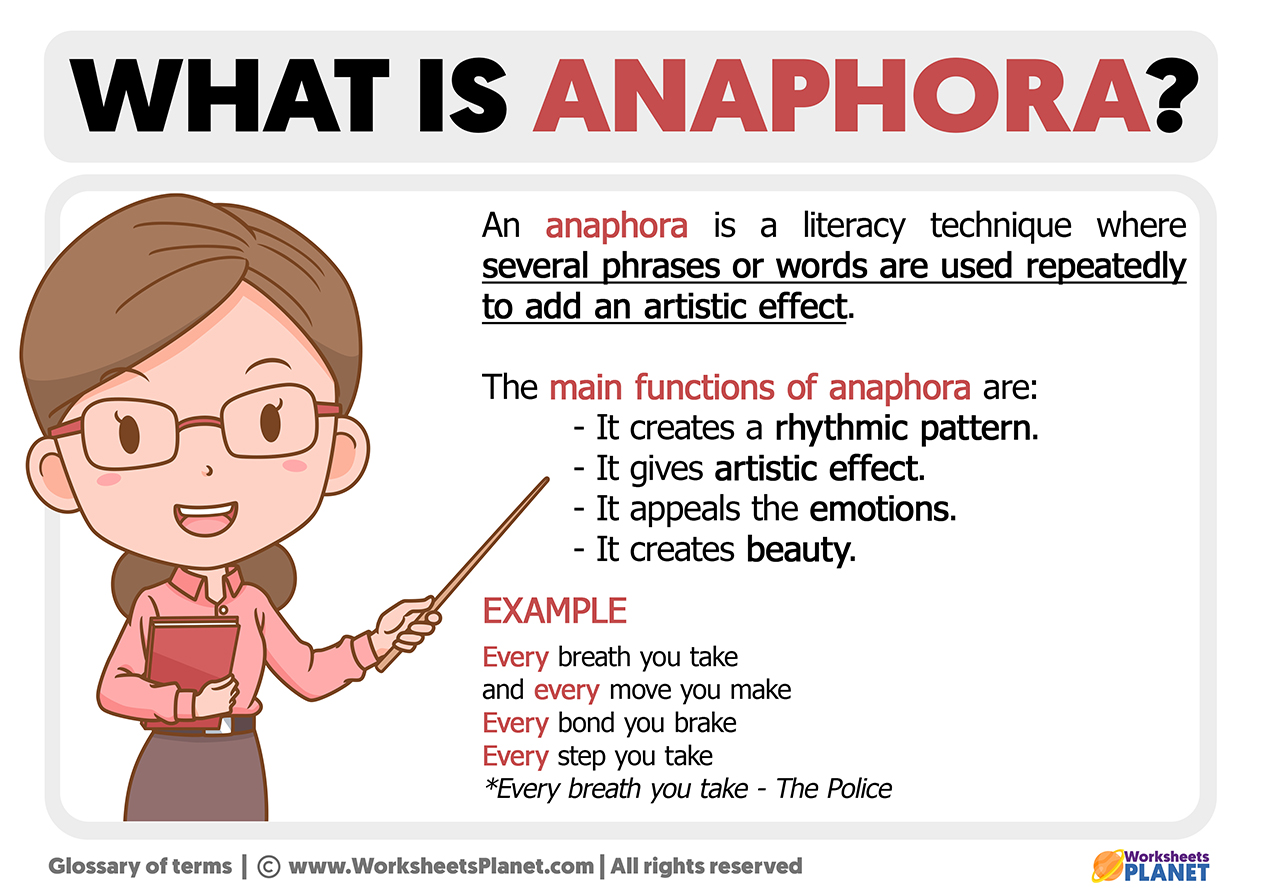
Anaphora is a potent rhetorical device that serves as a cornerstone in the realms of poetry, speeches, and prose. This literary technique, characterized by the deliberate repetition of a word or phrase at the beginning of successive clauses or sentences, creates an emphatic rhythm that resonates with audiences. While its impact is undeniably profound, understanding anaphora requires a nuanced appreciation of its various manifestations and applications.
To delve into the intricacies of anaphora, it is essential to categorize its usage across diverse contexts. The following exploration elucidates how anaphora operates through different lenses: literary works, political speeches, and everyday conversation, revealing its capacity to enhance emotional resonance and thematic coherence.
1. Anaphora in Literature
In the literary domain, anaphora finds its most captivating expressions within poetry. Poets have long wielded this device to create musicality and emphasize key thematic elements. A quintessential example can be observed in the works of Walt Whitman, whose verse frequently incorporates anaphoric structures. His poem “Song of Myself” showcases lines beginning with “I celebrate myself,” a repetition that not only emphasizes individuality but also establishes a lyrical cadence.
Similarly, the iconic poem “Do Not Go Gentle into That Good Night” by Dylan Thomas employs anaphora through the repeated phrase “Rage, rage against the dying of the light.” This repetition heightens the emotional intensity of the poem, reinforcing the struggle against death and the yearning for life. The rhythmic quality achieved through anaphora compels readers to feel the weight of the message while enabling a deeper engagement with the text.
Anaphora also serves to evoke powerful imagery. In Charles Dickens’s “A Tale of Two Cities,” phrases such as “It was the best of times, it was the worst of times” underscore the duality of the human experience. Here, the repetition facilitates a juxtaposition that poignantly highlights the complexities of life, encouraging readers to reflect upon their own dichotomies.
2. Anaphora in Political Rhetoric
Transitioning from the realm of literature to political rhetoric, anaphora emerges as a formidable tool for leaders seeking to inspire and galvanize audiences. Through the strategic repetition of key phrases, speakers craft memorable and impactful messages that resonate long after the oration ends. One notable instance is Martin Luther King Jr.’s “I Have a Dream” speech, where he repeats the phrase “I have a dream.” This anaphoric refrain not only reinforces King’s vision of racial equality but also imbues the speech with a rhythm that captivates listeners, transforming an ideological vision into a poignant call to action.
Additionally, modern political figures employ anaphora to encapsulate their platforms compellingly. For instance, former President Barack Obama frequently utilized the structure in campaign speeches. Phrases like “Yes, we can” created an uplifting refrain that instilled hope and solidarity, allowing communities to envision a collective future imbued with possibility. In these instances, anaphora transcends mere repetition; it becomes a rallying cry, an invitation to unity and progress.
3. Anaphora in Everyday Communication
Beyond literature and politics, anaphora infiltrates our everyday conversations, often without conscious recognition. We harness this rhetorical device instinctively to emphasize points during discussions, reinforcing our messages effectively. For example, consider the phrase “Every day, I strive to be better. Every day, I push my limits. Every day, I learn something new.” Here, the repetition of “Every day” is not just a mere stylistic choice; it underscores the commitment to personal growth, creating a momentum that underscores the speaker’s determination.
This technique is particularly effective in persuasive communication. When trying to convince others of a particular viewpoint, using anaphora can enhance the appeal of one’s argument. A salesperson might say, “Our product is reliable, our product is cost-effective, our product is designed for you.” Each repetition reinforces the brand’s value propositions, making the message more compelling and memorable.
4. The Psychological Impact of Anaphora
One cannot overlook the psychological ramifications of anaphora in communication and literature. The human brain is inherently wired to recognize patterns, and repetition engages cognitive processes that enhance memory and retention. Consequently, when anaphora is employed, listeners or readers generally experience heightened emotional responses, as the repeated phrases embed themselves into awareness.
Moreover, anaphora can also affect the pacing of dialogue or narrative. In faster-paced scenarios, it can create urgency, compelling audiences to act or think quickly. In contrast, a slower, measured use of anaphora can evoke contemplation, permitting audiences to linger upon poignant truths.
5. Conclusion
Ultimately, anaphora is a versatile and powerful rhetorical device that reverberates through literature, political discourse, and everyday conversation. Its ability to establish rhythm, evoke emotional responses, and enhance thematic resonance underscores its significance across various contexts. As we explore the wondrous manifestations of anaphora, we recognize its undeniable influence on communication and its capacity to shape perceptions, forging connections between speakers and listeners, writers and readers, and ultimately, between ideas and emotions.
In understanding anaphora, one gains insight into a broader spectrum of human expression, revealing the profound ways in which language weaves the fabric of our reality.