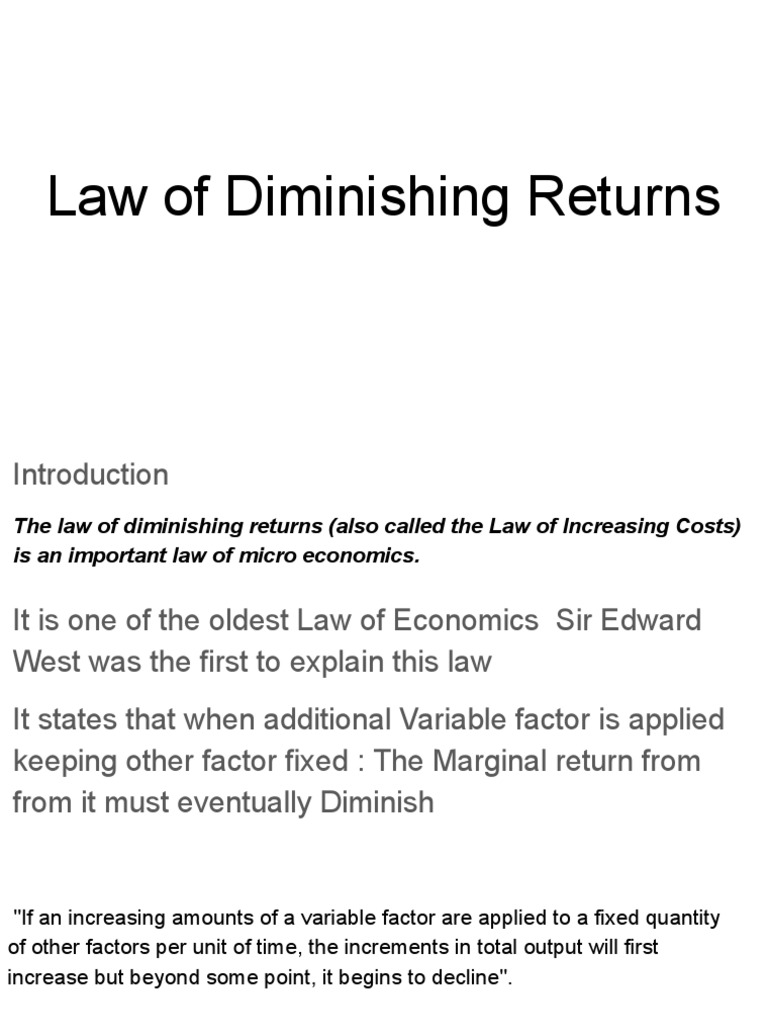
The Law of Diminishing Returns is a concept that resonates deeply within the realm of economics, often serving as a beacon for understanding production efficiency and resource allocation. It illustrates a fundamental truth: as we incrementally increase one factor of production while holding others constant, the additional output we gain from that extra input will eventually decline. In the myriad of scenarios this principle can be applied, one particularly captivating and relatable example is that of a farmer cultivating a plot of land. This scenario can almost be likened to a symphony, where each musician’s contribution produces a harmonious sound, but too many players can lead to chaos instead of melody.
Let us envision a small, fertile farm nestled in the heart of the countryside. Here, the farmer decides to plant an abundant crop of corn. Initially, as our diligent farmer sows seeds, the land thrives; moisture, sunlight, and each seedling burgeon into resplendent green stalks. This is the context of increasing returns—each additional seed planted translates into a higher total yield. The earth seems to flourish with every handful of seeds cast into the soil. The interplay between land, labor, and seed begins exuding a promise of a bountiful harvest. However, as more and more seeds are planted, the immediate beauty begins to fade.
Consider the moment when our farmer decides to plant more corn than his small plot can effectively support. The initial boost in productivity continues to rise with each additional seed, but at an ever-declining rate. As the field becomes saturated, the plants begin to compete for the same limited resources: nutrients in the soil, sunlight, and water. The lush paradise quickly spirals into a struggle for survival. What once flourished with each planted seed now causes the plants to choke one another, leading to a decrease in the overall efficiency of the crop production. In essence, the farmer has reached a tipping point where the addition of seeds, rather than yielding proportionate returns, begins to deplete the vitality of the harvest.
This analogy captures the essence of the Law of Diminishing Returns masterfully. In its simplest form, the law demonstrates that beyond a certain threshold, adding more of one factor—labor, in our case—while keeping others constant will yield less and less additional output. It’s as if the daydream of a corn utopia devolves into a baleful reality where yields do not multiply but rather diminish under the weight of excess.
Transitioning from agricultural fields to the bustling realm of manufacturing, the application of the Law of Diminishing Returns is equally striking. Picture a factory assembly line operating at peak efficiency. Imagine workers diligently piecing together intricate components. As the factory owner hires more workers, productivity initially surges. Each new hire brings fresh vigor and skill, resulting in units produced per hour climbing steadily. However, once a critical mass of employees is reached—where space becomes cramped, and coordination falters—the additional industrial output begins to plateau.
The brain behind this operation soon realizes a disconcerting truth: the addition of more workers generates more chatter and confusion than coordinated manufacturing. The assembly line becomes a cacophony of clashing steps rather than a smooth rhythm of production. Just like the cornfield, the factory highlights that sometimes less is more. Seeking to maximize productivity through unchecked growth leads not to viral success but to an unwieldy nightmare.
As with all principles in economics, the Law of Diminishing Returns is not simply a cautionary tale; it also paves the way for innovative practices and efficiency enhancements. When the burden of excess becomes clear, both farmers and factory owners alike are inspired to reflect on their operational strategies. Such reflection could lead them down the path of diversification, crop rotation, or in a factory context, through optimization techniques such as just-in-time production, where efficiency is paramount.
Beyond its agricultural and industrial allegories, the Law of Diminishing Returns applies poignantly to other dimensions of life. Consider the act of studying for an exam. As a student immerses themselves in their textbooks, each additional hour spent studying leads to a deeper grasp of the material. However, after a certain point, fatigue sets in; the brain, much like the overburdened corn plants, reaches a saturation point—where hours of study yield not knowledge, but confusion. This metaphor resonates well in the educational sector, reinforcing the notion that balance and moderation are key.
In sum, the Law of Diminishing Returns serves as an intriguing lens through which myriad scenarios can be examined, from the pastoral serenity of farmland to the industrious hum of factory life. It illustrates a core principle: that beyond a certain point, excess leads not to abundance but to diminishing results. Whether we are managing crops, orchestrating an assembly line, or studying late into the night, this law beckons us toward the wisdom of moderation. By embracing this perspective, we illuminate the path toward efficiency, sustainability, and balanced living, crafting a world where resources are allocated harmoniously rather than squandered in the fervor of excess.