
The concept of risk permeates every facet of our lives—sometimes subtly yet profoundly impactful. From financial investments to personal relationships and health choices, the inherent dangers can manifest in multifarious forms. This article aims to elucidate the multifaceted nature of risk by providing examples that promise to shift your perspective and spark your curiosity.
First, let’s consider financial risk, a terrain often navigated by investors and corporations alike. Imagine a burgeoning tech startup that decides to venture into the uncharted waters of artificial intelligence. The owners are acutely aware that their investment could yield immense returns, but they also face the stark reality of potential failure. Data suggests that approximately 90% of startups falter in their initial years. These statistics weigh heavily against even the most innovative ideas, highlighting an intricate dance between bravery and caution.
Equally compelling is the example of operational risk, prevalent in industries reliant on seamless processes. For instance, a manufacturing giant invests heavily in state-of-the-art machinery to streamline production. However, an unanticipated monsoon season disrupts supply chains, leading to material shortages and operational stagnation. This scenario illuminates the fragility of systems that often appear robust on paper. The interplay between environmental factors and operational efficacy delineates a stark reality—risk is often an unseen adversary lurking around the corner.
Now, let us pivot to the realm of health risk, where individuals often wrestle with decisions that can impact their well-being. Picture a young athlete, who faces a significant choice: to push through pain and potentially exacerbate an injury or to acknowledge the risk of long-term damage by sitting out. This decision can reverberate through their career trajectory, altering aspirations and physical capabilities. The dichotomy of immediate gratification versus future health serves as a poignant reminder of the complexities intertwined within personal risk assessments.
We can also explore strategic risk, which business leaders frequently confront. When a multinational corporation elects to diversify its portfolio into a volatile emerging market, it embraces both the alluring prospects of expansion and the possibility of severe pitfalls. The gamble is tantalizing; success can lead to a dominant market position, while failure can ensnare the organization in financial woes. Decisions in this dimension are not merely numbers on a spreadsheet—they reverberate through cultures, economies, and deference to ethical considerations.
A particularly interesting illustration arises when we delve into reputational risk. In our hyper-connected world, the slightest misstep can escalate into a public relations crisis. Consider a well-respected brand whose social media blunder elicits a firestorm of backlash. The ramifications of such a scenario are monumental—they could jeopardize consumer trust that took decades to build. Here, the stakes shift from immediate financial loss to long-term damage to brand integrity, urging companies to navigate public perception with vigilant dexterity.
Shifting gears, we arrive at systemic risk, an often-overlooked but crucial facet. This type of risk is not confined to individuals or singular entities. Instead, it acts as an insidious force within broader economic or social systems. The 2008 financial crisis serves as a quintessential example. Faced with a cascade of mortgage defaults, the interdependencies of financial institutions led to a global economic meltdown. The failure of a few entities resulted in widespread devastation, illuminating the interconnected web of risks that bind us in today’s globalized society.
Furthermore, engaging with psychological risk can also yield enlightening perspectives. Consider the decision to confront personal biases or face emotional traumas; it is fraught with discomfort, yet transformative. This introspective journey can lead to profound self-awareness and growth. The risk taken here is not external but remarkably internal, reshaping the individual’s narrative and outlook on life. Oftentimes, the most formidable risks are the ones we take within.
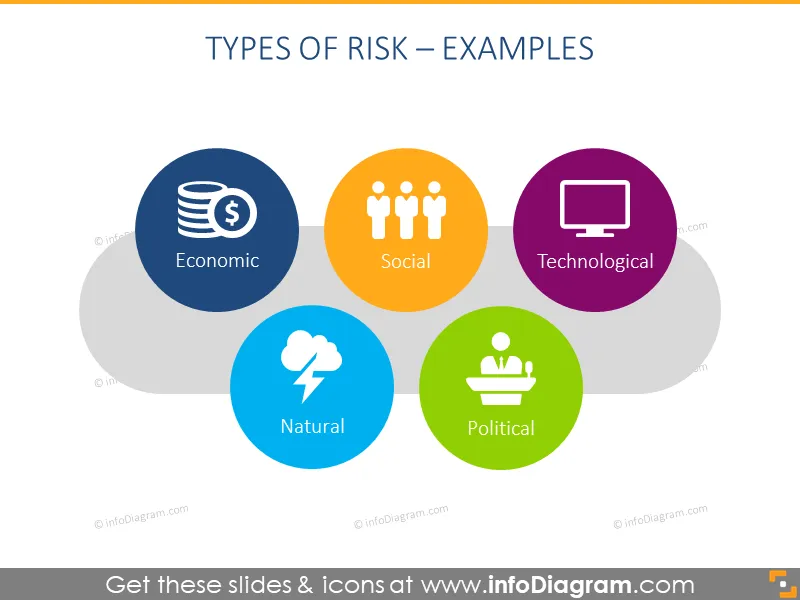
Lastly, let us contemplate technological risk, a contemporary specter that unnerves businesses and individuals in equal measure. A company might adopt cutting-edge software, believing it will double productivity. However, the steep learning curve, downtime, or the risk of data breaches introduces layers of uncertainty. Every technological advancement comes with potential drawbacks, urging both caution and excitement. As society hurtles toward unprecedented digital evolution, the need to balance innovation with prudence becomes paramount.
In conclusion, the myriad forms of risk are not merely impediments but rather compasses guiding our decisions. They challenge us to reassess our strategies, encouraging a nuanced understanding of potential gains versus losses. The dance with risk is inevitable; whether one engages lightly or dives deep, the lessons learned often lead to transformative outcomes. As we dissect these examples, one thing remains clear: embracing risk is not a journey into chaos but a pathway toward resilience, growth, and ultimately, empowerment. Welcome the risks, examine them closely, and discover the unique narratives they weave in your life.













