
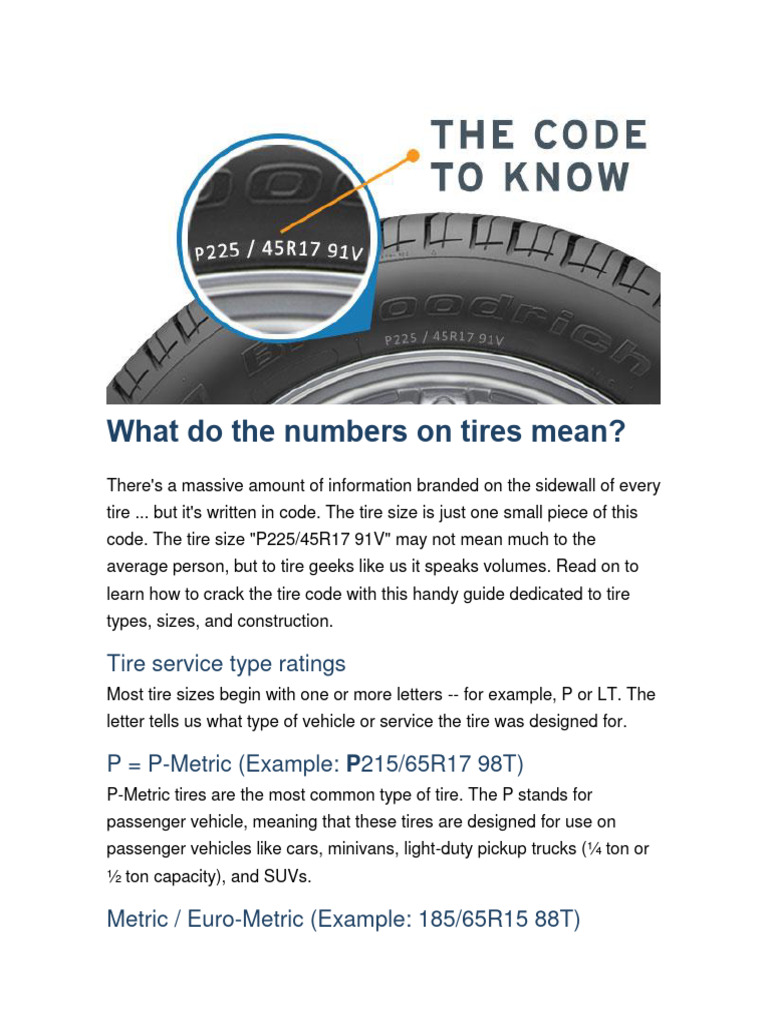
If you’ve ever glanced at your vehicle’s tires and felt bewildered by the assortment of numbers and letters imprinted on their sidewalls, you’re not alone. This alphanumeric code details essential information about your tires, including size, capabilities, and construction, ultimately helping you make informed decisions on safety and performance. By unlocking this code, you’ll not only gain insight into your tires but also empower yourself to maintain and choose the right ones for your vehicle.
Let’s embark on an intriguing journey to decode tire markings that reveal what lies beneath the surface. By the end, you’ll view tires through a knowledgeable lens, ensuring that each drive is safe and efficient.
1. Understanding Tire Specifications
The tire marking typically begins with a series of letters and numbers that indicate its size. For instance, a tire marked P225/65R17 contains vital data.
The first letter, in this case, P, stands for “Passenger” tire. This is common for standard vehicles, while other letters might indicate different uses, such as T for temporary spare or D for dual-purpose tires used on trucks. This classification gives you an immediate glimpse into the tire’s intended function.
2. Decoding the Numerals
Following the letter designation, we see a series of numbers. The first number, 225, denotes the tire’s width in millimeters. A wider tire can offer better traction but may impact fuel efficiency. Understanding this number allows drivers with particular driving needs to make informed choices.
The second numeral, 65, represents the aspect ratio—the height of the tire’s sidewall as a percentage of its width. In this context, a 65 aspect ratio indicates that the sidewall height is 65% of the tire’s width. A lower aspect ratio generally means better handling and performance, but inherent sacrifices may occur regarding ride comfort.
3. The Letter “R”: Tire Construction
The letter R signifies that the tire is of radial construction. Radial tires are the most common type today, providing superior handling and better tread wear than their bias-ply counterparts. This construction allows for increased flexibility and improved fuel efficiency, while also minimizing heat build-up during operation.
4. Rims and Load Index
The final number in our tire example, 17, references the diameter of the wheel rim in inches that the tire is designed to fit. Choosing a tire that corresponds with your vehicle’s rim size is paramount for safety and performance.
Additionally, businesses or manufacturers often include a load index next to the size marking. This numerical code correlates to the maximum load under which a tire can operate safely. For instance, a load index of 95 translates to a capacity of approximately 1,521 pounds per tire. Understanding this aspect ensures that you don’t overload your tire, safeguarding both performance and passenger safety.
5. Speed Rating: Unraveling Performance Potential
Next, the tire marking may include a speed rating, typically a letter following the tire size, such as S, T, or H. Each letter represents a different maximum speed capability, with S indicating a speed of up to 112 mph, while H signifies a commendable 130 mph. This rating is crucial for performance-oriented drivers or those who frequent highways, as it guarantees the tire’s reliability at higher velocities.
6. The DOT Code: History in Numbers
Among the intriguing elements on a tire’s sidewall lies the DOT code, identifying where and when the tire was manufactured. This code is unique and consists of numbers and letters, providing the manufacturer details and the plant of origin. Importantly, a four-digit number at the end signifies the week and year of production. For example, a DOT code concluding with “2319” reveals that the tire was produced in the 23rd week of 2019. Checking this code can help you discern the age of your tires, which is critical for safety, as rubber compounds degrade over time.
7. Treadwear Indicators and Pressure Recommendations
Amidst your newfound knowledge, keep an eye out for treadwear indicators that may be subtly imprinted on the tire. Also known as wear bars, these indicators become visible as the tire wears down. When they become flush with the tire’s surface, it’s time to consider replacement. Monitoring tire tread is vital for ensuring optimum traction and safety.
Additionally, accompanied by tire specifications, manufacturers typically offer recommended tire pressures. Maintaining the accurate inflation level enhances fuel efficiency, prolongs tire lifespan, and guarantees maximal handling capabilities. Tire pressure can fluctuate based on weather conditions, so regular checks maintain optimal performance.
8. Conclusion: A Mastery of Knowledge
By decoding the cryptic language on your vehicle’s tires, you’ve transformed a mundane chore into an empowering opportunity for knowledge. Familiarizing yourself with this information not only enhances your understanding of tire functionality but also nurtures your vehicle’s longevity. Next time you look at your tires, you won’t see a jumbled assortment of letters and numbers but rather a symphony of specifications guiding you towards safer, more efficient journeys. Embrace this newfound expertise and take pride in your ability to navigate the complexities of tire maintenance with confidence.












