
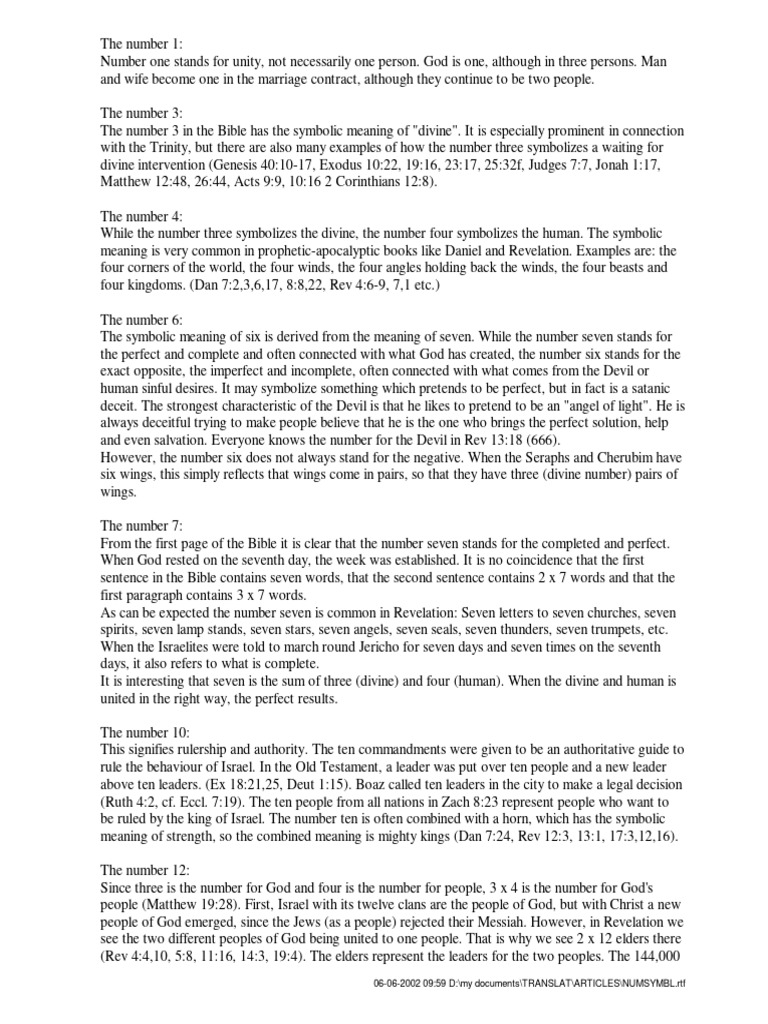
The number ten holds a distinguished place in Biblical scripture, symbolizing completeness, divine order, and the fullness of God’s authority. Its multifaceted representations permeate both the Old and New Testaments, imparting a wealth of understanding to scholars and lay readers alike. This exploration delves into the profound implications of the number ten within biblical contexts, unearthing its historical roots and spiritual significance.
To begin with, one must look at the foundational documents of faith: the Ten Commandments. Presented in Exodus 20, these divine edicts signify not merely moral directives, but also an encompassing covenant between God and His people. The fact that there are ten commandments encapsulates God’s complete ideal for ethical living, serving as a perennial guide for righteousness. Each commandment holds immense significance, covering essential aspects of life, from the prohibition against idolatry to the preservation of familial integrity. This comprehensive framework illustrates how the number ten embodies a divine order, laying the groundwork for moral principles that endure through time.
Moreover, the entirety of the ten commandments conveys a divine completeness meant to foster a sanctified way of life. Notably, the vertical relationship of the first four commandments focuses on our duty towards God, while the remaining six dictate our responsibilities to fellow humans. The symmetry arising from these two sets of five demonstrates how ten captures the duality of human relationships, reflecting both piety and ethical duty in one sacred number.
In addition to its implications in moral law, the number ten recurs throughout scripture, shaping narratives and reinforcing its archetypal representation of completeness. An exemplary instance is found in the historical account of the ten plagues of Egypt. Each plague embodies a decisive strike against the false gods of Egyptian mythology, affirming the singular authority of Yahweh. The culmination of these plagues vividly illustrates not just physical destruction, but spiritual enlightenment, elucidating God’s sovereign will over nations and individuals. Here, ten emerges as a potent symbol of God’s all-encompassing power and His ultimate desire for humanity’s liberation from bondage.
Transitioning from the Old Testament to the New Testament reveals further manifestations of the number ten within Jesus’ teachings and parables. The parable of the ten virgins, located in Matthew 25:1-13, powerfully illustrates preparedness and vigilance. The wise virgins, who brought enough oil for their lamps, represent readiness for the bridegroom’s arrival—symbolic of Christ’s return. Here, the ten virgins encompass the duality of human nature, where readiness and foolishness coexist, further illuminating the necessity for spiritual alertness.
The significance of ten extends beyond direct references, weaving itself through the very structure of biblical texts. For example, the Gospel of John has ten “I Am” statements that illuminate Christ’s identity and mission. “I am the bread of life,” “I am the light of the world,” each declaration embodies a facet of divine completeness, portraying the fullness of Christ as the savior. This literary structure accentuates how the number ten signifies a comprehensive expression of spiritual truths, reflecting the totality of Jesus’ redemptive purpose.
Interestingly, numerology in the Bible shows that ten connects back to earlier numbers, particularly to three and seven, which themselves proffer completeness and perfection. Ten can be seen as a culmination of divine intervention, a continuation of God’s design in creation—ten fingers and toes on humankind symbolize the perfect creation, reflecting divine craftsmanship. Each of these interpretations reinforces the idea that ten is a divine number, emphasizing God’s omnipotence and the orderly nature of creation.
Furthermore, the concept of ten can also be explored through the lens of faith and stewardship, addressed in various parables that define the Kingdom of Heaven. The faith of ten men, or the lack thereof, can lead to profound effects in the spiritual realm, challenging us to contemplate how we steward our gifts and opportunities. For instance, when considering the teachings surrounding the ten talents in Matthew 25:14-30, one sees a parable replete with instruction about responsible management of divine endowments. The call to increase what has been given reflects God’s desires for growth and prosperity, aligning directly with the completeness associated with the number ten.
In a broader theological context, ten presents as a reflection of divine order that resonates through the church’s history and eschatology. The Book of Revelation presents multiple references to groups of ten, notably alluding to the ten crowns worn by the beast (Revelation 13:1), symbolizing earthly authority that stands in opposition to the sovereignty of God. This imagery can be interpreted as not only a physical reality but a spiritual battle that encapsulates the struggle against completeness in God versus the chaos of worldly governance.
As one delves into the realm of biblical symbology, it becomes patently clear that the number ten encompasses both practical and esoteric meanings, broadcast across different narratives and teachings of scripture. Through the Ten Commandments, parables, and historical accounts, it bears a profound sense of completeness, justice, and readiness for God’s divine will. The imprint of this number serves to remind devotees of the necessary equanimity between faith and action, duty and privilege, encompassing the fullness of the divine relationship between humanity and the Creator.
In conclusion, the number ten is not merely a numerical value within scripture but a multifaceted symbol that encapsulates the essence of divine completeness. By understanding its dimensional meanings, one gains deeper insight into the interplay of faith, morality, and human connection, marking ten as a significant figure in the continuum of biblical symbolism.












