
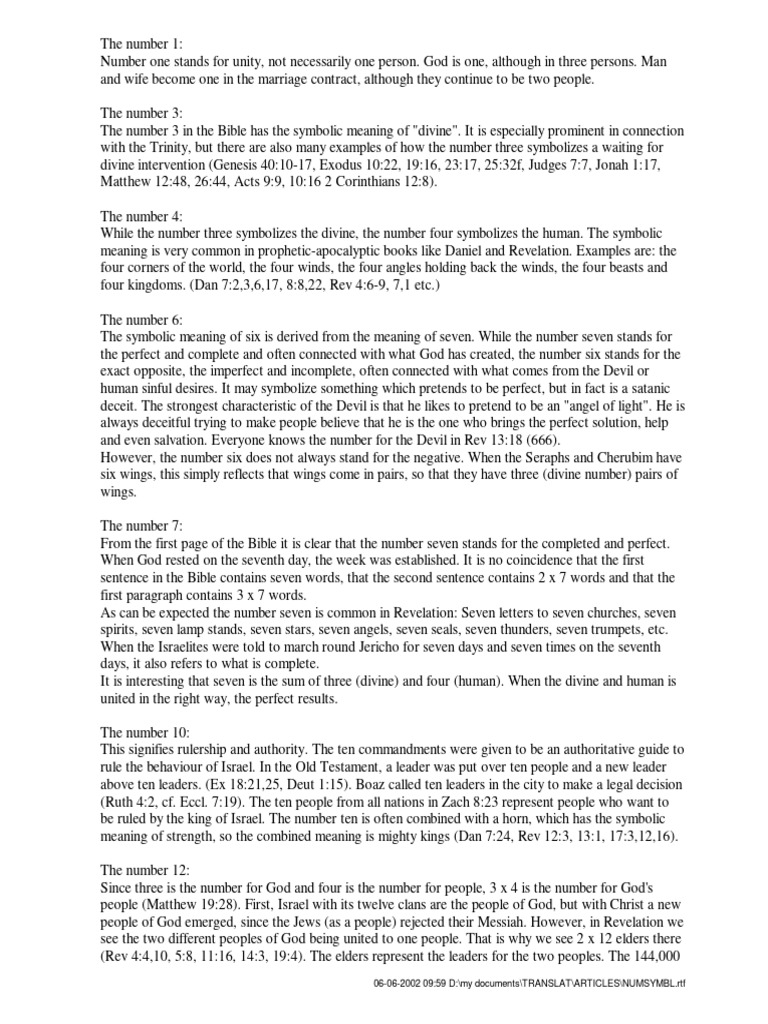
The number four holds a significant position in biblical texts, frequently embodying meanings that resonate deeply within the spiritual and cultural contexts of Christianity. Understanding the symbolism behind this numeral is essential for those seeking to delve into scriptural interpretations and the vast tapestry of biblical numerology. Here, we will explore the multifaceted implications of the number four, enriched with examples, themes, and theological insights from the Holy Scriptures.
To begin with, it is pivotal to understand the foundational aspects that surround the number four. In many instances, the number reflects completeness and universality—concepts that pervade various aspects of divine creation and God’s promises to humanity. Notably, the four cardinal directions—north, south, east, and west—serve as a metaphorical representation of God’s dominion over the entirety of the earth.
Moreover, throughout the biblical narrative, the number four appears repeatedly, symbolizing the physical universe. We observe it in various forms, such as the four corners of the earth. This imagery underscores the idea that God’s reach extends across the entire globe, encompassing all nations and peoples.
One of the most striking instances of the number four is found in the creation account in the Book of Genesis. In Genesis 1, the creation narrative unfolds over six days, culminating in the restful sanctity of the seventh day. However, the four elements emerge in the context of the divine ordering of creation: light, sky, land, and living creatures. Each of these elements signifies a different facet of existence that God meticulously crafted, pointing to a harmonious balance within His creation.
As we navigate further through the Scriptures, we encounter the four major prophetic books—Isaiah, Jeremiah, Ezekiel, and Daniel. Each of these prophets played a vital role in revealing God’s messages to His people, highlighting the continuity and constancy of His plans through the ages. This enumeration reinforces the concept of moving beyond singularity into a collective revelation of divine truth.
Additionally, the New Testament presents the four Gospels: Matthew, Mark, Luke, and John. These texts offer distinct perspectives on the life and teachings of Jesus Christ, yet collectively portray the principle of salvation, emphasizing both the diversity of experience and the unity of the gospel message. Each Gospel serves a specific audience and purpose, yet fundamentally converges on the portrayal of Christ as the Savior.
Delving deeper, the Book of Revelation introduces the four living creatures, each representing a facet of creation: a lion, an ox, a man, and an eagle. These creatures symbolize the completeness of God’s creation and His sovereignty over all life forms. Their presence around the throne underscores the majesty of God, manifesting the reverence and awe that the heavenly realm holds for the Creator.
Another significant biblical occurrence of the number four can be seen in the thematic representation of four winds, which often signify divine judgment or the outpouring of God’s spirit throughout the lands. In Revelation 7:1, the four winds are held back, signifying a pause in divine judgment and highlighting the sovereignty of God in controlling the forces of nature.
Transitioning from the tangible representations to a more metaphorical interpretation, the number four also denotes a manifestation of God’s covenantal nature. The four covenants established between God and humanity—the Noahic, Abrahamic, Mosaic, and Davidic covenants—illustrate the unfolding narrative of God’s commitment to His creation. Each of these covenants encapsulates the essence of divine promise, revealing God’s fidelity through the ages.
Furthermore, the number four can be associated with the life journey of an individual, representing the four stages of life: birth, adolescence, adulthood, and old age. This metaphor reflects the biblical tenet of growth and transformation under God’s providential guidance. It underscores the importance of faith and reliance on divine wisdom through every phase of existence.
Ultimately, the number four in the Bible encapsulates notions of completeness, all-encompassing order, and divine covenant. It beckons believers to reflect on the interconnectedness of God’s creation and the intricate tapestry woven through the pages of Scripture. As we engage with these themes, we are reminded of our place within this divine narrative and the responsibility bestowed upon us to live out God’s will.
In conclusion, the exploration of the number four serves as a gateway for profound theological reflection. It invites readers to deepen their understanding of the Scriptures and fosters a meaningful engagement with the divine mysteries depicted throughout the biblical narrative. As one contemplates the significance of this number, it becomes apparent that God’s plans are meticulously ordered, encompassing all aspects of life and existence, urging humanity to align with His purpose and voice in every season of life.












