
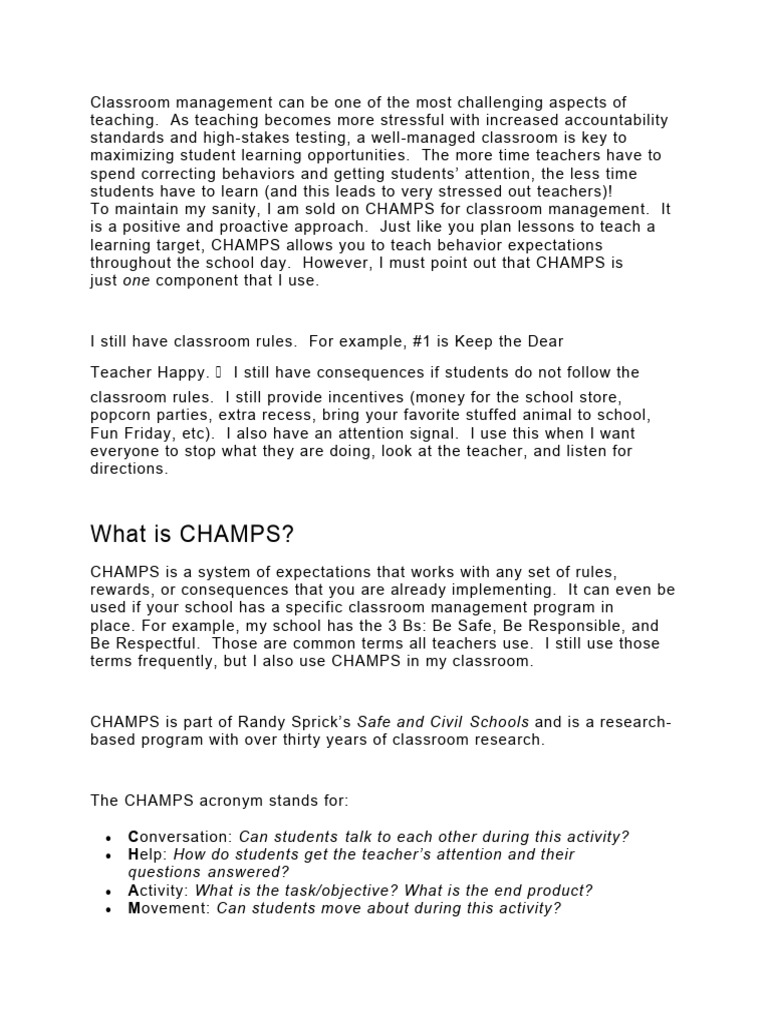
In the constellation of educational methodologies, CHAMPS beams brightly, illuminating the path for effective classroom management and student engagement. CHAMPS is an acronym that stands for Conversation, Help, Activity, Movement, Participation, and Success. This framework serves as a compass for educators seeking to navigate the often turbulent waters of a diverse classroom. Each element of CHAMPS plays a pivotal role, contributing to an environment where students can thrive academically and socially. Understanding the nuances of this approach elucidates its importance in modern education.
Conversation: Fostering Dialogue
Conversation is the bedrock of learning. In the context of CHAMPS, this element emphasizes the significance of structured dialogue between students and educators, as well as peer interactions. Effective communication creates a tapestry of ideas, fostering a sense of belonging and community. When students engage in conversations, they feel empowered to articulate their thoughts and opinions, thus reinforcing their confidence.
Moreover, fostering a culture of dialogue entails setting specific expectations. Educators often establish norms regarding when and how conversations should occur, creating a respectful space for discourse. This ensures that every student’s voice is heard, paving the way for collaborative learning where ideas can intermingle like threads in a vibrant quilt.
Help: The Lifeline of Learning
Next in the CHAMPS sequence is Help. This element underscores the importance of support structures available to students. It encourages them to seek assistance whenever they encounter obstacles, fostering resilience and resourcefulness. An environment that endorses the necessity of help cultivates independence, as students learn to navigate challenges with both guidance and self-agency.
In this way, Help serves as a safety net rather than a crutch. Educators can implement strategies such as “Ask 3 Before Me,” allowing students to utilize peer facilitation before turning to the teacher. This approach not only empowers students to assist one another but also promotes a collaborative learning atmosphere, akin to a family working collectively towards shared goals.
Activity: The Heartbeat of Engagement
Activity stands as the heartbeat of the CHAMPS framework, injecting vitality into the learning process. This component highlights the importance of engaging lessons that captivate students’ attention and stimulate their curiosity. When activities are purposeful and dynamic, they serve as catalysts for deeper learning, encouraging students to connect with the material on multiple levels.
Teachers often employ a variety of pedagogical strategies, ranging from hands-on experiments to group discussions, making the learning experience more immersive. In this respect, activity is akin to a dance, where students move gracefully between concepts and skills, fostering an array of competencies. The rhythm of engagement propels students forward, turning learning into a joyful pursuit rather than a mere obligation.
Movement: Breaking the Chains of Stagnation
Movement, a critical aspect of CHAMPS, recognizes the physiological and psychological benefits of physical activity in the learning environment. Research shows that when students are encouraged to move—be it through brain breaks, cooperative learning activities, or even spontaneous stretching sessions—they are more alert and attentive. Movement rejuvenates the body and mind, dispelling sluggishness and enhancing cognitive function.
Incorporating movement into the classroom fosters an exhilarating dynamic that ignites creativity and engagement. Teachers can orchestrate transitions that allow students to shift spaces, ensuring that the classroom remains a lively arena for exploration. Just as a river flows, unconfined and dynamic, student learning can be similarly fluid and responsive to change.
Participation: The Quilt of Involvement
Participation weaves together the intricate threads of active involvement and student engagement, demonstrating that learning is a communal endeavor. When students participate, they invest themselves in the learning process, forming connections with their peers and the material. Educators can create opportunities for participation through varied instructional methods such as group projects, discussions, and interactive technologies.
This aspect of CHAMPS invites educators to tap into the interests and strengths of their students, allowing everyone to contribute their unique perspectives. When each student feels valued, the classroom transforms into a collaborative quilt, each patch contributing to a grander pattern of knowledge. The resulting harmony creates a vivid tapestry of collective achievement, reinforcing the notion that collaboration amplifies understanding.
Success: The Culmination of Effort
Finally, Success serves as the ultimate destination of the CHAMPS journey, representing the culmination of effort and achievement within the classroom. By establishing clear criteria for success in each activity, educators guide students toward their goals. This element encourages students to measure their progress, fostering a mindset that prizes perseverance and growth.
Success can manifest in myriad forms—through academic performance, social skills, or personal development. When students recognize their achievements, no matter how small, they become motivated to strive for further excellence. Like a blooming flower, each student’s success adds to the vibrant landscape of the classroom, fostering an environment where growth flourishes.
Conclusion: A Harmonious Framework
The CHAMPS framework epitomizes a holistic approach to classroom management, seamlessly integrating essential elements that nurture academic and social growth. Each component—Conversation, Help, Activity, Movement, Participation, and Success—contributes to an environment where students feel empowered, engaged, and encouraged to soar to new heights. By fostering a culture of collaboration, support, and structured engagement, educators cultivate not just learners but lifelong enthusiasts who approach challenges with zeal and creativity. In the educational narrative, CHAMPS is not merely an acronym; it is a symphony of pedagogical practices that harmoniously orchestrates the melody of learning and development.












