
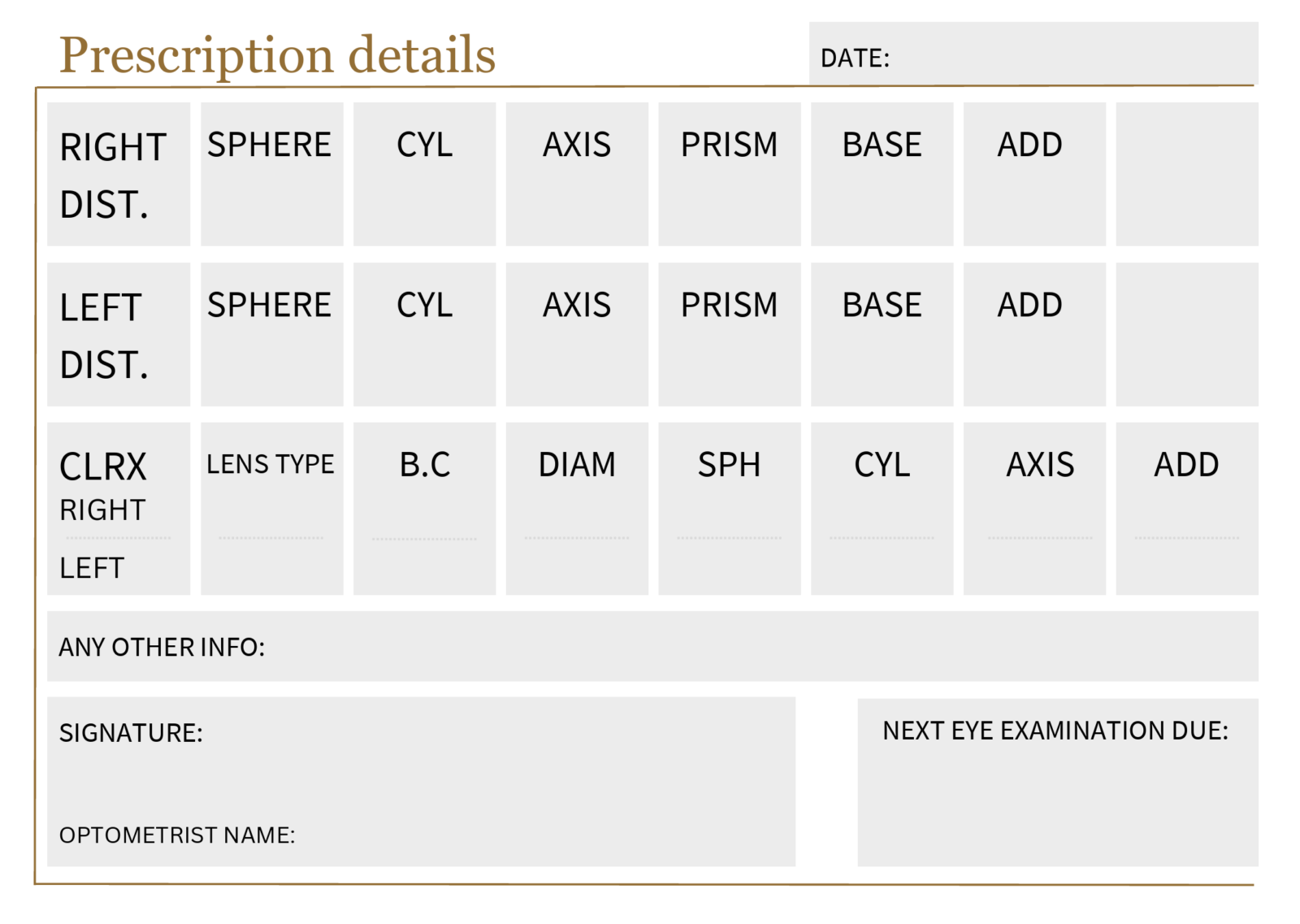
Understanding your eye prescription can often feel like decoding a foreign language. One term that frequently arises during discussions about eye care is “D.S.” or “Diopters Sphere.” This abbreviation encapsulates crucial information regarding an individual’s refractive error, which is not only relevant but also essential for achieving visual acuity. The complexities of eye prescriptions can be captivating, given that they hold the key to clearer vision for millions worldwide. But what exactly does “D.S.” signify, and why is it so significant?
1. The Fundamentals of Vision: A Brief Overview
To fully grasp the meaning of D.S. on an eye prescription, it’s imperative to understand the fundamentals of vision itself. The human eye operates akin to a camera, where light rays must be properly focused on the retina for optimal clarity. However, various imperfections in the eye’s structure or the cornea’s curvature can result in refractive errors such as myopia (nearsightedness), hyperopia (farsightedness), and astigmatism.
Each of these conditions can be precisely measured, allowing optometrists to prescribe corrective lenses tailored to individual needs.
2. The Meaning of D.S. in an Eye Prescription
D.S. stands for “Diopters Sphere,” which encapsulates the spherical measurement of a lens needed to correct vision. It encompasses positive and negative values:
- Positive Values: Indicate hyperopia, where distant objects appear clearer than those nearby.
- Negative Values: Indicate myopia, where nearby objects are distinct while those at a distance appear blurred.
By knowing the D.S. value, individuals can comprehend not just their corrective needs, but also the nature of their vision impairment. This information is essential in selecting appropriate lenses or contact lenses.
3. The Nuances of D.S. Measurement
Diopters measure the lens’s refractive power, where one diopter denotes the lens’s ability to converge or diverge light rays. The value reflects the degree of prescription required, with most prescriptions ranging typically from -8.00 D to +4.00 D. To visualize this, consider how the human eye’s natural focusing ability diminishes with age or due to other factors, compelling the need for corrective lenses to restore clarity.
Furthermore, each increment or decrement of a diopter significantly alters the light bending capacity of the lens, thereby impacting how the eye perceives the world. The peculiar nature of D.S. measurement and its relationship with vision quality provides a glimpse into the fascinating world of optical science.
4. Addressing Common Misconceptions
There are a plethora of misconceptions regarding D.S. and eye prescriptions in general. One common belief circulating is that higher D.S. values directly correlate with poorer vision. Although it’s a logical assumption, it doesn’t represent the entire spectrum of ocular health.
Another myth involves the idea that wearing glasses can worsen one’s eyesight. In reality, eyeglasses correct the existing refractive error without causing further degradation in vision. It is crucial to approach these narratives with a discerning eye, for understanding the science behind such terminology instills confidence in one’s corrective choices.
5. The Role of Optometrists in Interpreting D.S.
Optometrists play a pivotal role in interpreting eye prescriptions and ensuring that each patient’s vision requirements are met. During an eye examination, they conduct various tests to determine the refractive error and the necessary D.S. value.
This professional insight into one’s vision enables individuals to embark upon the journey toward clearer sight. Regular ocular evaluations ensure that adjustments can be made as needed, reinforcing the notion that vision care is an ongoing process rather than a one-time event.
6. The Fascination with Visual Clarity
The allure of achieving perfect vision extends beyond mere perception; it embodies the innate human desire for clarity and understanding. Individuals often find inordinate fascination with the intricacies of their eye prescriptions, spurred by the quest for better quality of life.
Consider the moment one receives their first pair of corrective lenses – the world sharpens into focus, colors become distinct, and details emerge where once there was only blur. Such experiences underline a fundamental truth: vision influences not just how we see but also how we engage with the world around us.
7. Beyond D.S.: The Holistic View of Eye Care
While understanding D.S. is crucial, it is merely one component of a comprehensive eye care regimen. Factors such as ocular health, eye strain, and lifestyle choices contribute immensely to overall visual acuity. Nutritional aspects, ergonomic practices, and routine eye exercises can all play a significant role in preserving vision and enhancing the eye’s natural abilities.
In conclusion, “D.S.” serves as both a vital measurement in optical prescriptions and a gateway to deeper understanding of the eye’s intricate capabilities. Eyes are not only windows to the soul but also windows to our interpretation of the world. By recognizing the significance of D.S. and nurturing our ocular well-being, we can enhance our appreciation for the remarkable faculty of sight, unlocking the full potential of our visual experience.












