
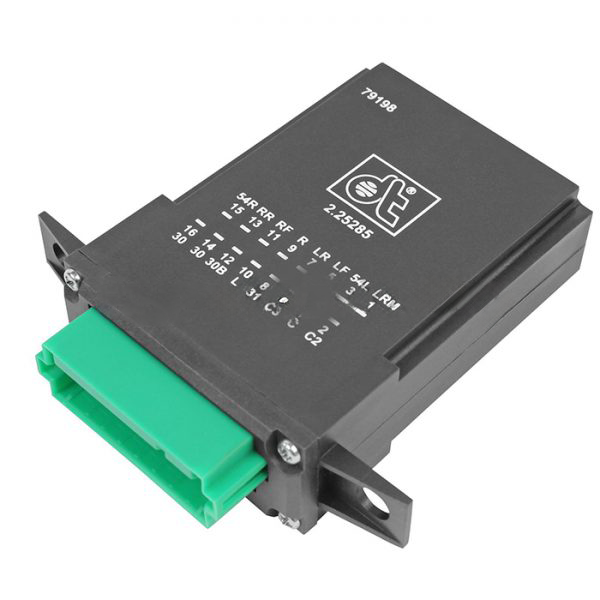
When it comes to the enigmatic world of automotive electronics, few components exert as significant an influence over vehicle functionality as the relay flasher. An often overlooked yet pivotal element in the operation of turn signals and hazard lights, the relay flasher performs a vital role in the communication between the driver and the vehicle’s lighting system. Among the myriad of acronyms you may encounter while navigating this intricate landscape, “EF” stands out as a term that warrants elucidation.
The acronym “EF” typically denotes “Electronic Flasher.” This designation signifies a transition from traditional bimetallic relay flashers to more advanced, electronically controlled units. To grasp the implications of this shift, it is essential to understand both the functionality of the relay flasher itself and the broader context of automotive electrical systems.
In the traditional realm, bimetallic relays relied on a physical mechanism, where two metals with different expansion coefficients would bend and break an electrical circuit. This mechanical action would engage and disengage the turn signals or hazard lights, leading to the characteristic blinking pattern. However, this system has its limitations, namely diminished reliability, susceptibility to environmental factors, and a tendency toward increased power consumption.
Enter the Electronic Flasher, or EF, which revolutionizes the relaying process. By utilizing solid-state components, EF flashers can modulate more complex signaling patterns, consume less battery power, and provide improved reliability. This advancement offers a plethora of benefits that enhance not only the function of lighting systems but also the user experience.
Understanding the functionality of an EF relay flasher begins with its core components. Unlike its mechanical predecessor, an electronic flasher comprises transistors and microcontrollers, which work in concert to manage the timing of the signal. The inherent advantages of this configuration become apparent in scenarios involving incandescent versus LED bulbs. For instance, because LED lighting typically draws less current, traditional flashers may misinterpret the load and fail to activate the lights or result in hyper-flashing. However, EF flashers adapt fluidly to the load presented, mitigating these issues and ensuring consistency in performance.
In addition, the EF flasher supports various features, including customizable blinking rates and even modulation patterns, which can enhance visibility and safety. Modern vehicles, particularly high-end models, often utilize these programmable flashers to provide unique signaling effects, such as sequential turn signals, which can be more noticeable to other drivers and pedestrians alike.
Before diving into the installation and troubleshooting aspects of EF relay flashers, it’s paramount to consider the vehicles in which they’re utilized. Many contemporary cars are now engineered with integrated lighting systems that require compatibility with EF technology. Understanding the connections and compatibility of these devices within the electrical architecture of your vehicle is vital, as replacing a traditional flasher with an EF unit may necessitate additional modifications or the reconfiguration of existing wiring.
Now, let’s explore the installation process for an EF relay flasher. First and foremost, the vehicle must be turned off and the battery disconnected to ensure safety. The location of the existing flasher—usually found within the fuse box or near the steering column—should be identified. Once located, the old flasher can be removed with a gentle twist or pull, depending on the model.
Next, the new EF flasher is installed by reversing the removal steps. Ensuring proper alignment of the terminals is crucial; incorrect installation could lead to malfunctions. After securing the new unit, the battery should be reconnected, and the vehicle can be tested. It’s wise to verify the operation of the signals, as well as to scan for any potential warning lights on the dashboard that may indicate a fault.
In terms of troubleshooting, one might encounter a variety of issues associated with EF flashers. A frequently reported problem involves the hyper-flashing phenomenon, which occurs when the turn signal blinks too rapidly. This often results from a mismatch between the flasher and the connected bulb type, primarily if switching from incandescent to LED. In such cases, incorporating load resistors or a specialized flasher compatible with low-draw bulbs could be necessary to rectify the issue.
Another aspect to consider is the lifespan of EF flashers. Generally, these electronic devices boast an extended lifespan compared to their mechanical counterparts. However, they are not immune to failure. Over time, temperature fluctuations and exposure to moisture can compromise their functionality. Therefore, routine inspections should include a check of the flasher unit alongside other electrical components.
Ultimately, understanding what “EF” means in the context of relay flashers opens a window into the advanced world of automotive technology. The transition from mechanical to electronic systems signifies not just a shift in componentry but a broader evolution in vehicle design, emphasizing reliability, efficiency, and enhanced safety measures. As cars become increasingly sophisticated, embracing these advancements will ensure that drivers reap the full benefits of the latest automotive innovations. Adopting an electronic flasher can lead to improved signaling responses, greater energy efficiency, and customized safety features—making it an invaluable investment for modern vehicles.
In conclusion, the EF relay flasher is a beacon of modernization in automotive lighting systems, providing efficient, adaptable, and reliable solutions for signaling. Its extensive applications and customizable features have redefined vehicle safety and functionality, ensuring that drivers remain informed and connected to the roads they navigate.












