
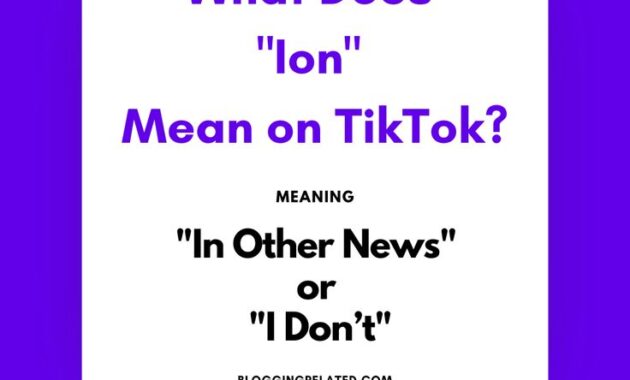
In today’s rapidly evolving digital landscape, slang often surpasses even the most established jargon in its richness and dynamism. The term “ion” exemplifies this phenomenon, particularly within certain online communities and social media platforms. As you traverse the vast terrain of modern vernacular, you may find yourself posing a playful question: “What does ‘ion’ even mean, and how is it used?” This inquiry can lead us to explore not just the definition, but the nuanced connotations and contexts surrounding the term. So, let’s delve into this linguistic curiosity and unveil its layers.
At its core, “ion” is a clipped version of the phrase “I don’t,” commonly employed in informal conversations and social media exchanges. This abbreviation encapsulates a distinctive brevity that epitomizes the essence of digital communication—quick, witty, and to the point. Imagine this: you’re engaged in a lively group chat when someone casually expresses, “Ion care what y’all think.” This usage illustrates a detachment from the opinions of peers and conveys a sense of indifference while maintaining an informal tone.
Yet, the appeal of “ion” lies not merely in its function as shorthand. Its charm stems from the cultural context and subtext that envelops it. The slang has burgeoned within specific demographics, particularly among younger individuals who seek to establish their identity and convey a certain attitude in their digital engagements. It’s not just about saying “I don’t”; it’s about the attitude that comes with the phrase. It emerges from a sense of empowerment or liberation, allowing individuals to assert their stance while feigning nonchalance.
One could argue that the emergence of “ion” as a slang term is representative of a broader trend in linguistic evolutions spurred by technology and social media. The rise of the internet has catalyzed the rapid dissemination of new phrases, often stripped of their formalities and reconstructed to fit the fast-paced rhythm of online interactions. The prevalence of abbreviations, acronyms, and clipped clauses signifies a shift in how we communicate, challenging traditional norms of linguistics while fostering a dynamic subcultural language.
Another dimension worth examining is the implications for social dynamics. When someone employs “ion” in conversation, it subtly signals to others a shared understanding or belonging to a particular group. It fosters a sense of camaraderie amongst users who understand its nuances and contextual significance. Consider the variance in reception among different age groups or cultural backgrounds: “ion” may elicit confusion from one demographic, while evoking a chuckle or an eye-roll from another.
Additionally, the transition from an acronym to a standalone term signifies a fascinating phenomenon in the evolution of language. What starts as a simple contraction morphs into a word adept at conveying complex ideas and attitudes. In this way, “ion” is more than a mere substitute; it embodies certain emotional resonances often packed within casual exchanges. Consider how the phrase encapsulates a sense of dismissal, a nonchalant retreat from engaging in debates while simultaneously allowing for continued participation in the conversation.
To truly grasp the essence of “ion,” one must explore its contemporary manifestations in popular culture and social media. Platforms such as TikTok, Twitter, and Instagram are rife with examples of its quirky usage, often forming the bedrock of humor or sarcasm in posts and comments. Imagine scrolling through your feed, encountering a meme where the caption reads, “Ion cook too much for you,” brilliantly juxtaposing culinary skills with a tongue-in-cheek attitude towards relationship dynamics.
Yet, it isn’t merely the format of usage that captivates; it’s the contextual layering of “ion” within various scenarios. For instance, it can serve as a response to criticism, a playful retort to a friend’s suggestion, or even a declaration of personal autonomy. Each application reveals a different spectrum of emotion—whether it’s levity, defiance, or camaraderie. This multifaceted nature of the word invites users to engage with it creatively, continuously evolving in alignment with societal dynamics and cultural shifts.
Despite its informal roots, the proliferation of “ion” has incited discourse on the legitimacy and appropriateness of slang in communication. Detractors argue that such colloquialisms detract from clarity or professionalism, particularly in more formalized settings. Conversely, proponents champion the significance of language as a living entity, evolving and adapting to reflect the experiences of its users. This debate poses an intriguing challenge to consider: as society progresses, will slang such as “ion” remain relegated to informal settings, or will it transcend these boundaries to gain acceptance in broader contexts?
Ultimately, the allure of exploring what “ion” signifies in modern-day dialogue extends beyond mere semantics. It invites us to reflect on the complexities of communication, the interplay between linguistic tradition and innovation, and the innate desires for connection and expression. In contemplating these dimensions, we gain insight not only into the word itself but into the cultural zeitgeist that shapes our interactions in an increasingly digital world. So next time you encounter this seemingly benign abbreviation, ponder its profound implications and the insights it reveals about contemporary discourse.












