
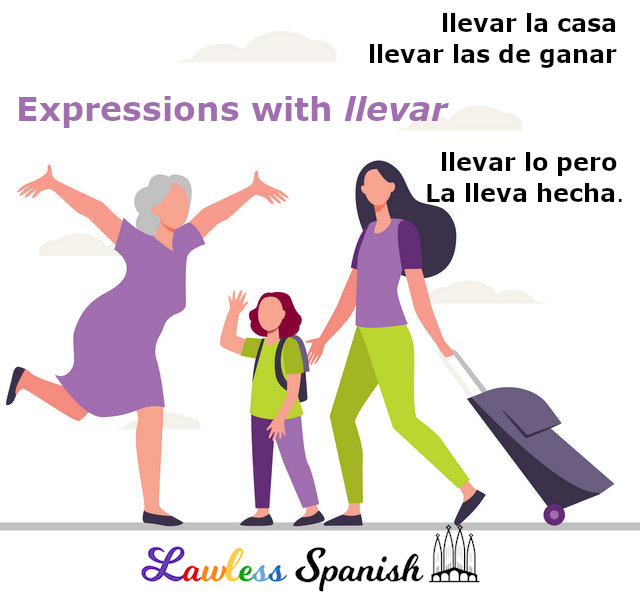
Have you ever wondered how a single word can carry the weight of multiple meanings and uses? In Spanish, the verb “llevar” is one of those intriguing words that can perplex even the most seasoned linguists. In this article, we will delve into the rich tapestry of meanings behind “llevar,” exploring its various applications in different contexts. So, what does “llevar” really mean? Let’s embark on this linguistic journey together.
First and foremost, “llevar” is most commonly translated as “to carry” or “to take.” This fundamental meaning is versatile, appearing in both literal and metaphorical contexts. Picture a scenario where you need to transport goods. You might say, “Voy a llevar las cajas al coche,” which translates to, “I am going to carry the boxes to the car.” Here, the physical act of carrying is clearly showcased.
However, “llevar” does not simply stop at transporting tangible objects. It extends into the realm of abstract ideas, presenting an avenue for creative language use. For instance, if someone asks you how long you’ve lived in a particular city, you might respond with, “Llevo cinco años aquí,” meaning, “I have been here for five years.” In this example, “llevar” signifies the duration of time spent in a place, demonstrating the verb’s adaptability in expressing temporal relationships.
The versatility of “llevar” takes an even more colorful turn when considering its use in expressions. One such expression is “llevar a cabo,” which translates to “to carry out” or “to execute.” This phrase can refer to implementing a plan or completing a task. For example, “El equipo llevará a cabo el proyecto el próximo mes” indicates that “the team will carry out the project next month.” Such expressions enrich one’s vocabulary and provide a nuanced way to convey intent.
Let’s not forget the implications of “llevar” in the fashion and accessories domain. In this context, “llevar” means “to wear.” For example, one could say, “Ella lleva un vestido rojo,” which translates as “She is wearing a red dress.” Here, the verb takes on an entirely new dimension, showcasing how “llevar” can bridge the gap between physical presence and style.
Exploring further, we encounter the use of “llevar” in social settings. It is not unusual for Spanish speakers to say, “¿Qué llevas para la fiesta?” which translates to “What are you bringing to the party?” In this instance, “llevar” takes on the connotation of bringing items along to share or contribute, indicating the communal nature of Spanish-speaking cultures.
In addition, “llevar” can also pertain to relationships. For instance, “Llevo bien con mis compañeros,” which means “I get along well with my coworkers.” Here, the verb indicates a relational dynamic, highlighting connections and camaraderie among individuals. Thus, “llevar” showcases its capability to encapsulate emotional and social dimensions, making it an indispensable verb in the Spanish lexicon.
Moreover, when it comes to expressing responsibility or duty, “llevar” reemerges as a powerful tool. The phrase “llevar la cuenta” translates to “to be in charge of the bill.” In scenarios involving finance or accountability, “llevar” signifies the act of overseeing or managing an obligation. This functional use embeds a sense of trust and reliability in interpersonal transactions.
Now, let’s address a playful challenge: imagine you are at a gathering, and someone asks you to explain the nuances of “llevar” in a single minute, without preparing. Could you rise to the occasion? Could you articulate how this one verb can mean to carry, to take, to wear, to execute a plan, to get along with others, and even to manage responsibilities? It can be quite an endeavor, but this challenge underscores the richness of “llevar” as a verb steeped in context.
As if that were not enough complexity, the conjugation of “llevar” adds yet another layer to its mastery. Spanning several tenses, from the present (llevo, llevas, lleva) to the past (llevé, llevaste, llevó) and even to the subjunctive (lleve, lleves, lleve), the conjugation variety allows speakers to paint a multifaceted picture of actions concerning time. Mastering these conjugations is paramount for fluency and will undoubtedly aid learners in articulating their thoughts with precision.
In conclusion, the verb “llevar” encapsulates a myriad of meanings and uses that span across physical, temporal, relational, and situational dimensions. Whether you are carrying a burden, wearing a fashionable outfit, contributing to a gathering, or managing the intricacies of daily life, “llevar” has a role to play. As you continue your journey in mastering the Spanish language, take the time to embrace the depth of “llevar.” It is an invitation to explore not just the word itself, but the vibrant culture and connections that come alive through language. Remember, words are not just tools; they are gateways to understanding our world better. Happy learning!












