
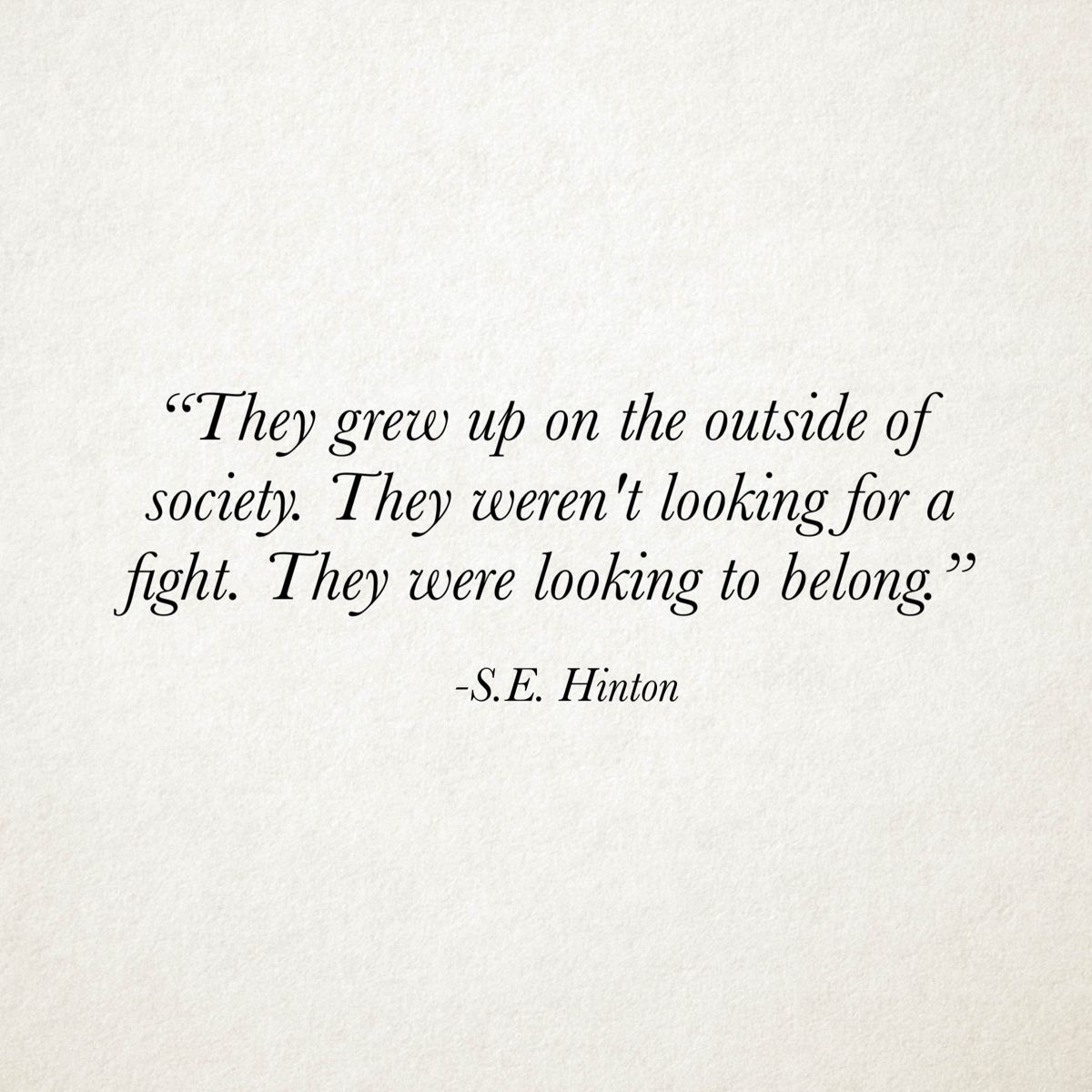
In the annals of classic American literature, few novels resonate as profoundly as “The Outsiders” by S.E. Hinton. This coming-of-age tale delicately encapsulates themes of identity, rivalry, and the poignant plight of youth. Within such a multifaceted narrative, the term “nonchalantly” emerges, capturing the essence of characters’ emotions and interactions. This article delves into the nuanced implications of the word “nonchalantly” as it appears in the novel, exploring its literary meaning and broader significance.
To begin with, let us ponder: What does it truly mean to act nonchalantly? In everyday parlance, this term insinuates a sense of casual indifference or an effortless demeanor, a façade of equanimity amidst turbulent circumstances. However, in the context of Hinton’s narrative, its connotations are layered and complex. The protagonists, entrenched in the throes of a class struggle, exhibit a certain detachment that belies their internal turmoil. This duality invites readers to reflect on the characters’ true feelings, presenting an intriguing challenge for interpretation.
At the heart of “The Outsiders,” the concept of nonchalance serves as a coping mechanism for the characters, particularly the Greasers—the marginalized youth of the novel. They navigate a treacherous landscape marked by violence and class disparity, and often, displaying nonchalance becomes a shield against the harsh realities that encircle them. Consider Ponyboy Curtis, the introspective narrator. His nonchalant attitude when confronting the Socs, the affluent rivals, highlights a defense mechanism. He adopts a façade of indifference as a means to mask his vulnerability, reflecting a profound internal conflict between fear and bravado.
Moreover, nonchalance is not merely about appearing indifferent; it encapsulates the struggle for identity in a world that continually seeks to define individuals by their social class. For Ponyboy and his friends, displaying nonchalance can be both liberating and confining. On one hand, it offers a momentary reprieve from the weight of societal expectations. On the other, it can lead to emotional disconnection, preventing genuine relationships from flourishing. This ongoing tension paints a vivid portrait of adolescent life—a time when the search for authenticity is often muddied by the desire to conform or appear ‘cool.’
Examining the interactions among characters further elucidates the role of nonchalance. Take, for instance, Johnny Cade, whose shy demeanor contrasts starkly with the bravado of some of his peers. Johnny’s nonchalant responses in critical situations often belies his profound insecurities and desperate longing for acceptance. His reluctance to reveal his struggles speaks volumes about the expectations placed upon him and the walls he erects to protect himself. Hinton masterfully uses these dynamics to reflect the complexity of youth—a juxtaposition of outward calmness and inward chaos.
Furthermore, the concept of nonchalance reverberates through the novel’s pivotal moments, most notably in scenes of conflict. When the Greasers encounter the Socs, there’s an observable bravado masked as nonchalance. It’s as if they adopt a social armor that allows them to confront their rivals with an air of confidence, even as their hearts race with trepidation. This bravado, tinged with nonchalance, reveals the paradox of their existence—an attempt to assert control in a world that consistently threatens to spiral beyond their grasp. Hinton’s exploration of this theme invites readers to question the true depth of courage and vulnerability intertwined within the fabric of youth culture.
Delving deeper into the metaphorical implications of nonchalance, it becomes apparent that Hinton juxtaposes this attitude with moments of raw emotional revelation. In the quieter scenes, when characters drop their pretentious facades, the weight of their true feelings emerges, spotlighting the stark contrast between their public personas and private anguish. Thus, nonchalance, in this literary context, serves as both a barrier and a bridge, illustrating the delicate balance between self-preservation and connection.
Additionally, the significance of nonchalance extends beyond individual characters, reflecting the broader societal commentary inherent in “The Outsiders.” The Greasers’ nonchalant bravado serves as an indictment of socio-economic conditions, highlighting how societal pressures shape behavior. Nonchalance, in this regard, becomes a symptom of disillusionment, a product of a life spent in the margins of society. Hinton crafts a narrative that compels readers to examine the systemic inequalities that cultivate such attitudes, fostering a deeper understanding of her characters’ plight.
In conclusion, the term “nonchalantly” in “The Outsiders” serves as a microcosm of the characters’ emotional landscapes and societal commentary. It carries with it an array of implications that speak to the essence of youth—vulnerability, bravado, and an inherent desire for connection amidst chaos. Hinton weaves a narrative that transcends its era, inviting readers to embrace the complexities of adolescence and the masks we wear to navigate the trials and tribulations of life. As we peel back the layers of nonchalance, we unveil the tender vulnerabilities that lie beneath, urging a deeper examination of our own personas and the societal constructs that shape them. What challenges do we face when we don our own masks? How often do we choose nonchalance as a shield, and what does it reveal about the world we inhabit?












