
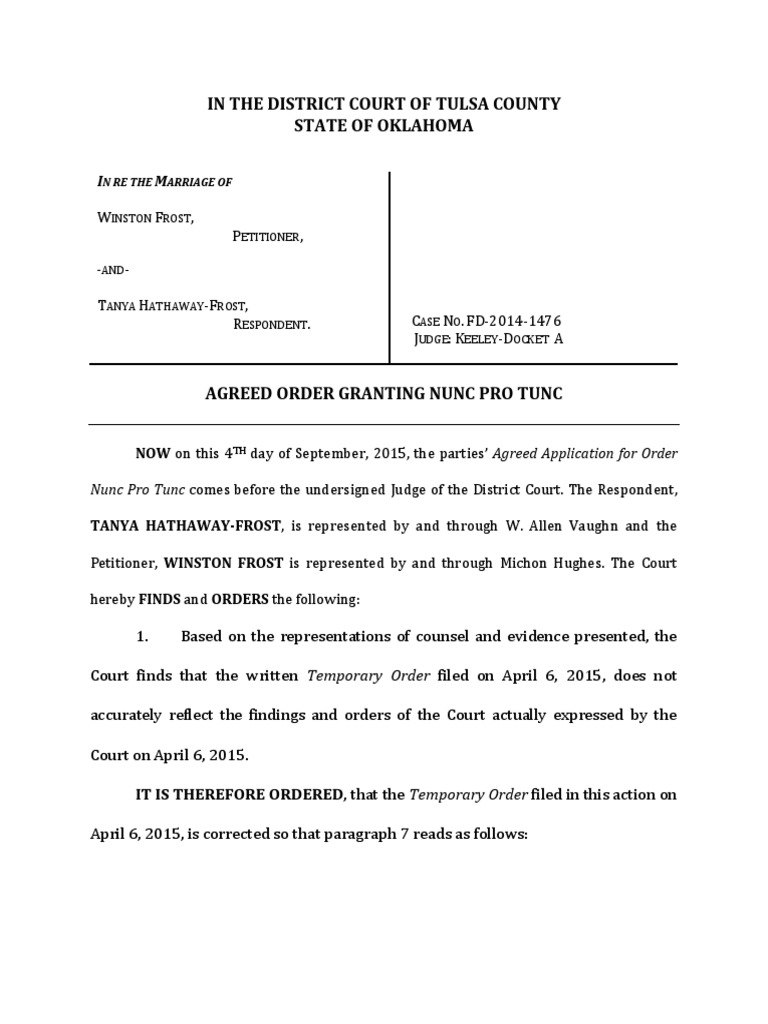
In the labyrinthine world of law, where precision is key and tradition runs deep, the term “Nunc Pro Tunc” emerges as a beacon of historical significance and pragmatic utility. Literally translating to “now for then,” this Latin phrase encapsulates the essence of rectifying judicial miscalculations with a flick of the pen, allowing the past to be amended in the present. Understanding this term is akin to picking the lock of an ancient treasure chest, revealing layers of legal history, flexible interpretations, and the pursuit of justice. This article unpacks what Nunc Pro Tunc means and its multifaceted implications.
To grasp the concept fully, one must dive into the annals of legal history. The origins of Nunc Pro Tunc can be traced back to English common law, where it served as a tool for correcting clerical errors or judgments that failed to reflect the truth of the matter. Imagine a painter who realizes, after stepping back from their canvas, that they’ve left a crucial detail unfinished. They would then make the correction not to alter the artwork’s essence but to ensure its authenticity. Similarly, a court’s use of Nunc Pro Tunc represents an endeavor to correct legal documents to reflect what truly transpired, thereby restoring integrity and coherence to judicial proceedings.
In legal parlance, the Nunc Pro Tunc order is a powerful remedy, often employed for rectifying mistakes that could have otherwise obstructed the wheels of justice. When a judgment or order is issued without complete consideration of the facts, or when the court’s words do not align with its intended actions, a Nunc Pro Tunc order may be sought. It acts as a bridge, spanning the chasm between erroneous constructs and reliable outcomes. The beauty of this legal mechanism lies in its retrospective application—the ability to treat an act as if it had been performed at an earlier date. This characteristic proves invaluable in myriad situations.
One such situation involves procedural shortcomings. Imagine a lawyer who has meticulously prepared a case only to discover, moments before a hearing, that a pivotal filing has not been formally recorded in the court docket. An application for Nunc Pro Tunc may rescue the attorney from an unanticipated dismissal, allowing the court to recognize the filing as if it had been completed in a timely manner. Through the lens of Nunc Pro Tunc, the courts wield the authority to restore procedural integrity, thereby ensuring that the judicial process respects the underlying facts of the case.
While the utility of Nunc Pro Tunc is clear, it is equally critical to understand its limitations. Courts do not wield this legal tool indiscriminately; its application is often circumscribed by doctrines of justice and equity. A decision made Nunc Pro Tunc does not create new cases or establish new legal principles. Instead, it serves to affirm what already existed in previously adumbrated records and determinations. It is the gentle hand that smooths the wrinkles in an aging quilt, ensuring that the fabric of the legal system remains intact, while also highlighting the necessity for judicial diligence.
The appeal of Nunc Pro Tunc extends beyond mere correction; it encapsulates a philosophy of fairness. The legal system is often viewed as an interlocking series of gears—each component must operate in harmony for justice to be served effectively. When one gear falters due to a clerical error or oversight, the entire mechanism risks becoming ensnared in bureaucratic quagmires. Nunc Pro Tunc acts as the oil that restores fluidity to this mechanical system, demonstrating that the pursuit of justice is not bound solely by rigid structures but is also defined by its capacity for humane remediation.
Advocates and opponents alike may express their opinions regarding the permissibility and ethics involved in employing Nunc Pro Tunc. On one hand, proponents argue that the flexibility of this legal tool is essential to achieving equitable outcomes, particularly in cases where the law serves as a double-edged sword. For instance, a late filing due to unforeseen circumstances, like a natural disaster or medical emergency, may otherwise result in unwarranted penalties that are merely procedural rather than substantive. Nunc Pro Tunc allows courts to exercise discretion, providing a safety net for litigants that reinforces the core tenets of justice.
Conversely, critics caution against the overuse or misuse of this principle, cautioning that it could potentially lead to a slippery slope wherein procedural norms are disregarded. They argue, in favor of preserving the sanctity of deadlines and formalities, which serve to maintain order and predictability in legal proceedings. The challenge, therefore, lies in striking a delicate balance between rectifying past oversights and maintaining structured legal frameworks that uphold accountability.
In conclusion, the exploration of Nunc Pro Tunc reveals a compelling intersection of historical significance, legal practicality, and equitable philosophy. Its implementation serves not merely as a corrective measure but as a testament to the legal system’s evolving narrative—a narrative that recognizes the importance of accuracy and fairness in the pursuit of justice. The essence of Nunc Pro Tunc underscores a pivotal truth within the legal realm: that while laws may be etched in stone, the pursuit of justice must remain adaptable, responsive to the complexities of human nature. As legal practitioners navigate the corridors of justice, Nunc Pro Tunc stands steadfast as a reminder of the human touch inherent to the law—a touch that encourages correction when the scales of justice tilt awry.












