
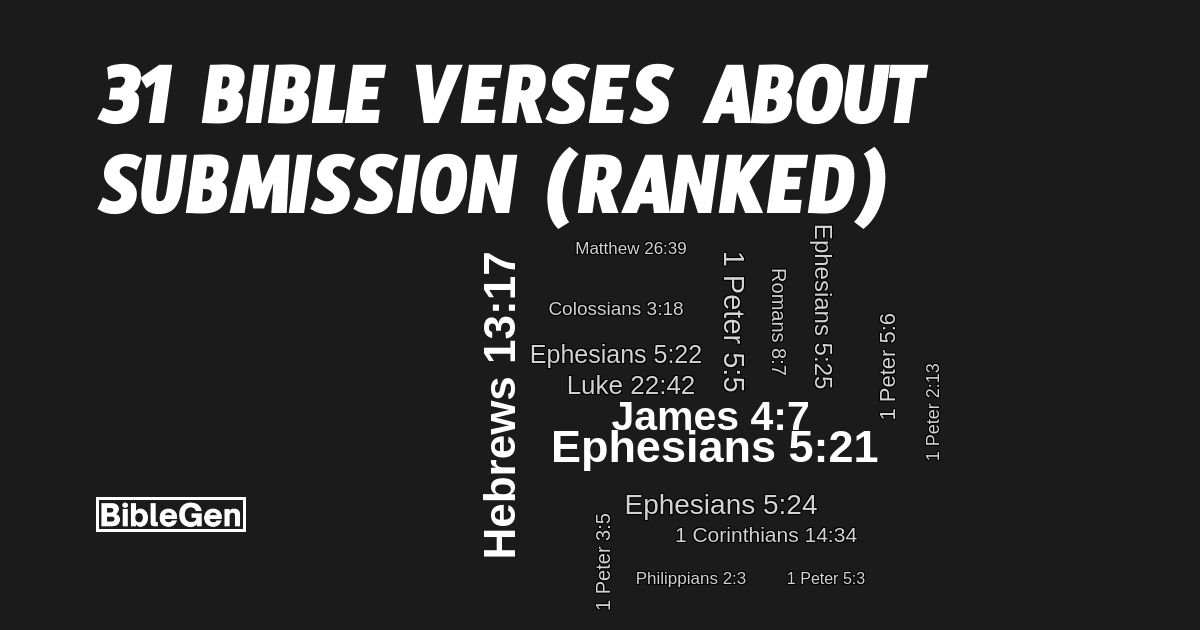
Submission is a concept that reverberates throughout biblical texts, often eliciting a myriad of reactions ranging from reverence to apprehension. As a theme frequently discussed within the Christian context, understanding what submission means in the Bible requires an exploration of both its conceptual underpinnings and its various applications across different scripture passages. This article offers a comprehensive examination of submission as addressed in the Bible, highlighting its significance and implications for believers today.
To fully grasp the essence of biblical submission, one must first delineate the term itself. In scriptural parlance, submission transcends mere compliance; it embodies a posture of humility and an acknowledgment of authority. At its core, submission is an act of willful surrender, an alignment of oneself to a greater purpose, and ultimately, to God’s divine order. This understanding prompts the inquiry: why does submission evoke such a spectrum of emotions?
The origins of submission can be traced back to fundamental biblical narratives. In the Garden of Eden, the fallout from Adam and Eve’s decisions illustrates the complexities of authority and rebellion. Their choice to step outside the divine directives serves as an archetype of humanity’s struggle with submission. This initial act of disobedience set the stage for an ongoing dialogue concerning authority, free will, and the consequences of defiance.
As one navigates through the scriptures, the New Testament provides a distinct lens through which submission can be evaluated. A pivotal passage appears in Ephesians 5:21-24, where Paul admonishes believers to “submit to one another out of reverence for Christ.” Here, submission does not merely denote a hierarchical model; rather, it introduces a reciprocal dynamic that reshapes traditional perceptions. This revelation is profound, suggesting that submission is intricately linked to relationships and mutual respect within the body of Christ.
This notion of mutual submission extends into the family sphere, where specific roles are delineated. For example, Ephesians 5:22-23 explicitly addresses the relationship between husbands and wives, suggesting that wives are to submit to their husbands as to the Lord. However, this directive must be interpreted within the broader context of love and sacrificial leadership as espoused in the preceding verses. Husbands are instructed to love their wives as Christ loves the church—selflessly and without reservation. This connection deepens the understanding that biblical submission is not about subjugation but rather a cooperative endeavor grounded in love and respect.
The theme of submission also reverberates in the context of church governance. Hebrews 13:17 encourages believers to “obey your leaders and submit to them, for they are keeping watch over your souls.” The sanctity of this relationship underscores accountability; leaders are charged with the spiritual well-being of their congregations, while congregants are called to trust and support that guidance. This bond fosters a community of faith where submission is an expression of collective faithfulness rather than individual conformity.
Moreover, the life of Jesus epitomizes the essence of submission. The son of God embodies obedience to the Father, ultimately culminating in His crucifixion. Philippians 2:6-8 poignantly captures this reality, stating that Christ, although in the form of God, “did not count equality with God a thing to be grasped, but emptied himself, taking the form of a servant.” This radical submission transformed the concept from one of hierarchical oppression to one of divine purpose and sacrificial love. In doing so, it invites believers to emulate this self-denial and commitment to a greater good.
Intertwined with the idea of submission is the notion of strength. The prevailing misconception often posits that submission denotes weakness. However, the biblical narrative reaffirms that true strength is manifested in the conscious choice to submit. This paradox is evident in Matthew 5:5, where Jesus proclaims, “Blessed are the meek, for they shall inherit the earth.” Meekness, often confused with weakness, signifies power under control—a quality that is, in essence, deeply spiritual and divinely aligned.
Addressing the implications of submission in contemporary society unveils even more intriguing dimensions. In an age marked by individualism and defiance against authority, the biblical call to submission may seem counterintuitive. Yet, upon closer examination, it reveals itself as a radical act of trust in God’s sovereign plan. This act fosters peace and unity, challenging the prevailing cultural norms that often prize autonomy over community.
For many, the struggle with submission often stirs a well of internal conflict. It beckons believers to confront their fears of loss of control and vulnerability. Yet, embedded within this struggle is an invitation to discover deeper faith. By surrendering to God’s will and the authorities He appoints, believers step into a macroscopic narrative of divine orchestration. This transition from resistance to submission marks a profound journey toward spiritual growth.
In summation, the biblical concept of submission transcends simplistic definitions, entailing a rich tapestry woven throughout scripture. From the dynamics of marital relationships to church authority and the ultimate example set forth by Christ, submission emerges as a multifaceted theme that calls for active engagement and introspection. It is an invitation to relinquish the ego, embrace humility, and participate in God’s unfolding story. As believers grapple with the essence of submission, they unearth the transformative power that it holds—one that fosters unity, enhances relationships, and ultimately glorifies God.












