
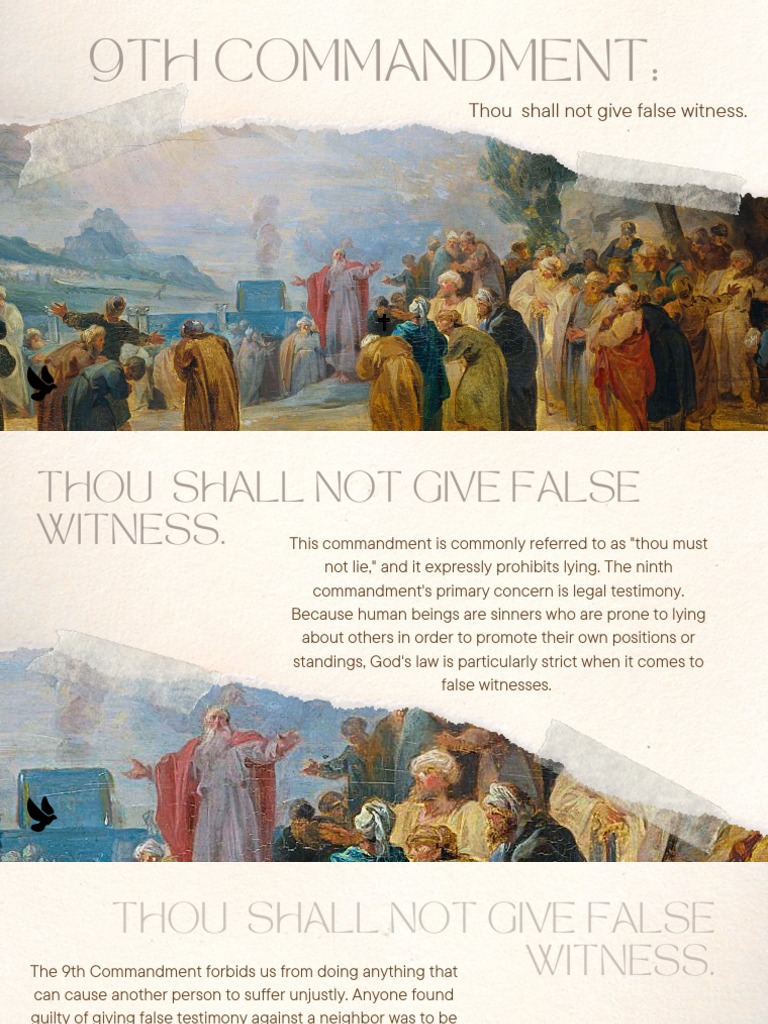
The 9th Commandment, articulated succinctly as “You shall not bear false witness against your neighbor,” reverberates through the annals of Judeo-Christian moral teachings. This edict, nestled amid the foundational Ten Commandments delivered to Moses, engages with the core of interpersonal relationships and societal justice. In a world rife with misinformation and deceit, this ancient injunction remains profoundly relevant, beckoning exploration not only of its historical context but of its moral implications for contemporary life.
At its essence, the 9th Commandment calls upon individuals to uphold truthfulness and integrity within their communications. The phrase “bear false witness” extends beyond mere detraction; it encapsulates the act of slandering, libeling, or maligning another’s character through deliberate falsehoods. This commandment, therefore, serves as a bulwark against the destructive nature of lies, which can tarnish reputations and breed mistrust in communities.
Delving deeper, the significance of this commandment resonates within various domains—religious, legal, and philosophical. In a religious context, the foundation of trust and honesty fosters healthy relationships not only among individuals but also between the divine and humanity. The Scriptures frequently emphasize the importance of truth in God’s nature. When individuals propagate falsehoods, they distance themselves from the divine attributes of honesty and holiness.
From a legal viewpoint, the 9th Commandment underscores the necessity of maintaining veracity within judicial proceedings. Witnesses are obligated to provide accurate recounts of events, for their testimony can significantly influence the outcome of trials. When false testimonies are rendered, justice becomes an elusive specter, thus corrupting the sanctity of legal equity. The commandment, therefore, not only governs personal ethics but is integral to societal fairness.
Philosophically, the 9th Commandment beckons one to explore the larger implications of truth in society. The moral imperative to speak and uphold truth highlights the intrinsic value of authenticity. In a world where truths can be easily manipulated by persuasive rhetoric, the commandment prompts individuals to engage in reflective thought regarding the weight of their words. Are we, as members of society, vigilantly committed to truthfulness? The 9th Commandment calls forth a clarion challenge to examine our personal integrity and the ethical ramifications of our speech.
Exploring the consequences of falsehood further accentuates the vitality of this commandment. Lies can catalyze discord and polarization, fracturing relationships that once thrived on trust. The societal fabric, woven with the threads of honesty, becomes frayed and susceptible to disunity when individuals choose deceit over truth. Moreover, falsehoods can generate cognitive dissonance, where an individual’s professed values are at odds with their actions, leading to inner turmoil and external relational chaos.
In everyday life, the practical applications of the 9th Commandment come into sharper focus. Consider the realm of workplace dynamics: rumors, gossip, and misinformation can erode team cohesion and diminish morale. Organizations thrive when communication is grounded in transparency. In what ways can we foster a culture of honesty in our professional spaces? Upholding the principles embodied in the 9th Commandment can lead to enriched collaboration and trust amongst colleagues and peers.
The impact of the 9th Commandment also extends to personal relationships. In friendships, family ties, and romantic partnerships, honesty serves as the cornerstone. The act of bearing false witness can dismantle bonds that take time to forge. Reflecting upon our interactions, are we being entirely truthful? When we consciously choose candor—even in uncomfortable situations—we cultivate stronger relationships that are resilient against the trials of life.
Sociopolitically, the commandment challenges individuals to scrutinize the information they consume and share. In today’s digital landscape, where information disseminates at lightning speed, the ethical obligation to verify facts before relaying them is paramount. The spread of disinformation can have dire consequences, leading communities into chaos and engendering a crisis of trust in public institutions. By adhering to the principles articulated in the 9th Commandment, individuals can champion a culture of honesty that empowers informed and engaged citizenry.
As the 9th Commandment pervades our lives, it heralds transformative promises—of personal integrity, social equity, and relational harmony. It compels us to reassess our commitment to truth. At a time when misinformation dominates discourse, how can each of us embody the tenets of this commandment? How can we consciously contribute to a milieu that values honesty as a moral imperative?
Ultimately, the 9th Commandment implores us not merely to refrain from falsehood but to actively cultivate truthfulness. This entails striving toward authenticity in our speech, bearing witness to our reality through an unwavering commitment to honesty. It is an invitation to transcend the triviality of casual dishonesty and instead embrace a life grounded in integrity. Adhering to this commandment may not always be convenient, but it invariably facilitates deeper, more meaningful connections with ourselves and those around us.
In conclusion, the 9th Commandment serves as more than a mere ethical guideline; it is a beacon that illuminates the path toward a more honest, trustworthy, and compassionate existence. By embracing its essence, we can transform our interactions, fostering a society built on courage and integrity in the face of a world that often rewards deceit. The journey toward truth may be fraught with challenges, but the rewards—of peace, trust, and community—are immeasurable.












