In the realm of science, a phenomenon that ignites curiosity and provokes thoughtful inquiry is the concept of chemical change. It’s not merely a transformation; it encapsulates the essence of matter’s fundamental shift, revealing the intricate dance of atoms and molecules. To understand this pivotal concept, one must first grasp its nature, significance, and, most importantly, its manifestations in the world around us.
A chemical change, also referred to as a chemical reaction, occurs when substances interact to form new compounds with different properties. This contrasts sharply with physical changes, where no new substances emerge, such as melting ice or boiling water. Chemical changes are heralded by the formation of precipitates, color shifts, gas emissions, and temperature variations—all captivating indicators of transformation. But what might serve as an everyday example of such a profound occurrence? Let us delve into a commonplace scenario: the rusting of iron.
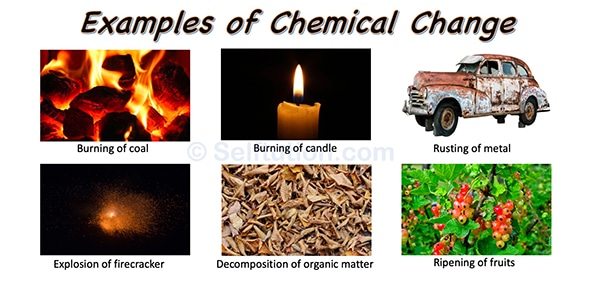
Rusting, scientifically known as iron oxidation, exemplifies a chemical change that many encounter yet few appreciate in its complexity. When iron is exposed to moisture and oxygen, it undergoes a reaction that ultimately leads to the formation of iron oxide, commonly recognized as rust. The reaction can be succinctly summarized in the equation:
4 Fe + 3 O2 + 6 H2O → 4 Fe(OH)3
This chemical process is not just a simple transformation; it is a reflection of the relentless forces of nature acting upon materials. The intricate interplay between the elements reveals deeper truths about the environment—all facilitated by the presence of moisture and air. A rusty bicycle left outside can evoke nostalgia, yet it also discloses the ongoing battle between man-made objects and the elements.
To further explore the significance of chemical changes, we might consider the effect of heat in chemical reactions. Take the transformation of wood into charcoal during the process of combustion. When wood is ignited, the application of heat induces a series of reactions that break down wood’s cellulose into simpler compounds. The resultant carbon residue, or charcoal, exhibits markedly different properties from its predecessor. Not only is it blackened and charred, but it also serves a variety of purposes—from fuel for grilling to a medium for drawing. Here, heat facilitates a metamorphosis that provides utility, displaying the duality of destruction and creation inherent to chemical changes.
Further extending our exploration, consider baking bread—a culinary chemical change that is as aromatic as it is transformative. When ingredients such as flour, water, yeast, and salt are combined, and subsequently subjected to heat, a multitude of chemical reactions unfold. Yeast ferments sugars, producing carbon dioxide, which causes the dough to rise, while heat causes proteins to denature and starches to gelatinize. This alchemical process not only results in a delightful loaf but also presents an exquisite interplay of biology and chemistry in a manner that appeals to our senses, culminating in the tantalizing aroma of freshly baked bread wafting through the air.
It’s also worth examining the broader implications of chemical changes within our ecosystems. For instance, photosynthesis is a quintessential chemical change that sustains life on Earth. During this process, plants convert sunlight, carbon dioxide, and water into glucose and oxygen, effectively enabling energy conversion at a cellular level. The very essence of life hinges upon this reaction, illustrating how chemical changes underpin the existence of nearly all organisms. The lush greenery of a forest or the vibrant hues of a blooming flower serve as reminders of this vital chemical transformation.
As we ponder on the enigma of chemical changes, it becomes evident that they are not merely theoretical constructs confined to laboratory settings. They are ubiquitous, observable phenomena that permeate our daily lives. From the food we consume to the air we breathe, chemical changes are inextricably intertwined with the fabric of existence. Each reaction tells a story, reflecting the intricate interdependencies between individuals, environment, and elements.
This exploration of chemical changes would be incomplete without addressing the phenomenon of decomposition—a chemical change marked by the breakdown of organic matter. Whether it’s the decay of fallen leaves in a woodland or the composting of kitchen scraps, decomposition illustrates nature’s cyclical patterns. Microorganisms, enzymes, and the elements work harmoniously to recycle nutrients back into the ecosystem, closing the loop of life. The process, although grim in appearance, embodies the essential idea of rebirth and renewal, showcasing the beauty that can emerge from decay.
In conclusion, the exploration of chemical change unveils a fascinating tapestry woven with complexity and beauty. It challenges our understanding and invites us to appreciate the underlying principles that govern not only the physical world but also the very essence of life. From rusting bicycles to the intricate dance of photosynthesis, chemical changes manifest in various forms, each worthy of admiration and inquiry. As we traverse through these examples, we gain insight into the molecular choreography that shapes our surroundings and our very existence, revealing that chemistry is not just a branch of science, but a lens through which we may regard the world with awe and understanding.