
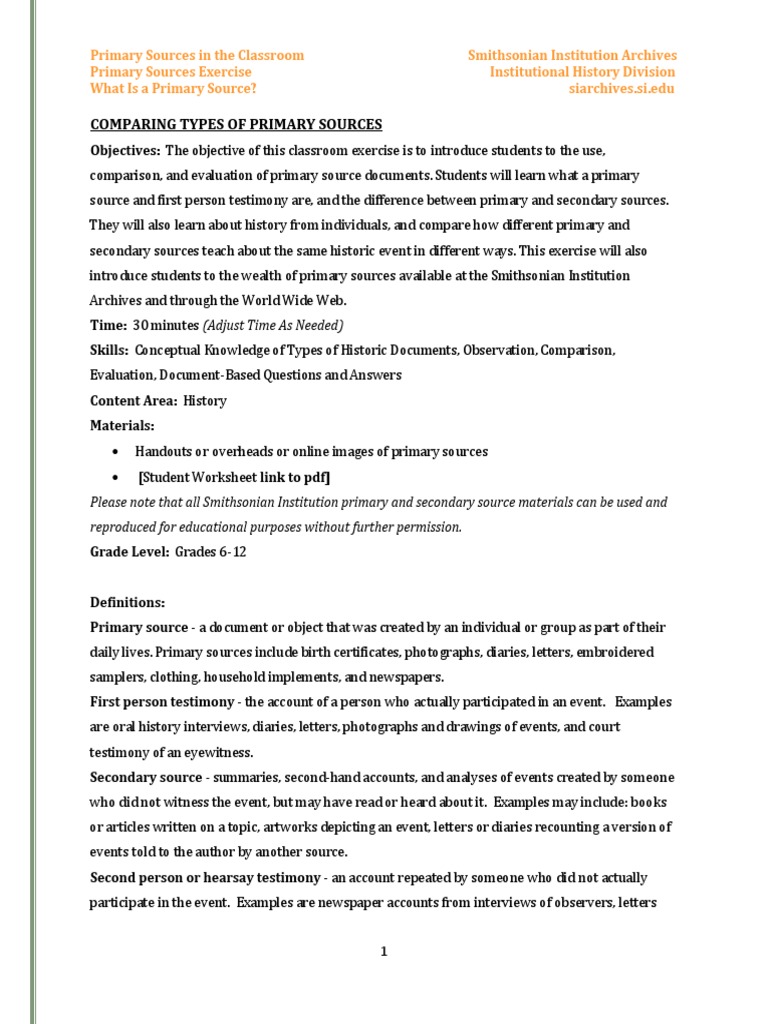
The concept of primary sources often eludes many, yet these artifacts hold a treasure trove of information that can shift our understanding of history, art, and culture. To elucidate the notion further, we shall take a multifaceted approach, delving into various examples and the significance they carry. Through an exploration of primary sources, we uncover not just facts but narratives that intertwine with human experience, offering invaluable insights.
At its core, a primary source is an original document or record that has not been altered or interpreted by others. These sources provide firsthand accounts or direct evidence of a particular event, period, or phenomenon, enabling historians and researchers to analyze and interpret raw data without the lens of secondary analysis. Imagine stepping into a time capsule, where the air is imbued with the essence of the past—this is precisely what a primary source offers.
The Historical Document: An Eyewitness Account
Consider the poignant letters written by soldiers during the Civil War. These correspondences, penned in the heat of battle or the quiet of encampments, offer an unfiltered glimpse into the fears, hopes, and stark realities faced by those on the frontlines. Each word becomes a brushstroke, painting an intricate portrait of the era’s psyche. Such letters serve not only as personal stories but also as vital historical documents that contribute to our understanding of societal norms and the collective human condition during tumultuous times.
Furthermore, these letters challenge conventional narratives crafted by historians. They reveal the emotional turbulence of war that statistics alone cannot convey. In reading a soldier’s heartfelt plea to a loved one, the reader is transported beyond the dates and events, fostering empathy and a deeper comprehension of history.
Artistic Expressions: Paintings and Music
Moving beyond textual accounts, primary sources extend into the realm of art and music. Take, for instance, a painting by Vincent van Gogh, such as “Starry Night.” This artwork, an original piece, allows viewers to experience the artist’s emotional landscape—the swirling night sky reflecting his tumultuous mental state. When we engage with such pieces, we peer into the soul of the creator, grappling with their passions and despair.
Similarly, consider the original recordings of music from various epochs. A song from the jazz age, for example, captures not only the auditory essence of a bygone era but also encapsulates the cultural revolution of its time. Through these auditory primary sources, listeners can discern the rhythms that shaped societal narratives and inspired movements. Music thus becomes an auditory testament to the zeitgeist of an era.
Government Documents: Treaties and Legislation
Delving into the realm of governance, one encounters primary sources in the form of treaties and legislative documents that have shaped nations. The Declaration of Independence stands out as not just a political manifesto but as a poignant declaration of human rights. This document, a primary source, articulates the aspirations and convictions of a fledgling nation, encasing the philosophies of its founding fathers.
Exploring such documents allows scholars to scrutinize the ideologies that propelled these pivotal moments in history. Analyzing changes in language or the omission of certain clauses can lead to revelations about power dynamics and societal values at the time of writing. These nuances enrich our comprehension of political evolution, prompting us to rethink our present-day convictions.
Personal Artifacts: Diaries and Photographs
A diary, penned in the stillness of one’s room, stands as a significant primary source, revealing the innermost thoughts and struggles of the author. Anne Frank’s diary, for instance, emerges as a profound narrative of a young girl’s life in hiding during the Holocaust. Her reflections transcend time, making the harrowing experience of wartime palpable for future generations.
On the other hand, photographs are visual primary sources that capture moments in time with startling clarity. A photograph from a civil rights protest acts as more than mere documentation; it summons the visceral energy of the event. Each image serves as a historical milestone, providing a visual narrative that complements written accounts. As one gazes upon these images, the weight of historical significance resounds, evoking emotions and stirring curiosity about the stories behind them.
Unveiling the Layers of Interpretation
What emerges from the exploration of primary sources is the realization that they are not mere artifacts but gateways to understanding the human experience. Each source possesses layers of context that beckon for interpretation, demanding a thorough examination of the time, place, and circumstances surrounding their creation. Historians and researchers find themselves engaged in a perpetual dialogue with these sources, allowing fresh perspectives to arise.
Moreover, primary sources challenge us to reconsider existing historical narratives. By juxtaposing various primary accounts, discrepancies and contradictions emerge, encouraging critical thinking and further inquiry. In an age dominated by secondary interpretations, the allure of primary sources lies in their authenticity, sparking curiosity and compelling us to seek the stories that lie beneath the surface.
Conclusion: The Continuous Quest for Understanding
In conclusion, the significance of primary sources extends far beyond their immediate content. They serve as conduits to the past, granting us new perspectives and deepening our understanding of the human experience. Engaging with these original documents, artworks, and records invites us to embark on a journey through time, challenging our preconceptions and enriching our comprehension of history, culture, and expression. The allure of primary sources will continue to evoke curiosity, promising an unraveling of the stories that chronicle our shared legacy.













