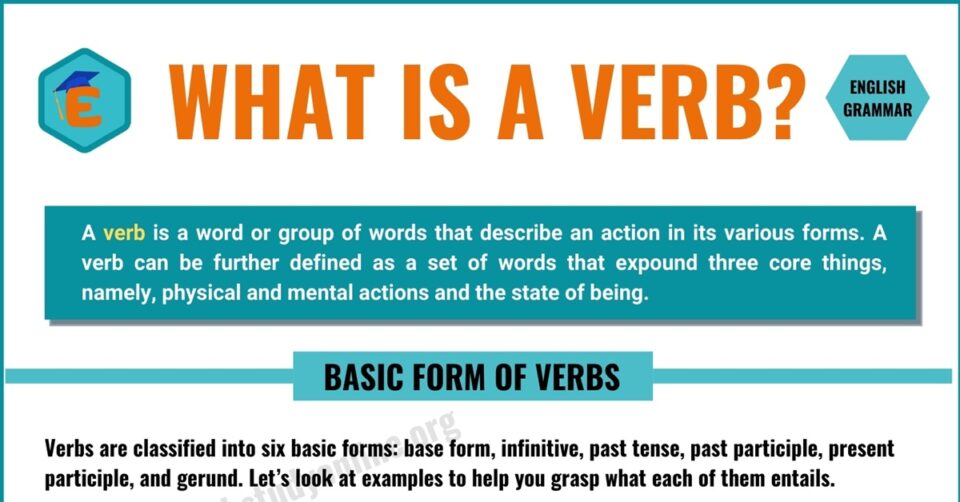
Verbs stand as one of the foundational pillars of any language, infusing action and dynamism into our sentences. They serve as the heartbeat of communication, transforming static thoughts into vibrant expressions. But what exactly is a verb? Can you recall examples of verbs that encapsulate the multitude of actions or states in daily life? Let’s embark on a fascinating exploration of verbs and their incredible versatility.
The essence of a verb lies in its ability to convey not just action but also existence, occurrence, or state of being. When you ponder the word “run,” it evokes images of speedy movement; however, verbs also encompass feelings, conditions, and processes. The challenge lies in identifying how verbs infuse life into our language. What if we thought of verbs as the very brushstrokes of language artistry, painting intricate narratives with vivid clarity?
To navigate the realm of verbs, we can categorize them into several distinct types, each showcasing unique functionalities. Let’s delve deeper into these classifications:
1. Action Verbs
Action verbs are perhaps the most recognizable type, representing physical or mental activities. They are the driving force behind stories and narratives. Consider verbs like “jump,” “eat,” or “ponder.” Every time we engage in an activity, we’re either expressing or responding to an action verb. Their power resides in their ability to evoke imagery; for instance, “leap” suggests an energetic and graceful movement, while “crawl” conjures a sense of slow, deliberate action.
2. Linking Verbs
In contrast to action verbs, linking verbs function as connectors, tying the subject of the sentence to additional information. The most common among these is the verb “to be,” which serves as a bridge between the subject and its complement, providing clarity about the state or condition of the subject. For example, in the sentence “She is joyful,” the verb “is” links “she” to her emotional state. Other linking verbs include “seem,” “become,” and “appear,” each adding nuance to the subject’s description.
3. Transitive and Intransitive Verbs
Another fascinating aspect of verbs is their transitivity, distinguishing between transitive and intransitive verbs. A transitive verb requires a direct object to receive the action, as seen in “He kicked the ball.” Here, “kicked” is the verb, and “ball” is the direct object. Conversely, intransitive verbs do not require a direct object and can stand alone, as exemplified by “He laughed.” The distinction adds depth to the language, offering alternatives for sentence construction and enhancing clarity.
4. Regular and Irregular Verbs
As you venture further into the world of verbs, you encounter the intriguing phenomenon of regular and irregular verbs. Regular verbs form their past tense by adding “-ed” (such as “walk” becoming “walked”), demonstrating predictable patterns. However, irregular verbs defy conventions, undergoing unique transformations (e.g., “go” changes to “went”). This inconsistency can pose a delightful challenge for language learners, beckoning them to memorize and practice these variations.
5. Modal Verbs
Modal verbs introduce another layer of nuance, as they express ability, necessity, permission, or possibility. Words like “can,” “must,” “may,” and “should” articulate varying degrees of intent and obligation. For instance, an assertion like “You must finish your homework” shows a strong obligation, whereas “You may join us” offers permission. The subtlety of modal verbs enriches our discussions, enabling us to communicate preferences and intentions more delicately.
The Role of Verbs in Everyday Language
Having unraveled the complexities of verbs, one might consider how these elements influence everyday language. Verbs not only delineate clear actions, but they also dictate the pace and tone of our narratives. A brisk verb can hasten the reader’s experience, while a more languid one can introduce a reflective pause. For instance, “strolled” evokes a leisurely pace, contrasted with the abruptness of “sprinted.” The choice of verb can dramatically alter the reader’s emotional response, highlighting the art of selective word choice.
The Transformative Nature of Verbs
Consider the idea that verbs are not static; they transform over time through variations in tense, mood, and aspect. Present, past, and future tenses elucidate the timeline of actions—offering clarity about when an action occurs. The progressive aspect (“is running”) conveys an ongoing action, while the perfect aspect (“has run”) signifies completion. This dynamic nature allows speakers and writers to provide context and depth to their expressions.
The Challenge of Mastery
Embracing the realm of verbs presents a fulfilling challenge. Whether one is engaged in crafting compelling stories, writing persuasive pieces, or simply conversing in a lively manner, mastering the use of verbs is crucial. One might ask: can you recognize the verbs in your daily conversations? Challenge yourself to identify and classify these verbs, noting variations in action, linking, and modality. Such conscious engagement with language enhances verbal dexterity and facilitates more effective communication.
Ultimately, verbs are much more than mere words; they are the vibrancy of language, infusing it with meaning and movement. As you continue to explore this fascinating component of grammar, remember that with each verb you encounter, you have the power to evoke, express, and articulate the rich tapestry of human experience. So, what example of a verb will you explore next?