
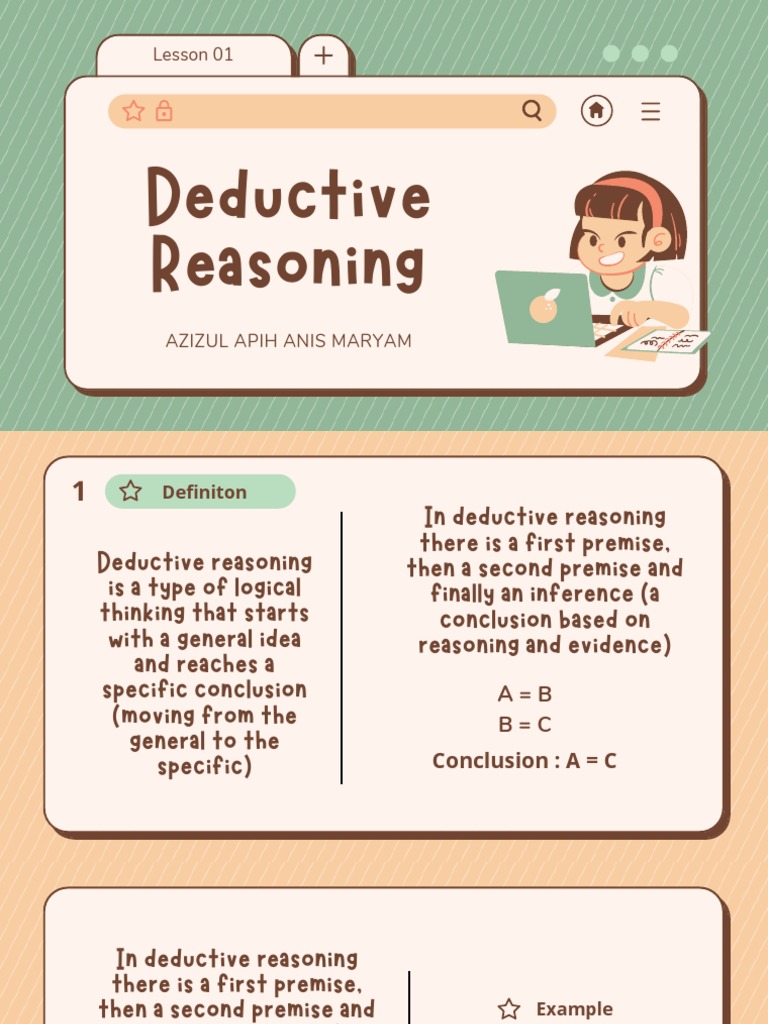
Deductive reasoning, much like a meticulously assembled puzzle, invites us to connect disparate pieces of knowledge into a coherent tapestry of logic. It is a powerful cognitive tool, often depicted as a ladder that rises from the general to the specific, guiding us from overarching truths to pinpoint conclusions. To truly appreciate the depth of deductive reasoning, we must first explore its principles, delve into its examples, and understand its significance in our daily lives.
Understanding Deductive Reasoning
At its core, deductive reasoning is a logical process wherein one starts with a general statement or hypothesis and examines the possibilities to reach a specific, logical conclusion. Think of it as a scientific experiment wherein broader laws of nature guide the inquiry; it is a sophisticated dance between certainty and logic. This form of reasoning is most often articulated through syllogisms—structured arguments comprising a major premise, a minor premise, and a conclusion. For instance, consider the classic, “All humans are mortal. Socrates is a human. Therefore, Socrates is mortal.” Each statement incrementally elevates our understanding, building upon established truths until we arrive at an unavoidable conclusion.
Examining Examples
To illuminate the concept further, consider an array of illustrative examples that paint the picture of deductive reasoning in action. One might envision a detective piecing together clues. A forlorn detective enters a dimly lit room and observes that the window is broken. The detective recalls that whenever a window is broken in this neighborhood, a burglary has occurred. He then rationalizes that this broken window may imply the presence of a thief. Here, a general law about the neighborhood’s burglaries leads him to a specific conclusion about the current situation.
Another illustration might involve a more mathematical scenario, where deductive reasoning shines bright. Imagine a student who understands that the sum of the angles in a triangle equals 180 degrees. If presented with a triangle where two angles measure 70 degrees and 40 degrees, the student can confidently deduce that the third angle must be 70 degrees as well. The brilliance lies in moving from the general rule of triangles to a specific outcome with clarity and precision.
The Role of Deductive Reasoning in Everyday Life
In the labyrinth of daily decision-making, deductive reasoning serves as a beacon, illuminating the path in situations fraught with uncertainty. For instance, consider a scenario where you are planning a family picnic. You are aware that if it rains, the picnic must be canceled; it is common knowledge that rain is prevalent during the spring months. If the weather forecast predicts rain for Saturday, one could conclude with reasonable certainty that the picnic will, indeed, be canceled. Here, the interconnected logic helps in making informed choices, allowing for adaptability and foresight.
Diving Deeper: The Implications of Deductive Reasoning
The implications of mastering deductive reasoning stretch far beyond simple problem-solving; it contributes to our capacity for critical thinking and informed dialogue. In today’s information-saturated landscape, the ability to discern validated premises from flawed ones is paramount. When confronted with arguments laden with rhetoric or emotional appeal, a discerning mind equipped with deductive reasoning can sift through claims and isolate the foundational truths. Just as a seasoned sailor relies on the stars to navigate the tumultuous seas, so does the adept thinker rely on reason to traverse the complexities of discourse and debate.
Common Misconceptions
It is crucial to delineate deductive reasoning from its cousin, inductive reasoning. While deductive reasoning flows from general premises to a specific conclusion, inductive reasoning reverses this journey; it begins with specific observations and attempts to form a general conclusion. The former, akin to mathematicians deriving equations, offers certainty, whereas the latter resembles scientists hypothesizing patterns based on observations—always rife with some degree of uncertainty. Misunderstanding this variance can lead to erroneous assumptions, rendering discussions moot or misguided.
Applications Across Various Fields
This paradigm of thought extends its tendrils into various academic and professional fields. In the realm of law, for instance, attorneys employ deductive reasoning to draw connections between statutes and individual case details, constructing compelling arguments that could sway a jury. In medical diagnostics, physicians utilize logical deductions when approaching symptoms presented by patients, narrowing down potential ailments based on established medical knowledge. Likewise, in technical fields such as computer programming, developers rely on deductive reasoning to debug software, systematically eliminating potential errors until they arrive at a solution. The fertility of deductive reasoning manifests in every corner of human intellect, establishing it as a linchpin of analytical thinking.
Conclusion: The Elegant Dance of Logic
Ultimately, deductive reasoning embodies a sophisticated framework that enables us to navigate the complexities of thought and argumentation with grace. Its clarity cuts through confusion, providing a structured approach to reasoning that resonates across cultures, disciplines, and daily challenges. Like a symphony built upon a foundation of harmonic principles, the art of deduction invites us to orchestrate our thoughts into a beautifully coherent narrative. Harnessing this potent skill empowers not only individual understanding but enriches collective discourse, fostering an enlightened society that celebrates rational thought.













