In our ever-evolving digital landscape, the concept of storage media has transcended beyond simple hard drives and cloud storage into a diverse realm where portability reigns supreme. Removable media, with its unique attributes, has become an indispensable tool for personal and professional tasks alike. From transferring data between devices to providing backup storage, removable media offers unparalleled convenience. But what exactly qualifies as removable media? Let’s delve deeper into various examples, elucidating their specific functions, advantages, and how they continue to shape our interaction with technology.
1. USB Flash Drives: The Ubiquitous Companion
Let’s start with one of the most familiar examples: the USB flash drive. These small, portable devices may easily fit onto a keychain, but their capabilities far exceed this modest stature. For students archiving notes or professionals sharing large files, USB flash drives promise efficiency. They come in various storage capacities, from a meager 2GB to a staggering 2TB, making them versatile for different requirements. Moreover, with an increasing trend toward encryption, these devices also provide a level of security for sensitive information.
2. External Hard Drives: Expansive Storage Solutions
Transitioning from the compact size of USB flash drives, external hard drives offer significantly more storage capability. These devices connect via USB, Thunderbolt, or eSATA and serve as expansive storage solutions for both home and business environments. Ideal for photographers dealing with large image files or gamers requiring ample space for their extensive libraries, external hard drives can hold hundreds of gigabytes to several terabytes. Their capability to serve as a backup option for entire systems further underscores their importance in the realm of removable media.
3. CD and DVD Discs: The Classic Format
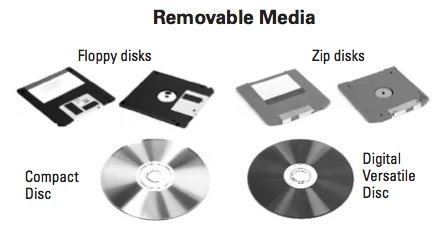
The introduction of compact discs (CDs) and digital versatile discs (DVDs) revolutionized the way we store and consume media. Although they have experienced a decline with the rise of digital streaming and downloads, CDs and DVDs still represent a quintessential form of removable media. Users can archive music, movies, or software with ease, and these discs remain an accessible option for long-term storage. To some, they evoke nostalgia while serving practical purposes for others, especially in educational contexts where physical copies of material are beneficial.
4. Blu-ray Discs: High-Definition Storage
Stepping further into the realm of physical media, Blu-ray discs have emerged as a standout option for high-definition storage. With their capacity to hold up to 25GB on a single-layer disc and 50GB on a dual-layer, they are ideal for high-definition films, extensive software applications, and data archival. The patents surrounding Blu-ray also facilitate enhanced security features, making this format particularly appealing to audiovisual professionals. As the entertainment industry continues to prioritize quality, Blu-ray serves as a modern bridge between traditional and digital media.
5. SD Cards: The Photographer’s Lifeline
In the world of digital photography and videography, Secure Digital (SD) cards reign supreme. These petite cards provide robust storage solutions for cameras, smartphones, and tablets, delivering high-speed data transfer and seamless compatibility. With storage variations—from SD to SDHC (High Capacity) and SDXC (Extended Capacity)—photographers can select cards that fit their specific shooting requirements. The ability to quickly swap out cards during a shoot epitomizes the flexibility that removable media offers, allowing users to adapt to their creative needs.
6. Thumb Drives: Functionality Coupled with Accessibility
Often confused with USB flash drives, thumb drives possess their own unique flair. Characterized by their pocket-sized design, thumb drives are highly portable, making them a favorite among travelers needing to transport files across various devices. They often feature rotating or retractable designs that eliminate the common issue of missing caps. This functionality, coupled with their accessibility, ensures that thumb drives remain a staple in the everyday carry of tech enthusiasts.
7. Cloud Storage: The Digital Removable Option?
While not removable in the traditional sense, cloud storage platforms like Google Drive, Dropbox, and OneDrive offer users the flexibility often attributed to removable media. Users can access their files from virtually any device, transferring them seamlessly from the cloud to a local system whenever necessary. The alluring aspect of cloud storage lies in its mobility—no physical device is required, and users can manage large amounts of data without the constraints of physical space. This paradigm shift prompts us to reconsider the notion of “removable,” as digital and physical landscapes converge.
8. Innovation on the Horizon: Future of Removable Media
As technology continually advances, the realm of removable media is poised for future innovations. From increasing the capacity and reliability of existing formats to pioneering entirely new mediums of storage, the possibilities are endless. Imagine a world where new technologies emerge that blend speed, security, and massive storage capabilities—transforming the way we think about data transfer and storage entirely. The future promises a compelling shift in perspective, urging users to rethink their approach to data management.
In summary, removable media encompasses a vast array of devices—from USB flash drives to external hard drives and beyond. Each example showcases the nuances of data handling, illustrating how they cater to various needs. As we navigate our digital world, the intrigue surrounding removable media continues to flourish. It beckons us toward a future rich with potential, where the interplay between convenience and security remains ever-relevant. In exploring these examples, we uncover not just tools, but paradigms that shape how we engage with technology and consequently, how we transform our daily lives.