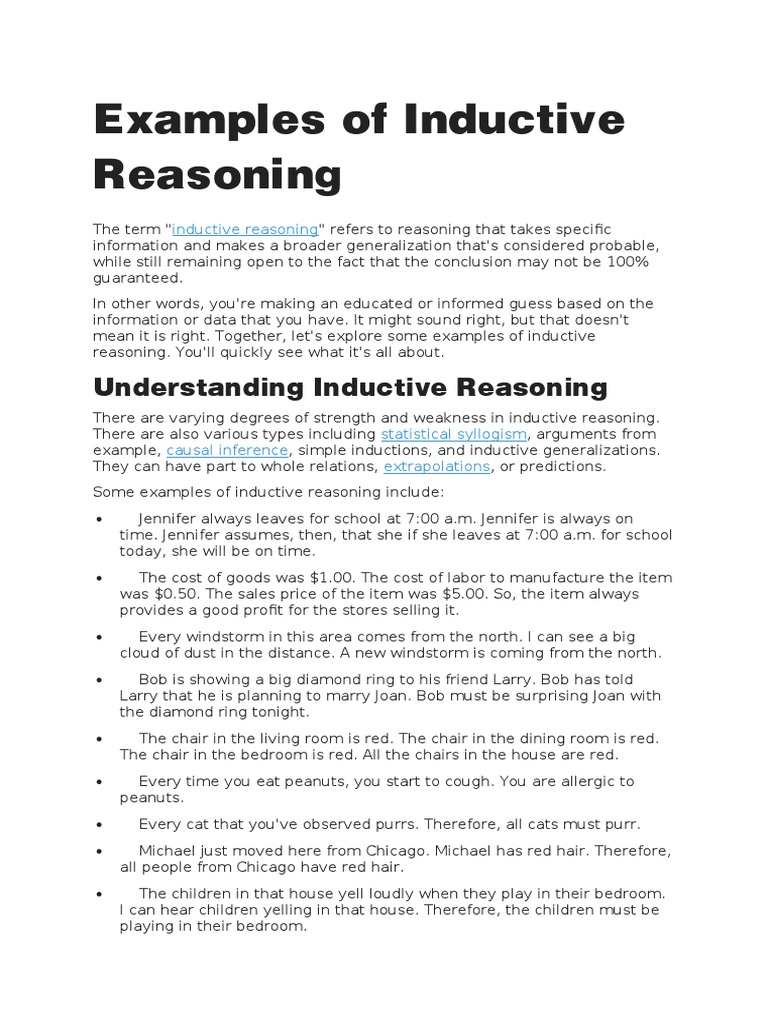
Inductive reasoning, a cornerstone of logical thought, shrouded in nuances and implications, invites individuals to form generalizations based on specific observations. Unlike its deductive counterpart, which derives conclusions from overarching premises, inductive reasoning intrigues us by elevating individual instances to broader truths. This beguiling method of reasoning is prevalent in everyday life and scientific inquiry alike, offering a tapestry of thought that connects disparate observations with finesse.
To grasp the art of inductive reasoning, it is essential to examine its structure and characteristics. At its core, inductive reasoning operates by collecting various observations—often as varied as they are plentiful—and stitching together a logical narrative that posits a general principle. This process often feels intuitive. For instance, if one observes the sun rising in the east every morning, it is tempting to conclude that the sun will rise in the east indefinitely. Although this assertion is grounded in personal experience, it also embodies the quintessential spirit of inductive reasoning: deriving a broader rule from individual instances.
Such reasoning may lead to profound shifts in how we view our world. Consider the profound implications of scientific theories that arise from inductive logic. The laws of nature, often bolstered by countless experimental observations, typically emerge from inductive methodologies. For example, observing that water boils at 100 degrees Celsius at a standard atmospheric pressure may lead one to generalize that water will always boil at this temperature under similar conditions. Nonetheless, this generalization retains a level of uncertainty, as it is contingent on empirical verification.
Now, let’s delve deeper into the realm of inductive reasoning through vivid illustrations and thought-provoking examples. Imagine you’re an avid birdwatcher. You observe a variety of feathered friends at your local park: robins with their bright red breasts, blue jays exhibiting striking azure plumage, and cardinals donning their captivating crimson attire. Each sighting adds to your reservoir of knowledge. Over time, you conclude that every bird you encounter displays some form of vibrant coloration. While this premise is compelling, it invites a cautious eye. Are there not species that thrive in the shadows of muted hues? This exemplifies a common pitfall in inductive reasoning: the potential for overgeneralization based on limited evidence.
Engaging further with the concept, we can explore inductive reasoning’s application in the realm of technology. Consider, for instance, your experiences with different smartphone brands. You notice that the latest models from one particular brand frequently outperform their predecessors in speed and battery life. After witnessing this trend across several iterations, it becomes reasonable to speculate that future models will follow suit, exhibiting enhanced performance. However, the inherent risk lies in assumptions based on available data; manufacturers can surprise consumers with models that divergence from past excellence.
Moreover, the fascinating interplay between inductive reasoning and statistical analysis adds another layer to its complexity. Let’s examine the research world. When scientists seek to draw conclusions from data gathered through experiments or surveys, they often employ inductive reasoning. For instance, a clinical study may reveal that 75% of patients respond positively to a new medication. While this offers a robust foundation for concluding that the medication is effective in most cases, it equally highlights the necessity of rigorous testing. The randomness of individual responses introduces variables that could challenge the generalization drawn from the data.
As we ponder the implications of inductive reasoning, the concept of confirmation bias emerges as a crucial element to consider. This cognitive bias compels individuals to favor information that confirms pre-existing beliefs. To illustrate, imagine an individual ascribing to the idea that “all politicians are corrupt.” This individual then selectively recalls stories of political scandals while disregarding accounts of ethical politicians. Such a pattern underscores the importance of objectivity in the inductive reasoning process; for accurate generalizations, one must remain vigilant against biases that skewer evaluative insight.
In light of the aforementioned complexities, the question inevitably arises: How can one hone the skills necessary for effective inductive reasoning? The first step entails embracing a mindset of curiosity and open-mindedness. By engaging with diverse perspectives and considering contrasting evidence, individuals can fortify their reasoning capabilities. Additionally, exercising critical thinking by scrutinizing assumptions helps to bolster the reliability of generalizations drawn. Furthermore, maintaining an iterative approach—constantly refining conclusions in light of new observations—can significantly enhance the inductive reasoning process.
In the end, the beauty of inductive reasoning lies in its potential to unveil patterns and establish connections that might otherwise remain obscured. By analyzing specific evidence and crafting general conclusions, one embarks on intellectual explorations that yield profound insights. Yet, this journey is fraught with challenges and requires a balanced approach, integrating an understanding of the nuances of observation and the inherent uncertainties of generalization.
As we traverse the complexities of inductive reasoning, we invite curiosity and foster a vibrant discourse that challenges our preconceived notions. The pursuit of knowledge, grounded in both specific instances and broad concepts, remains a dance of intellect and intuition. Through this lens, we can gain a deeper appreciation for the myriad ways in which inductive reasoning shapes our understanding of the world around us.